O Republicans, save the Supreme Court, the republic, the nation, the constitution of liberty! 1
The Republican-dominated House needs to legislate ASAP to confirm the constitutional functions of the Supreme Court.
How the law needs to be worded is a puzzle that the specialists must solve. Fast, please!
Shawn Fleetwood writes at the Federalist:
Not a day seems to go by without some activist lower court judge issuing an overreaching injunction blocking part of President Trump’s agenda.
Throughout Wednesday and Thursday [April 23 & 24, 2025] alone, judges across multiple venues handed down decrees barring numerous executive actions taken by the president since returning to office. From DEI to election policy, these cases are but a few of the more than 170 lawsuits Democrats and left-wing political actors have filed to sabotage Trump and the 77 million Americans who voted for him.
Despite this clear effort to destroy American democracy via a judicial coup, the U.S. Supreme Court (SCOTUS) seems to have no interest in stopping it. The nation’s highest court has had ample opportunities to halt these lower court judges’ destructive antics but has repeatedly declined to do so.
The first notable instance of this cowardice came to fruition in early March. In a 5-4 decision, a majority on the court declined a request from the Trump administration to shut down a ruling from a Biden-appointed district court judge. The judge had ordered the State Department and United States Agency for International Development (USAID) to disburse roughly $2 billion in foreign grants to nongovernmental groups.
Comprised of Chief Justice John Roberts, Associate Justice Amy Coney Barrett, and the court’s Democrat appointees, the majority offered no rationale for the decision, a move that left Associate Justice Samuel Alito “stunned”.
Writing for the dissent, Alito underscored the overreaching nature of the lower court’s order and chastised the majority for its unwillingness to shut down such abusive behavior. He wrote, “Does a single district-court judge who likely lacks jurisdiction have the unchecked power to compel the Government of the United States to pay out (and probably lose forever) 2 billion taxpayer dollars? The answer to that question should be an emphatic ‘No,’ but a majority of this Court apparently thinks otherwise.”
By declining to rein in the Biden-appointed judge’s outlandish behavior, the high court’s majority all but gave the green light to activist judges across the country to take similar actions on leftist-backed lawsuits filed in their respective jurisdictions. As previously noted, this has encouraged these judicial supremacists to issue blanket injunctions barring the Trump administration from implementing policies the American people voted for, thus effectively rendering the 2024 presidential election results moot.
SCOTUS’s inclination to tolerate judicial tyranny among the lower courts is perhaps unsurprising, however, given that a majority of the justices have indicated their own infatuation with overstepping the constitutional limits erected by America’s founding document.
In the dead of night on Easter weekend, without explanation, seven of the justices essentially usurped the executive branch’s authority over immigration by blocking Trump’s deportation of Venezuelan gang members. Associate Justices Clarence Thomas and Alito dissented, with the latter once again penning a scathing opinion blasting the majority’s “unprecedented and legally questionable” actions.
It’s unclear exactly what game the high court’s majority is playing. Even for a wannabe politician like Chief Justice Roberts — whose primary concern seems to be protecting the judiciary’s “legitimacy” rather than interpreting the Constitution as written — the decisions to allow the lower courts to run afoul of America’s constitutional order and issue late-night orders are unlikely to sit well with the public. In fact, one could argue the high court’s antics are doing more damage to its reputation than leftists’ smear campaigns ever could.
Recall over the past few years when Democrats and their media allies ran hit pieces against many of SCOTUS’s Republican-appointed justices. While much of this manufactured psyop was directed at the high court’s most reliable originalists (Thomas and Alito), the end goal was the same — to delegitimize the body and its constitutional rulings in the eyes of the American public.
Yet, for all their bluster, the media’s smear campaign didn’t seem to have significantly affected non-leftists’ opinion of the Supreme Court. Pew Research data published in August shows that the decline in the court’s favorability in recent years has been driven almost exclusively by Democrats and Democrat-leaning independents, whose views of the court turned sour following the 2022 Dobbs decision overturning Roe v. Wade.
But what the media couldn’t do to SCOTUS — destroying its credibility among Americans — the high court is now doing to itself. By refusing to rein in the lower courts’ lawlessness, the justices have authorized a judicial coup that is stymying the will of the 77 million Americans who voted for Trump.
The longer a majority on the high court allows this circus to continue, the more faith citizens will lose in its ability to operate as a capable branch of government.
How woke activism destroyed Professor Bongani Mayosi 1
Violent protest by racists against “racism” on university campuses is an amusement to American students. The only victims of it are Jewish students and they of course deserve all the persecution that can be inflicted on them because – well, um, because they are Jewish.
Less powerful and safe countries imitate the jolly fun with tragic results.
Columnist Richard Wilkinson writes (in part) at the South African journal the Daily Friend:
The life-story of Professor Mayosi is one of the most extraordinary and most overlooked chapters of recent South African history. Born in 1967, Professor Mayosi grew up in the village of Nqamakwe in the rural Eastern Cape. He completed his schooling at St John’s College in Umtata where he displayed exceptional academic ability. At the age of just 15, he achieved the highest marks in the then-independent Transkei’s Matric Exams. He proceeded to the University of Natal at which he studied for Bachelor of Medical Sciences and Bachelor of Medicine degrees, both of which he achieved with distinction. After specialising in cardiology at the University of Cape Town, Professor Mayosi was awarded a Nuffield Fellowship to Oxford University where he read for a Doctor of Philosophy degree in cardiovascular medicine.
Professor Mayosi was widely regarded as one of the outstanding academics of his generation. He published over 300 peer-reviewed academic articles in leading scientific journals, including Science, The Lancet and the New England Journal of Medicine. His scholarship was acclaimed both domestically and internationally, with Professor Mayosi being elected to the Academy of Science of South Africa as well as to the American College of Cardiologists, the US National Academy of Medicine, the European Society of Cardiology and the Royal College of Physicians of London. Most notably, Professor Mayosi was part of the team which discovered a gene, CDH2, which has been linked to the life-threatening heart disease arrhythmogenic right ventricular cardiomyopathy. This breakthrough is regarded as one of the most important advances in South African cardiology since Dr Christiaan Barnard’s pioneering human heart transplant.
Professor Mayosi played a pivotal role in developing systems to train physician-scientists. Working alongside the Minister of Health and key industry figures, he helped establish the “1,000 PhD Programme”, a transformative initiative aimed at advancing medical research in South Africa. He also secured over R 250 million in research funding, significantly boosting scientific innovation. At just 39, Professor Mayosi was appointed to lead UCT’s Department of Medicine and, a decade later, he became Dean of the Faculty of Health Sciences. In recognition of his extraordinary contributions, in 2009 Professor Mayosi was awarded the Order of Mapungubwe, South Africa’s highest civilian honour.
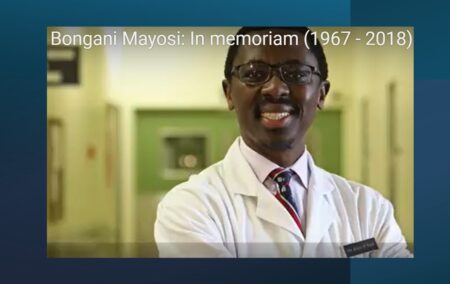
The University of Cape Town conducted a full enquiry into the death of Professor Mayosi, culminating in a 157-page report which provides a valuable (though not entirely exhaustive) account of the events which drove him to end his life. The findings of the report are clear and damning:
The panel had no hesitation in concluding, from the testimony presented, that the eruption of the #FeesMustFall protests a few days after Professor Mayosi took up his post as Dean was the single most influential factor directly and indirectly affecting his Deanship.
…
The abuse was horrific. Using the social media hashtag #OccupyFHS (i.e. Occupy the Faculty of Health Sciences), Fallist* thugs intimidated staff and students in the health faculty during October 2016, occupying the Dean’s suite of offices for two weeks and forcing Professor Mayosi and his staff to relocate. One public engagement was effectively hijacked by activists, with staff members subjected to what the report calls “crude engagement” and heckling. The situation became so intense that one staff member suffered an emotional breakdown during the meeting. The report further notes that, by this stage, Professor Mayosi had lost control over the faculty’s affairs, ultimately descending into what it describes as “a state of fear and stuttering”.
As one Health Faculty official recalled:
Bongani was just absolutely eviscerated. When he conveyed the decision in this stammering voice … this powerful orator who kind of commanded a room had been reduced to someone who was just so unsure of himself, and so terrified, and understandably, in that situation. And, you know, he explained to them that he couldn’t close the faculty, because that was the university’s decision. And the rage was just massive…”
What caused Professor Mayosi’s depression and mental decline? The report found that Professor Mayosi faced relentless harassment, stating that “there is evidence that students showed an incredible amount of disrespect, both in face-to-face encounters with him and in numerous electronic communications with him”. Disappointingly (and inexplicably), the report does not disclose full details of the email correspondence or name any of the perpetrators of the bullying.
However, the report does recount one notable incident in which a group of Fallist activists, who had failed to meet the minimum requirements necessary to gain entrance to the year-end exams (known at the University of Cape Town as “due performance” or “DP” status), confronted Professor Mayosi in his office late one night. Under pressure and threats, he reluctantly sent an email to faculty confirming that the students would be granted a concession. Professor Mayosi immediately regretted this decision, confiding in two colleagues that “he felt he had made a serious mistake by giving in to the student demands”.
The following day, overwhelmed and disillusioned, Professor Mayosi made the first of several attempts to resign as Dean of the Faculty of Health Sciences. He formalised his intent in an email to the university’s Vice Chancellor, Dr Max Price:
Dear Max
I have decided to resign my position as Dean of the Faculty of Health Sciences. I believe that the faculty deserves better leadership than I have been able to provide in the past year. I am sorry to do this in the middle of a crisis. I will ask Dr Reno Morar to act as Dean while I await your decision.
Yours sincerely
Bongani Mayosi
After discussions with Dr Price, Professor Mayosi chose to withdraw his resignation.
Discussions. Discussions? Discussions!
…
All of this took a terrible toll on Professor Mayosi. On one occasion, he was found slumped over his desk with his head on his folded arms, unresponsive to verbal communication from colleagues. On another occasion, after failing to appear at a scheduled event, he was discovered sitting alone in his car in a car park, staring blankly into space. Attendees at a cardiology conference in Egypt, at which Professor Mayosi had been invited to present, reported that he had trouble speaking and was physically shaking. A similar incident occurred at a conference in the United Kingdom, where he failed to attend his session and was eventually found in his hotel room by a concerned friend. Professor Mayosi had wandered the streets of London alone in a despondent state.
During this period, the university’s leadership failed to take meaningful action against the disruptive Fallist activists in the Faculty of Health Sciences. Professor Mayosi was effectively abandoned, with the report describing him as “a man alone, under siege from all directions, with nowhere to turn”. According to Professor Mayosi’s sister, he took sick leave from the university, during which time he confided in his mother that he felt an increasing sense of isolation from his colleagues and a lack of support from the university and faculty.
That Professor Mayosi achieved so much despite spending the first 25 years of his life under the constraints of apartheid is extraordinary.
…
Many – probably all – of these incidents involved criminal conduct. Did the university’s leadership take any action to hold those responsible accountable? The answer to this question is a resounding “No”. On the contrary, there are numerous examples of the university intervening to assist and protect Fallist activists. For example, university leaders intervened in support of the bail application of Masixole Mlandu, a key instigator of violence who somehow was never expelled from the university and would go on to preface his Honours research project with the words “ONE SETTLER ONE BULLET”. …
The university’s failure to act allowed the violence and intimidation associated with Fallism to persist for years. In December 2022, [a notorious Fallist] repeatedly punched Professor Jeremy Seekings in the face, knocking his glasses to the floor. And in the past few weeks, radical students disrupted lectures and sports events, bringing academics to a halt. The reality is that the month of March 2015 has lasted a decade at the University of Cape Town.
Ultimately, thousands of people had their studies disrupted, their careers jeopardised and, in some cases, their souls destroyed when the flames of Fallism engulfed the university. Anyone who did not support the Woke Revolution was targeted. The Fallists called them “racists” if they were white; “house-niggers”, “sell-outs”, “coconuts” or “Uncle Toms” if – like Professor Mayosi – they were black. Many left academia. Others emigrated. A significant number struggled with severe psychological distress, with some expressing suicidal thoughts and many relying on anti-anxiety and antidepressant medication just to get through the day.
For one man, it became unbearable. On Friday, 27 July 2018, Bongani Mayosi took his own life. He was 51 years old.
*Fallist: In the context of South Africa, “Fallist” refers to individuals or movements that advocate for the “fall” of structures and systems perceived as oppressive, particularly within universities. [From the internet.]