Obama giggles, flirts, and disgraces his country 179
There’s nothing serious in mortality. All is but toys. Renown and grace are dead.
– Shakespeare, Macbeth Act ii, scene 3
We are not prudes or puritans. If Barry Obama wants to play the fool in his private life, it is nothing to us. But the presidency of the United States is an office which should be held with dignity. President Obama (a combination of words that never ceases to astonish us) fails in that duty.
This account of how he behaved at the Mandela memorial in Johannesburg may be a little too lurid, but it errs if at all in the right direction.
From the New York Post, by Andrea Peyser:
The president of the United States, leader of the free world, standard-bearer for everything upright, good and wholesome about the nation he leads, lost his morality, his dignity and his mind, using the solemn occasion of Nelson Mandela’s memorial service … to act like a hormone-ravaged frat boy on a road trip to a strip bar.
In front of 91 world leaders, the mourning nation of South Africa and Obama’s clearly furious wife, Michelle, the president flirted, giggled, whispered like a recalcitrant child and made a damn fool of himself at first sight of Denmark’s voluptuously curvy and married prime minister, Helle Thorning-Schmidt.

Not to be outdone by the president’s bad behavior, the Danish hellcat hiked up her skirt to expose long Scandinavian legs covered by nothing more substantial than sheer black stockings.
With Michelle glowering, the world judging and mental fidelity floating into the abyss, the president leaned into the air space of the cross-legged Danish cupcake, who is known in Copenhagen as a fan of America’s randy TV show “Sex and the City.’’ It was the memorial equivalent of a bodice-ripper.
Thorning-Schmidt placed her hands dangerously close to Obama’s side. The president’s cackling head moved inches from the Danish tart’s and yards away from his wife’s. Obama then proceeded to absorb body heat from the Dane, which he won’t be feeling at home for a long time.
This wasn’t a key party. This was a service that filled an entire Johannesburg soccer stadium for Mandela …
Actually, it didn’t fill the stadium. The attendance was poor. But that’s beside the point of this article.
It was unseemly.
Michelle frowned and looked as if she wanted to spit acid at the man she married, a good-time guy who humiliated her in front of their friends, the world and a blonde bimbo who hadn’t the sense to cover up and keep it clean.
Finally, Obama posed for an iPhone selfie with the Danish hottie and British Prime Minister David Cameron.

Only after the damaging photo eruption did Obama get hold of himself and regain a dim memory of his marriage vows. He finally straightened his face and moved away from the gentle gams of the Danish object of his desire.
He leaned nearer to Michelle, who clearly wasn’t having any of her husband.
Perhaps at his wife’s insistence, he switched seats with her.
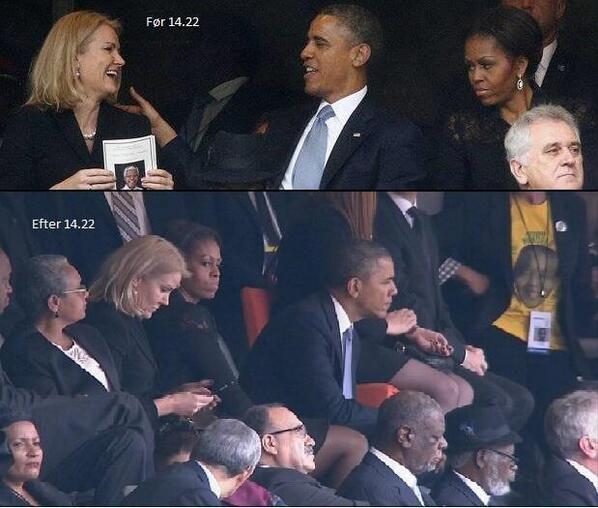
On Wednesday, Thorning-Schmidt saw nothing wrong with the public display of middle-aged lust. One Danish Facebook user called the antics of a president of 52 and a prime minister of 46 “frivolous and disrespectful”. Another said it was “extremely inappropriate and embarrassing”.
But Thorning-Schmidt attempted to laugh off the whole thing, saying, “It was not inappropriate.’’ Not inappropriate?
Pairing a black suit and blue tie is not inappropriate. Giving your wife grounds for divorce might be seen as otherwise.
But people won’t soon forget the escapades of the people whose salaries they pay.
President Obama has some explaining to do. To the woman he married. To his daughters. To the people of South Africa. And to the scandalized folks here at home.
He owes the world an apology.
Are the folks here at home scandalized? Not all Americans seem to have been scandalized by Obama’s lies about the murderous attack in Benghazi, the Fast and Furious gun-running, the persecution of conservatives by the IRS and of journalists by the Department of Justice, the embracing of Iran, the false promises made for Obamacare. But maybe a giggling flirtation by the President at a state mourning ceremony will evoke national condemnation. We wait to see.
Obama did something worse on the same occasion. He shook the blood-stained hand of Raul Castro, the sadistic mass-murdering dictator of Cuba. (See here and here.)
That stupidity will certainly shake the pillars of US prestige throughout the world.
Quaker terrorists 260
To most people “Quaker terrorists” may seem a contradiction in terms. So we must explain.
To excuse or defend terrorism is to encourage it; to encourage it is to co-author it.
And what is terrorism? It is not an ideology. It is a method, a tactic. It is the systematic use of violence to create public fear. By the targeting of the innocent the fear is spread. Everyone in a certain place, or of a certain race or calling, or in a certain position, must be given reason by the terrorist to fear that he or she, or his or her spouse or child or parent, can be blown into pieces, or be knifed or beaten or shot to death, by complete strangers at any moment. Terrorism is morally indefensible. Arguably the most morally indefensible form of violence that can be imagined. Nothing can justify it. No cause. Nothing.
For centuries the Quakers were a widely respected sect. They were pacifists on moral grounds. Pacifism was one of their founding religious principles. Their name was synonymous with non-violence. In wars, they would serve their country as doctors, nurses, ambulance drivers, stretcher-bearers … They eschewed violence even in self-defense. As a sect, they lived up to their principles. That was what they were respected for.
(For the record – in our view a pacifist upholding his principle of non-violence when the aggressors are Nazis or Communists say, while others risk their lives to save him from them, is not admirable. But our task here is to explain the Quaker view, which many hold in high esteem: that it’s wrong to use violence at all. Ever.)
But now the Quakers are terrorists. They are terrorists in that they excuse, defend, and actively encourage terrorism.
Here is the story of how the change, the reversal of their values, came about. We have taken it from the The Tower, condensing the full account given by Asaf Romirowsky and Alexander H. Joffe:
The Quakers — thus named because they tremble or “quake” before God — [is] a Protestant sect founded in England during the mid-17th century. … As part of their beliefs, Quakers oppose violence in all its forms and reject any compulsion in religion. …
The Quakers are also called The Friends. So unthreatening. So simple. So trustworthy. So good.
On April 30, 1917, the Quakers formed The American Friends Service Committee (AFSC) “in response to America’s entrance into World War I”.
Challenged by public hostility and government disapproval due to their refusal to be drafted, the Quakers formed the AFSC in order to organize alternative forms of service for its members, such as providing medical aid and other non-violent participation in the war effort.
The AFSC slowly expanded over the years, and by the late 1940s it was an established Christian organization with global experience, recognized by national and international establishments as a major provider of international relief, charity, and aid. …
The dawn of the Cold War, however, proved a turning point in the history of the organization. In April 1947 …
Just thirty years after its founding …
… a faction within the AFSC’s leadership convened a meeting at which the head of the organization, Clarence Pickett, and others argued that tensions between the United States and the Soviet Union had become so intense, and the threat of atomic war so grave, that the AFSC should abandon its long-standing tradition of political neutrality.
The argument was absurd. How by taking one side against the other would they be lessening the tension and preventing atomic war?
It is true that one side of the Cold War was working through agents of influence to get the other side disarmed by public opinion. It paid its agents to organize “Peace” movements. Not because it was for peace, though it pretended to be. Far from being peaceful, it was arming, aiding and abetting proxy wars of “liberation” on five continents. That lying, hypocritical, relentlessly belligerent side was the Soviet Union. And that is the side the AFSC took.
Can there be much doubt that Clarence Pickett, whether personally paid or not, was one of its agents?
Such a stance [of neutrality], Pickett said, could no longer be an article of faith but a crime. The radical nature of this [new] stance was reflected in the words of another participant, who said, “Evolution is too slow. We need revolution in the Society of Friends.”
Hear in that the vocabulary, the phraseology of Marxism.
The organization, Pickett and his supporters felt, should actively spearhead a peace movement that would directly challenge America’s Cold War policies.
Not for a moment did they apparently consider that the American Cold War policies were a direct challenge to the Soviet Union’s hot war ambitions.
This began the AFSC’s transformation from a religious group to, as one Quaker scholar later put it, “just one more pressure group within the secular political community”.
Or in other words, it changed not only from a pacifist to a revolutionary movement, it also changed, effectively, from a Christian sect into a Communist sect.
The AFSC’s newly radical stance took aim at American policies throughout the 1950s and paid little or no heed to repression and terror in Communist countries. This hit its stride during the Vietnam War. The organization bitterly and actively opposed the war throughout the 1960s and 1970s. Its attacks on American policy in Vietnam were furious and wide-ranging, opposing everything from the escalation of military operations to all forms of aid to South Vietnam to the conduct of the war itself. In addition, the AFSC directly violated American embargoes and sent medical aid directly to North Vietnam. These actions proved to be extremely controversial. In one case, the AFSC was accused of revealing to the North Vietnamese that a prominent Buddhist activist was a CIA agent, prompting one prominent Quaker to hold a sit-in at AFSC headquarters in protest.
So some individual Quakers – many, according to the authors – were still true to their founding principles, or perhaps were American patriots.
The AFSC’s activism placed it unquestionably on the side of the American far-Left, where it remains to this day.
The Quakers’ [erstwhile] beliefs in nonviolence have not prevented them from supporting bloody despotic regimes. …
And the hypocrisy was – and remains – blatant:
While still voicing support for pacifism, the organization increasingly aligned itself with violent Left-wing governments and movements, some of which used terrorism to advance their goals.
Many rank-and-file Quakers were appalled at the AFSC’s overt support for such regimes and movements, as well as its double standards … But their protests proved fruitless. The AFSC rejected all criticism as fundamentally illegitimate “red-baiting and McCarthyism”.
“Red-baiting”. Again, the vocabulary of the Communists. Or rather of the Comintern – the Soviets’ ideological club for foreign fans of its appalling system.
… The AFSC’s policy towards Iran is [to demand] the removal of sanctions and [dismiss] concerns about Iranian nuclear weapons.
It is openly, shamelessly supportive of the most terrible regime on earth:
Today the group operates collective farms in North Korea …
And is intimately supportive of at least one of the most savage terrorist groups on earth – Hamas.
Romirowsky and Joffe trace the history of the Quakers relationship to the “Holy Land”, the Palestinians, and Zionism, giving them credit for aiding the refugees more rationally than most other organizations working among them. But …
… after the 1967 Six Day War, the AFSC began to take a more explicit and fervent pro-Palestinian stance, applying its growing radicalism and willingness to accommodate the use of violence to the Middle East conflict.
As the 1970s saw the rise of Palestinian terrorism as a major source of global violence, the AFSC began to take a disturbingly understanding approach to the issue. A 1972 AFSC pamphlet, Nonviolence: Not First For Export told its readers:
… before we deplore terrorism it is essential for us to recognize fully and clearly whose “terrorism” came first, so that we can assess what is cause and what is effect.
It was clear enough that, in regard to Israel the AFSC had no doubts about whose “terrorism” came first. The pamphlet expressed, for example, deep understanding toward the Palestinian Fedayeen — “those who sacrifice themselves” — terrorists whose main purpose was to infiltrate Israel and kill civilians. …
In 1973, the AFSC called for a U.S. embargo on arms and other aid to Israel, and in 1975 adopted “a formal decision to make the Middle East its major issue.” It quickly opened an office in Israel, installed specialized staff members at regional offices in the U.S., and began advocating for the Palestinians in Israeli and international courts. Israeli officials quickly discovered, however, that the new AFSC representative in Jerusalem was attempting to organize on behalf of the PLO. …
The AFSC has moved ever closer to the Palestinian cause since the 1970s. Today, this is expressed through fieldwork, lobbying, and activism, in particular through the BDS [Boycott, Divestment and Sanctions] movement [against Israel] …
In regard to Hamas’ indiscriminate use of rockets against Israeli civilians, the AFSC simply notes that “it is important to look at the firing of rockets by Palestinian armed groups in context”, since this is “intertwined” with “ongoing Israeli military actions in Gaza”. …
Military actions which are rare, targeted, and defensive only. While the rockets are constant, indiscriminate, and aggressive.
The authors suggest that the Quaker movement now clings to its anti-Zionism as a cause to keep it alive.
It may be that a movement like the Quakers, which has seen its numbers dwindle along with other liberal Protestant denominations, sees anti-Zionism as a last resort; a movement with powerful emotional appeal on which it can draw in order to maximize its power. If so, then it has undone a great deal of the good it once did, and substituted hypocrisy and bad faith instead.
Once a byword for humanitarianism … it has now become, in effect, a brand — one on which the AFSC can trade as it exploits the putative neutrality and pacifism it stands for in order to advance hostility toward Israel and, with its promotion of the “right of return”, an end to Israel itself.
In the end, the AFSC’s story reflects the tensions between pacifism and politics, between aid work and political activism … It demonstrates that small religious movements are susceptible to hijacking by radicals, and suggests that pacifism may inevitably engender its opposite. The organization’s slide has been a long one, and at the moment it shows no sign of or interest in reversing it.
Building a monumental ruin 79
In lands whose history goes back millennia, there are ruins of great buildings that rulers ordered their subjects and slaves to construct. They stood proud and splendid once, monuments to the prowess of the rulers and the nations. Now, although ruined, they remain as memorials.
Obamacare will be Obama’s memorial. The difference is that it starts off as a ruin.
Mark Steyn tells the story of how the ruin was built here:
For much of last year, a standard trope of President Obama’s speechwriters was that there were certain things only government could do. “That’s how we built this country — together,” he declared. “We constructed railroads and highways, the Hoover Dam and the Golden Gate Bridge. We did those things together.”
As some of us pointed out, for the cost of Obama’s 2009 stimulus bill alone, you could have built 1,567 Golden Gate Bridges — or one mega–Golden Gate Bridge stretching from Boston to just off the coast of Ireland. Yet there isn’t a single bridge, or a single dam (“You will never see another federal dam,” his assistant secretary of the interior assured an audience of environmentalists). Across the land, there was not a thing for doting network correspondents in hard hats to stand in front of and say, “Obama built this.”
Until now, that is. Obamacare is as close to a Hoover Dam as latter-day Big Government gets. Which is why its catastrophic launch is sobering even for those of us who’ve been saying for five years it would be a disaster.
It’s as if at the ribbon-cutting the Hoover Dam cracked open and washed away the dignitaries; as if the Golden Gate Bridge was opened to traffic with its central span missing; as if Apollo 11 had taken off for the moon but landed on Newfoundland.
Obama didn’t have to build a dam or a bridge or a spaceship, just a database and a website. This is his world, the guys he hangs with, the zeitgeist he surfs so dazzlingly, Apple and Google, apps and downloads. But his website’s a sclerotic dump, and the database is a hacker’s heaven, and all that’s left is the remorseless snail mail of millions and millions of cancellation letters.
For the last half-century, Obama has simply had to be. Just being Obama was enough to waft him onwards and upwards: He was the Harvard Law Review president who never published a word, the community organizer who never organized a thing, the state legislator who voted present.
And then one day came the day when it wasn’t enough simply to be. For the first time in his life, he had to do. And it turns out he can’t. He’s not Steve Jobs or Bill Gates or Jeff Bezos. And Healthcare.gov is about what you’d expect if you nationalized a sixth of the economy and gave it to the Assistant Deputy Commissar of the Department of Paperwork and the Under-Regulator-General of the Bureau of Compliance. …
[Obama] broke the lifelong rule that had served him so well — “Don’t just do something. Stand there” — and for the first time in his life did something, terribly.
It will bear his name forever.
Yet another pope gets it horribly wrong 125
The Washington Post reports that Pope Francis (born Jorge Mario Bergoglioco in Argentina), issued a long (50,000 word) statement on November 26, 2013, in which he expressed disgust with capitalism and advocated redistribution as a sure formula for eliminating poverty.
It is a highly audacious – in our opinion impudent – display of economic ignorance.
Pope Francis … sharply criticized growing economic inequality and unfettered markets in a wide-ranging and decidedly populist teaching that revealed how he plans to reshape the Catholic Church.
“Unfettered markets.” If you don’t chain ’em up they will attack you?
In his most authoritative writings as pontiff, Francis decried an “idolatry of money” in secular culture and warned that it would lead to “a new tyranny”. …
A statement rich in baloney. (1) No one sane worships money (not even the many cruel and lascivious Popes who accumulated it passionately in pre-Enlightenment times did that). It is a medium of exchange. It is wanted for what it can do, what it can acquire, not for what it is. That’s why the poor are in need of it. (2) He decries poverty, yet he scorns money. (3) Market economies do not lead to tyrannies. But governments that redistribute money are exercising a form of tyranny. And wherever economic equality is enforced, it is always an equality of misery. Except for those who do the distribution. They invariably redistribute a big whack to themselves.
[Pope Francis] showed a willingness to use tough language in attacking what he views as the excesses of capitalism.
“The excesses of capitalism”? Wherever on this earth there is prosperity, wherever the poor are least poor and have the best chance of getting richer, capitalism is the magic that does the trick; and it is only in a free society, where the free market – or “capitalism’ – operates, that the poor are least poor and can most easily become richer.
Using a phrase with special resonance in the United States, he strongly criticized an economic theory — often affiliated [sic] with conservatives — that discourages taxation and regulation.
Yes, we conservatives do dislike, and would discourage, governments taking money from those who earn it and giving it to those who don’t. And we don’t think bureaucrats know better how to run our businesses than we do.
The Pope’s statement is then quoted directly:
“Some people continue to defend trickle-down theories which assume that economic growth, encouraged by a free market, will inevitably succeed in bringing about greater justice and inclusiveness in the world. This opinion, which has never been confirmed by the facts, expresses a crude and naive trust in the goodness of those wielding economic power and in the sacralized workings of the prevailing economic system. Meanwhile, the excluded are still waiting.”
Since he does not understand that wealth is created, but conceives it to be a fixed “pie” that some get too big a slice of leaving too little for others, he thinks that those capitalists “affiliated” with a “trickle-down” theory (his use of that phrase greatly impressed the reporters who see it as a sign that Bergoglioco knows what he’s talking about) have made some sort of promise or prediction that their riches will bring about “greater justice and inclusiveness in the world”. He means “social justice” – a meaningless phrase, dear to the hearts of egalitarians, statists, and collectivists in general. But the poor in – say – America, are not poor because someone, or a class of people, has been unjust to them. And what can he mean by “inclusiveness”? If he means participation in the market, it is open to all in a free – but not an egalitarian – society. Perhaps he has a picture of ragged starving people begging at the gates of a castle, as in the centuries when the Catholic Church ruled over Europe.
Although Francis has previously raised concerns about the growing gap between the wealthy and the poor, the direct reference to “trickle-down” economics in the English translation of his statement is striking. The phrase has often been used derisively to describe a popular version of conservative economic philosophy that argues that allowing the wealthy to run their businesses unencumbered by regulation or taxation bears economic benefits that lead to more jobs and income for the rest of society. Liberals and Democratic officials have rejected the theory, saying it is contradicted by economic evidence.
It is not contradicted by the evidence. All the evidence points the other way. Every experiment in redistribution, ie socialism, has failed. And how does encumbering business with regulation and taxation help society? Is a heavily taxed business more or less likely to employ more people? As for regulation, the Obama administration has issued and continues to issue such a volume of it, that if it could reduce unemployment and restore prosperity it would surely have done so spectacularly by now!
Then comes the really dangerous part of the Washington Post article:
Some scholars say the Pope’s statement should invariably shape the thinking of today’s Catholics.
“There’s no way a Catholic who is a serious intellectual can ever again not address the issue of income inequality, of the structural sins of our economic system. This is so front and center,” said Michael Sean Winters, a fellow at Catholic University’s Institute for Policy Research and Catholic Studies. …
Francis’s words may ripple across many fronts.
‘The structural sins of our economic system.” Capitalism, or the free market, or “the natural order of liberty” as Adam Smith called it – is sinful! If millions of Catholics are going to have to believe that …
But wait. Will Catholics who are literate in economics and therefore supporters of the free market have to “address the structural sins of our economic system”?
The pope’s statements — especially if they continue — could impact U.S. politics. Several potential contenders for the presidency in 2016 are economic conservatives who are also Catholic, and liberal Catholic groups have in the past taken aim at what they view as the overly stingy policies of Republicans who have little regard for the role of government in redistributing income.
A government that doesn’t redistribute is being “stingy”, you see?
Rep. Paul Ryan (R-Wis.), a recent proponent of those policies and a devout Catholic, has said before that he tries to uphold Catholic teaching “as best I can” and believes his policies match Catholic teaching because they emphasize small institutions close to the people — for example, churches — over the role of state or federal government. A spokesman for Ryan declined to comment Tuesday on the pope’s statement.
Hard to imagine what he could possibly say to reconcile irreconcilables. If this nonsense from Pope Francis is now “Catholic teaching”, will someone like Paul Ryan have to choose between being a Catholic and being a Republican?
There is a lot more nonsense to be read in the article – including a reminder that the Church is against Communism!
John Paul II’s warnings on economic inequality were swallowed at times by his war on Communism, a far more dangerous problem in the church’s eyes because of its anti-religious bent …
So atheism is even worse than the “unfettered” market in papal eyes.
Also reported is the Pope’s belief that the 2001 economic collapse of his native country, Argentina, was due to a failure of free market capitalism. For a description of what actually happened – authoritarian central control, hyperinflation, rising debt, bad decisions, and extreme corruption – listen to the first 13 minutes or so of this lecture.
Winters said a key to understanding Francis is that he’s from Argentina and was archbishop of Buenos Aires in 2001, when the country’s economy collapsed.“When you see people trying to bless capitalism, he has a very real, vivid experience of capitalism and what it has brought to his country, and it’s not a happy experience,” Winters said.
We cannot of course review all the evil that the Catholic Church has done over the last 1800 years, to which this mischief is now to be added. (Yes, it might sometimes have meant to do good, but as Christians say, the road to hell is paved with good intentions.) But we will give one reminder since we received only yesterday an email from a retired academic, commenting on the Pope’s statement, that provides a particularly vivid example of the Church’s iniquity in recent history.
Alexander Firestone writes:
How did Hitler become German chancellor? The one man most responsible, apart from the Nazis themselves, was Eugenio Pacelli, Papal Nuncio to Germany at the time and later Pope Pius XII. And he did it consciously and deliberately. Throughout Weimar Germany from the Kaiser’s abdication in 1918 until Hitler became chancellor on 30 January 1933, elections were generally free and fair in Germany. The three largest political parties were [1] the Communists (KPD) who in every election got 20% of the vote, concentrated mostly in a few large cities like Berlin and Hamburg; [2] the Socialists (SPD) who always got another 20% of the vote, also concentrated in major cities. Both parties had their loyal followers who never wavered. But the largest party was [3] the Catholic Center Party which regularly got 30% of the vote, heavily concentrated in Catholic Bavaria and the Rhineland. They got zilch in heavily Protestant areas like Saxony and Prussia.Thus, most governments were headed by Chancellor Heinrich Brüning, leader of the Catholic Center Party a generally conservative, but not extremist group.
In the election of June 1932 the communists and socialists each got their standard 20% and the Catholic Center got its standard 30%. A government was formed with Brüning as chancellor consisting of the catholic center, the socialists, and a few votes from the remaining parties; mostly small and mostly representing agricultural interests in largely Protestant areas, to get over 50%. In that election the National Socialists [the Nazis] got 12%, an all time high for them, at the expense of some small agricultural parties. The coalition did not work well. Thanks to the depression, unemployment was high and taxes could not be raised further, but the socialists demanded ever larger welfare programs. Brüning did the only thing he could; print more money, basically surrendering to the socialists. That summer Eugenio Pacelli became Papal Nuncio to Germany and chair of the German Catholic Council of Bishops.
Eventually, Brüning had to call for new elections, and he did so for December 1932. German electoral law specifies that elections may be held on any day of the week except Sunday. Therefore, there must be a last Sunday before an election. The practice had been (actually going back to Bismark’s time) for a letter to be read in every Catholic church in Germany on the Sunday just before an election providing church guidance to all German Catholics on how to vote. That letter is written by the Papal Nuncio, blessed by the Pope, and definitive for all Catholics. Since 1918 the letter recommended voting for the Catholic Center Party but did not require it. It also forbade voting for the Communists. After 1923 it was modified to forbid voting for the Communists or the Nazis. Pacelli abolished the Catholic Center Party, calling a Catholic party “unseemly”, even though it was the largest party in Germany. Pacelli also rewrote the Catholic Church letter. The recommendation to vote for the Catholic Center Party was dropped, but the provision forbidding (as a mortal sin) a vote for the communists was still there. The provision forbidding a vote for the Nazis was also dropped. On a vote for the Nazis the letter was silent.
In the December 1932 election the Communists and Socialists each got their standard 20%, and from the usual places, and the Nazis increased their vote from 12% in June to 44% in December. Analysis of voting patterns shows that they increased from 12% to 14% at the expense of the little agricultural parties AND they got the entire 30% from Bavaria and the Rhineland that had once gone to the Catholic Center Party. The German Catholics of Bavaria and the Rhineland got the message and voted as they were supposed to. Always helpful, the Communists announced that they would vote against any government in which they did not get the economics, labor and foreign ministries. Of course, with 44% of the votes themselves, the Nazis had only to bribe a few of the little agricultural parties to get over 50%, which they did. There was a lot of twisting and squirming in December and January, but on 30 January 1933 President Hindenberg did the inevitable and asked Hitler to form a government. That is how, in short, Eugenio Pacelli made Hitler Chancellor of Germany.
As a comment on the idea that capitalism ruined Argentina, TAC Associate Robert Kantor adds this:
The latest speech by the Pope makes explicit what has been known for a long time, namely, that the Church is and has always been anti-capitalist, preferring the top-down economic control and redistributionist policies that have proved such spectacular failures in Marxist and fascist countries. At the turn of the 20th century, the United States and Argentina both served as powerful magnets to immigrants from Europe. Both seemed to be a land of the future. Argentina, which has had the kind of strong central government (i.e., semi-fascist) the Pope seems to find so congenial, is still the land of the future — and always will be.
The decision maker 38
In this video it is said that Valerie Jarrett was in the situation room on 9/11/2012 when the terrorist raid on the US mission in Benghazi was carried out. It is also said that she gave the “stand down” order. We can accept all that as likely to be true.
What we find hard to believe is that her reason for giving the “stand down” order to stop any military rescue of the beleaguered Americans was because she feared failure – as is claimed here.
We also don’t think it probable that Jarrett’s reason for trying to stop the killing of Osama bin Laden – which she did for some months – was fear of failure.
We suspect her reasons had more to do with her sympathies being for Islam rather than America.
We do not quarrel with the accusation of treason. And we would like Obama to be impeached. But we don’t think he will be.
Watch the video and see what you think:
“God” is superfluous to political requirements 299
Seth Mandel writes at Commentary online:
The fact that the Supreme Court will hear a religious freedom-based challenge to the ObamaCare contraception mandate is the kind of story that possesses significance likely beyond any volume of coverage it will receive. Indeed, while liberal activists will repeatedly try to cast this in the mold of the fictional “war on women,” their own arguments reveal just how far-reaching a definitive ruling on this would be for American religious and political practice. …
Liberals have a curious definition of rights. Last night … the birth-control activist Sandra Fluke [said] on MSNBC …
There’s an attack on allowing employers to be required to provide this insurance coverage on insurance that employees pay for, at the same time that there’s an attack on public availability through clinics.
One more time: [Fluke reckons that] there’s an attack on allowing employers to be required to provide this insurance.
To the left, there is no freedom without government coercion. … That’s the argument the left is running with: they want you to be forced to provide the funding for even their most private activities; only then will you be truly free.
But Fluke isn’t the only one making this argument. … [In] an MSNBC roundtable on the issue … the panelists are panicked at the thought of affording Americans full religious liberty because, essentially, it’s then a slippery slope to protecting all constitutional rights. And then – mayhem, or something:
“This is another reason why we should have moved toward a single payer system of health coverage, because we’re just going to end up with one challenge after another – whether it’s in the courts or outside of the courts – and I just don’t see an end to this,” [Bob] Herbert submitted.“We’re already on the slippery slope of corporate personhood,” he continued. “Where does it end?”
“Where does it end” is the attention-getter in that comment, but I think Herbert’s plea for single-payer health insurance is just as telling. Put the government in charge of the country’s health care, Herbert argues, because then it will be much more difficult for Americans to “challenge” the government’s infringement on their freedom. It’s not just legal challenges either. Herbert says those challenges can be brought “in the courts or outside of the courts,” the latter perhaps an allusion to the shady world of participatory democracy.
So this is much more than a fight over birth control, or even health insurance. It’s about two fundamentally different views on American constitutional freedoms. Conservatives want those freedoms to be expansive and protected, as the Founders did. Liberals want those freedoms to be curtailed lest … the democratic process imperil the state’s coercive powers.
Thus far we agree with Seth Mandel. We are for individual freedom: the Left (whether it calls itself liberal or progressive or socialist) is not.
Free people can say what they like and do what they like (short of interfering with anyone’s else’s freedom), and that means they can believe anything they like, worship anything they like or nothing at all, make and follow any self-imposed rules they like. They only mustn’t impose their rules on anyone else, or if they’re in a group on anyone outside it.
If the government pays for everyone’s health care, it will claim the right to dictate how everyone must live in order to stay healthy. Paying for health care is the quickest way for a government to become a dictatorship. That is why government should not be the paymaster for health care.
But now the article changes from making good sense to arguing a spurious case for religion as a brake on government power:
The Founders saw religious freedom as elemental to personal liberty in America. But they were not alone in thinking that unimpeded religious worship was a guard against an overly ambitious or arrogant national government. As Michael Burleigh writes about the role of religion in post-French Revolution European politics, with a supporting quote from Edmund Burke:
The political function of religion was not simply to keep the lower orders quiescent, as has been tiresomely argued by generations of Marxists, but also to impress upon those who had power that they were here today and gone tomorrow, and responsible to those below and Him above: “All persons possessing any portion of power ought to be strongly and awfully impressed with an idea that they act in trust, and that they are to account for their conduct in that trust to the one great Master, Author, and Founder of society.”
Guarding against ambitious and arrogant government was not at all the point of allowing religious freedom in America. Allowing freedom and establishing participatory democracy set limits on government power, but the idea that the unleashing of all religions was done to ensure some sort of cumulative force for restraint is absurd.
Edmund Burke was an important philosopher of Conservatism. But that assertion of his does not stand up to examination. Were the popes and primates of the Catholic Church ever restrained in the way they exercised their nearly totalitarian power by remembering that they were “here today and gone tomorrow”? That they would have to “account for their conduct” to their Master, Author or whatever else they called their god? No, they were not. Nor did their actions ever suggest that they thought they “ought to be”. They carried on, and expected their successors to carry on, in the well-established tradition of compulsion by terror.
Mandel goes on:
Religion was not the “opiate of the people,” intended to keep them in line. It was, rather, to keep the government in line. This was not a revolutionary idea; it predated the American Constitution, certainly. As Francis Fukuyama writes in The Origins of Political Order: “The existence of a separate religious authority accustomed rulers to the idea that they were not the ultimate source of the law. The assertion of Frederic Maitland that no English king ever believed that he was above the law could not be said of any Chinese emperor, who recognized no law other than those he himself made.”
The medieval Church kept everyone in line, monarchs and people alike, as firmly as it could. It did exercise a brake on the powers of the secular rulers. (One famous example: King Henry II of England felt that he had to submit to the humiliating punishment imposed on him by Pope Alexander III for letting his knights murder Archbishop Thomas Becket in 1170.) But it is also true that the secular rulers exercised a brake on the power of the Church. There was a long sustained secular-papal power struggle (manifested notably, for instance, between the Pope-supporting Guelphs and the Emperor-supporting Ghibellines in Italy, a struggle that lasted from the 12th to the 15th centuries).
The Church or the belief in a Heavenly Judge had nothing whatever to do with English kings accepting that the law was above them. Magna Carta held them to it, and it was issued by King John in 1215 without any help from the Church.
Mandel seems to be trying to build a case – which he touches on by mentioning the Founders, but then wanders off it – that the liberty-enshrining Constitution of the United States was a product of the religiousness of those who framed it. The Constitution itself said no such thing. Individuals among the framers may have thought they were carrying out their God’s will when they wrote it – who can know? But what is certain is that they were inspired by the secular ideas of the Enlightenment – ideas which broke the power of the Churches forever. With all due respect to Edmund Burke – it was especially in post-French Revolution European and American politics that religion had no significant role.
If rulers are to be restrained by anything, it must be by the people they rule: by the democratic process that Mandel himself refers to.
“God” is superfluous to democracy, to justice, and to freedom. In his – ie the Church’s – long reign over Europe, there was no democracy, no justice, and no freedom. And wherever else religion dominates to this day, there is only oppression, injustice, subjugation and fear.
Thanks to private property 213
There is much that we like about libertarianism, but have points of strong disagreement with most of the libertarians we listen to and read. The one we find ourselves most often in agreement with is John Stossel.
Here is his reminder of what we ought to be thankful for on Thanksgiving day: private property. The history of the Pilgrims bears a powerful message that private property is a way to life, liberty, and happiness, while communism is the road to starvation:
Had today’s politicians and opinion-makers been in power four centuries ago, Americans might celebrate “Starvation Day” this week, not Thanksgiving.
The Pilgrims started out with communal property rules. When they first settled at Plymouth, they were told: “Share everything, share the work, and we’ll share the harvest.”
The colony’s contract said their new settlement was to be a “common.” Everyone was to receive necessities out of the common stock. There was to be little individual property.
That wasn’t the only thing about the Plymouth Colony that sounds like it was from Karl Marx: Its labor was to be organized according to the different capabilities of the settlers. People would produce according to their abilities and consume according to their needs. That sure sounds fair.
They nearly starved and created what economists call the “tragedy of the commons.”
If people can access the same stuff by working less, they will. Plymouth settlers faked illness instead of working the common property. The harvest was meager, and for two years, there was famine. But then, after the colony’s governor, William Bradford, wrote that they should “set corn every man for his own particular,” they dropped the commons idea. He assigned to every family a parcel of land to treat as its own.
The results were dramatic. Much more corn was planted. Instead of famine, there was plenty. Thanks to private property, they got food — and thanks to it, we have food today.
This doesn’t mean Pilgrims themselves saw the broader economic implications of what they’d been through. “I don’t think they were celebrating Thanksgiving because they’d realized that capitalism works and communal property is a failure,” says economist Russ Roberts. “I think there were just happy to be alive.”
I wish people understood. This idea that happiness and equality lie in banding together and doing things as a commune is appealing. It’s the principle behind the Soviet Union, Medicare, the Vietnam War, Obamacare and so on. …
The Pilgrims weren’t the first settlers on the East Coast of the New World to make this mistake.
Just a few years before, the colony of Jamestown was almost wiped out by the same idea.
Historian Edmund S. Morgan, in “American Slavery, American Freedom: The Ordeal of Colonial Virginia,” describes what happened in 1609-1610: “There are 500 people in the colony now. And they are starving. They scour the woods listlessly for nuts, roots and berries. And they offer the only authentic examples of cannibalism witnessed in Virginia. One provident man chops up his wife and salts down the pieces. Others dig up graves to eat the corpses. By spring only sixty are left alive.”
After that season, the colony was abandoned for years.
The lesson that a commons is often undesirable is all around us. What image comes to mind if I write “public toilet”? Consider traffic congestion and poor upkeep of many publicly owned roads. But most people don’t understand that the solution is private property.
When natural resources, such as fish and trees, dwindle, the first impulse is to say, “Stop capitalism. Make those things public property.” But they already are public — that’s the problem.
If no one owns the fishing rights to a given part of the ocean – or the exclusive, long-term logging rights to part of the forest – people have an incentive to get there first and take all they can before the next guy does. Resources are overused instead of conserved. We don’t maintain others’ property the way we maintain our own. …
No one starves when ranchers are allowed to own land and cattle. Or turkeys.
Private ownership does good things.
The rise and rise of theocratic Iran 161
In addition to allowing Iran to become a nuclear power, Obama is making the mullahs secret promises of power and glory, if this report from DebkaFile is true:
President Barack Obama and Secretary of State John Kerry secretly agreed to elevate Iran to the status of seventh world power, as a strong inducement for signing the interim nuclear accord in Geneva Sunday, Nov. 24 …
While Iran has always demanded respect and equal standing as a regional power, never in their wildest dreams had the ayatollahs expected to be granted big power standing, with an authoritative role recognized by the six big powers for addressing issues in a broad region spanning the Persian Gulf, the Middle East and Western Asia, including Afghanistan. …
President Hassan Rouhani and Foreign Minister Javad Zarif presented this awesome achievement Monday to their hard-line critics at home, who accused them of giving away too much in terms of Iran’s nuclear program for the sake of a deal with the West.
!!
We come home from Geneva with recognition as a world power, they replied.
The small print of Iran’s new rating is not yet in place, but Western sources familiar with the new US-Iranian understandings say they would not be surprised to find President Rouhani sitting in future summits on the same side of the table as the six powers who faced Iran in the Geneva negotiations. Zarif would also attend future foreign ministers’ meetings as an world-class equal.
Jerusalem and Riyadh are aghast at this development. Our Jerusalem sources report that Prime Minister Binyamin Netanyahu, who has kept it back from his cabinet colleagues, has been holding back-to-back confidential consultations with the heads of Israel’s security and intelligence services and the high IDF command to decide how to handle Obama’s sudden replacement of Israel with Iran as America’s No. 1 ally in the region.
Most immediately, a hostile Iran with a role in the ongoing US-sponsored negotiations with the Palestinians does not bear thinking of.
The Saudi royal house is deep in similarly anxious and angry discussions.
The report states that –
Israel and Saudi Arabia both find Iran’s promotion to world status more shocking and deleterious even than its pretensions to a nuclear weapon. Neither had imagined the Obama administration capable of an about face so extreme.
The about face is not conjecture – it has happened.
It has happened because it seems unthinkable to most people that Obama would destroy the West if he could. However naive, incompetent, ignorant, deceitful he is, the very fact that no one would believe that that is what he is hoping to do, has made it possible for him to take such steps as this giant one in Geneva. Iran is obviously more likely to advance Islamic world-power than Saudi Arabia or the Muslim Brotherhood. So with Iran he has negotiated the great betrayal.
Ignominy without umbrellas 371

Two admirable journalists write about the agreement reached last Saturday by the Great Powers (“P5+1”) with the evil Iranian regime, both comparing it to the agreement Neville Chamberlain thought he had secured with Adolf Hitler in 1938.
Bret Stephens writes at the Wall Street Journal:
To adapt Churchill : Never in the field of global diplomacy has so much been given away by so many for so little.
Britain and France’s capitulation to Nazi Germany at Munich has long been a byword for ignominy, moral and diplomatic. Yet neither Neville Chamberlain nor Édouard Daladier had the public support or military wherewithal to stand up to Hitler in September 1938. Britain had just 384,000 men in its regular army; the first Spitfire aircraft only entered RAF service that summer. “Peace for our time” it was not, but at least appeasement bought the West a year to rearm.
The signing of the Paris Peace Accords in January 1973 was a betrayal of an embattled U.S. ally and the abandonment of an effort for which 58,000 American troops gave their lives. Yet it did end America’s participation in a peripheral war, which neither Congress nor the public could indefinitely support. “Peace with honor” it was not, as the victims of Cambodia’s Killing Fields or Vietnam’s re-education camps can attest. But, for American purposes at least, it was peace.
By contrast, the interim nuclear agreement signed in Geneva on Sunday by Iran and the six big powers has many of the flaws of Munich and Paris. But it has none of their redeeming or exculpating aspects.
Consider: Britain and France came to Munich as military weaklings. The U.S. and its allies face Iran from a position of overwhelming strength. Britain and France won time to rearm. The U.S. and its allies have given Iran more time to stockpile uranium and develop its nuclear infrastructure. Britain and France had overwhelming domestic constituencies in favor of any deal that would avoid war. The Obama administration is defying broad bipartisan majorities in both houses of Congress for the sake of a deal.
As for the Vietnam parallels, the U.S. showed military resolve in the run-up to the Paris Accords with a massive bombing and mining campaign of the North that demonstrated presidential resolve and forced Hanoi to sign the deal. The administration comes to Geneva fresh from worming its way out of its own threat to use force to punish Syria’s Bashar Assad for his use of chemical weapons against his own people.
The Nixon administration also exited Vietnam in the context of a durable opening to Beijing that helped tilt the global balance of power against Moscow. Now the U.S. is attempting a fleeting opening with Tehran at the expense of a durable alliance of values with Israel and interests with Saudi Arabia. …
That’s where the differences end between Geneva and the previous accords. What they have in common is that each deal was a betrayal of small countries — Czechoslovakia, South Vietnam, Israel — that had relied on Western security guarantees. Each was a victory for the dictatorships: “No matter the world wants it or not,” Iranian President Hasan Rouhani said Sunday, “this path will, God willing, continue to the peak that has been considered by the martyred nuclear scientists.” Each deal increased the contempt of the dictatorships for the democracies: “If ever that silly old man comes interfering here again with his umbrella,” Hitler is reported to have said of Chamberlain after Munich, “I’ll kick him downstairs and jump on his stomach.”
And each deal was a prelude to worse. After Munich came the conquest of Czechoslovakia, the Nazi-Soviet pact and World War II. After Paris came the fall of Saigon and Phnom Penh and the humiliating exit from the embassy rooftop. After Geneva there will come a new, chaotic Mideast reality in which the United States will lose leverage over enemies and friends alike.
What will that look like? Iran will gradually shake free of sanctions and glide into a zone of nuclear ambiguity that will keep its adversaries guessing until it opts to make its capabilities known. Saudi Arabia will move swiftly to acquire a nuclear deterrent from its clients in Islamabad; Saudi billionaire Prince Alwaleed bin Talal made that clear to the Journal last week when he indiscreetly discussed “the arrangement with Pakistan.” Egypt is beginning to ponder a nuclear option of its own while drawing closer to a security alliance with Russia.
As for Israel, it cannot afford to live in a neighborhood where Iran becomes nuclear, Assad remains in power, and Hezbollah — Israel’s most immediate military threat — gains strength, clout and battlefield experience. The chances that Israel will hazard a strike on Iran’s nuclear sites greatly increased since Geneva. More so the chances of another war with Hezbollah.
After World War II the U.S. created a global system of security alliances to prevent the kind of foreign policy freelancing that is again becoming rampant in the Middle East. It worked until President Obama decided in his wisdom to throw it away. If you hear echoes of the 1930s in the capitulation at Geneva, it’s because the West is being led by the same sort of men, minus the umbrellas.
The article is valuable as an erudite and accurate assessment of the Geneva sell-out. But Stephens’s visualization of what the “after Geneva” Middle East will look like, bad though it is, is too mild. We predict that Iran will become armed with nuclear weapons and will use them.
Douglas Murray writes at the Spectator (UK):
America and Europe’s overwhelming desire to declare a deal meant that there had to be a deal to declare. The P5+1 countries, with the ludicrous Catherine Ashton speaking for Europe, have indeed made a historic and terrible mistake.
The mullahs did not come to Geneva because they wished to give up their capability. And they did not come to the table because after 34 years of revolutionary Islamic governance they have seen the error of their ways. They came because international sanctions were beginning to hurt. Those sanctions – which took years to put in place – have now fallen apart thanks to a few days of incompetent negotiating on the part of the P5+1 plus some simple common sense from Tehran. People tend to say at this stage that the Iranians are ‘master negotiators’. They aren’t especially. They are simply fortunate to be playing against Catherine Ashton and a generation of other weak and short-sighted American and British politicians.
The result is that the Iranian regime has managed to walk away with a deal to relieve the pressure of sanctions at the very moment that the pressure was working and the very moment that it should have been kept up and ultimately used to break them. They now have the breathing hole they need to reinforce their power at home and continue their search for nuclear weaponry.
At the root of this debacle is the fact that the Iranians went into the sanctions knowing exactly what they wanted: time and the bomb. The P5+1 countries, by contrast, were riddled by doubt and muddled thinking.
There should only ever have been two aims with regard to the Iranian regime.
The first is to ensure that it never ever gains the capability to develop nuclear weapons: not only to ensure that the world’s most destabilising regime never possesses the world’s most dangerous weaponry, but to ensure that it cannot precipitate a nuclear arms race across the Middle East.
The second aim, and one which appears to have slipped even further down any international agenda, is to see the end of the brutal rule of the mullahs. Sadly this does not even appear to be on the table any more. Ever since President Obama failed to come out in support of the brave Iranian protestors who rose up in 2009, the basic human rights of the Iranian people have been ignored utterly. So what that the regime promotes terror around the world? So what that it oppresses, rapes, tortures and executes its opponents at home? By negotiating with this regime and allowing it off the hook at this moment America, Britain and our allies have not only given a stay of execution to the mullahs, we have further undermined the hopes of any opponents of the regime inside Iran.
I was watching and listening to [British foreign secretary] William Hague earlier today and I must say that it was a pathetic experience: a diminished figure trying to persuade a sceptical nation to support a demeaning deal. All he lacked was a winged collar, a piece of paper and the slogan: ‘nuclear peace in our time.’
And the umbrella.
What Iran can do now 100
As a result of the patient efforts of Barack Obama, Valerie Jarrett, and John Kerry, Iran can now build nuclear bombs. When it has them it is more than likely to use them. Then, assuming that countries attacked by Iran’s nuclear weapons will retaliate with theirs, nuclear war will have started and this is what will happen to vast numbers of people and the earth we inhabit.
Our information source may be found here. It is a site dedicated to general nuclear disarmament, which is not a goal we argue for. But we are reasonably confident that the facts they provide are reliable.
Effects of Nuclear Weapons Detonations
Because of the tremendous amount of energy released in a nuclear detonation, temperatures of tens of millions of degrees C develop in the immediate area of a nuclear detonation (contrast this with the few thousand degrees of a conventional explosion). … At these temperatures, everything near ground-zero vaporizes (from a few hundred meters in 15 kiloton weapons to more than a kilometer in multimegaton weapons). The remaining gases of the weapon, surrounding air and other material form a fireball.
The fireball begins to grow rapidly and rise like a balloon. As the fireball rises and subsequently expands as it cools, it gives the appearance of the familiar mushroom cloud. The vaporized debris, contaminated by radioactivity, falls over a vast area after the explosion subsides – creating a radioactive deadly fallout with long-term effects.
Because of the very high temperatures and pressures at ground zero, the gaseous residues of the explosion move outward. The effect of these high pressures is to create a blast wave traveling several times faster than sound. A 15 kiloton weapon creates pressure created in excess of 10 Psi (pounds per square inch) with wind speeds in excess of 800 km per hour up to about a 1.2 km radius. Most buildings are demolished and there will be almost no survivors. …
The surface of the fireball also emits large amounts of infrared, visible and ultraviolet rays in the first few seconds. This thermal radiation travels outward at the speed of light. As a result this is by far the most widespread of all the effects in a nuclear explosion and occurs even at distances where blast effects are minimal.
The range of thermal effects increases markedly with weapon yield (thermal radiation decays only as the inverse square of the distance from the detonation). Large nuclear weapons (in the megaton class and above) can start fires and do other thermal damage at distances far beyond the distance at which they can cause blast damage.
Even with a 15 kiloton detonation, the intensity of the thermal radiation can exceed 1000 Watts per square cm. This is similar to getting burnt by an acetylene torch used for welding metals. For a 15 kiloton bomb, almost everyone within 2 km will suffer third degree burns (which damage the skin and tissues below it); for 550 kiloton bomb, third degree burns occur in a radius up to 9 km. There will be almost no survivors since no immediate medical attention will be available (the entire U.S. has specialized facilities to treat 1500 burn victims). …
It is the cumulative effects of these firestorms – the creation of a stratospheric smoke layer resulting in deadly global climate change – which ultimately become the primary environmental consequence of nuclear war which threatens [the continuation of] human existence.
There basically are two kinds of ionizing radiation created by nuclear explosions, electromagnetic and particulate. Radiation emitted at the time of detonation is known as prompt or initial radiation, and it occurs within the first minute of detonation. Anyone close enough to the detonation to be killed by prompt radiation is likely to be killed by blast and thermal effects, so most concerns about the health effects of radiation focus upon the residual or delayed radiation, which is caused by the decay of radioactive isotopes and is commonly known as radioactive fallout.
If the fireball of the nuclear detonation touches the surface of the Earth, large amounts of soil, water, etc. will be vaporized and drawn up into the radioactive cloud. This material then also becomes highly radioactive; the smaller particles will rise into the stratosphere and be distributed globally while the larger particles will settle to Earth within about 24 hours as local fallout. Lethal levels of fallout can extend many hundreds of kilometers and miles from the blast area. Contaminated areas can remain uninhabitable for tens or hundreds of years.
Radiation injury has a long-term effect on survivors. Reactive chemicals released by ionization cause damage to DNA and disrupt cells by producing immediate effects on metabolic and replication processes. While cells can repair a great deal of the genetic damage, that takes time, and repeated injuries make it that much more difficult. Immediate treatment requires continual replacement of blood so that the damaged blood cells are replaced, and treatment of bone marrow and lymphatic tissues which are amongst the most sensitive to radiation. One must remember in this context that there are very few hospitals equipped to carry out such remedial procedures. …
Ionizing radiation from the fireball produces intense currents and electromagnetic fields, usually referred to as the electromagnetic pulse (EMP). This pulse is felt over very large distances. A single high-yield nuclear detonation will create destructive EMP over hundreds of thousands of square kilometers beneath where the explosion occurs.
EMP from high-yield nuclear detonations will subject electrical grids to voltage surges far exceeding those caused by lightning. Modern VLSI chips and microprocessors, present in most communication equipment, TVs, radios, computers and other electronic equipment are extremely sensitive to these surges and immediately get burnt out. Thus all possible communication links to the outside world are cut off.
War planners consider the EMP from the detonation of a high-yield warhead as capable of disrupting the entire communication system of their nation, and in this way a single missile launch could begin a nuclear war.
Massive absorption of warming sunlight by a global smoke layer would cause Ice Age temperatures on Earth. NASA computer models predict 40% of the smoke would stay in the stratosphere for 10 years. There the smoke would also destroy much of the protective ozone layer and allow dangerous amounts of UV [ultra-violet] light to reach the Earth’s surface.
Half of 1% of the explosive power of the deployed nuclear arsenal can create nuclear darkness. 100 Hiroshima-size weapons exploded in the large cities of India and Pakistan would put 5 million tons of smoke in the stratosphere and drop average global temperatures to Little Ice Age levels. … A large nuclear war could put 150 million tons of smoke in the stratosphere and make global temperatures colder than they were 18,000 years ago during the coldest part of the last Ice Age. Killing frosts would occur every day for 1-3 years in the large agricultural regions of the Northern Hemisphere. Average global precipitation would be reduced by 45%. … Growing seasons would be eliminated.
A large nuclear war would … cause most [survivors] to starve to death. … Deadly climate change, radioactive fallout and toxic pollution would cause a mass extinction event, eliminating humans and most complex forms of life on Earth.
Connoisseurs of irony may like to remember that Obama was awarded a Nobel Peace Prize – and that he has been steadily reducing America’s military capabilities while working to allow a huge increase of Iran’s, a self-declared and proven enemy of the United States.