Atheist attacked in Bangladesh 99
Bad news, but not surprising…
This is from CP World (CP = Christian Post):
An atheist blogger in Bangladesh has been stabbed repeatedly by three suspected Islamist fundamentalists and is currently in critical condition in a local hospital.
Asif Mohiuddin, 29, was attacked earlier this week as he was leaving work at night in Dhaka, when a group of unidentified men jumped him and stabbed him repeatedly. Mohiuddin is one of the nation’s most well-known atheists, and runs a Bengali blog titled “Almighty only in name, but impotent in reality,” which is one of Bangladesh’s most visited websites. …
Now that is surprising!
The news has been met with widespread condemnation especially among secularists, who are demanding that the Muslim-dominated country, where Islam is a state religion, do more to protect the human rights of its citizens. Although the perpetrators have not yet been found, many suspect that Mohiuddin’s atheist posts and his commentaries on free speech and human right issues are most likely the reason for the attack. …
“Asif did absolutely nothing to deserve this. Even if he had insulted people instead of ideas, he wouldn’t have deserved this. This is faith-based madness, and every decent person should stand in his defense. To accuse him of doing anything wrong means supporting his attackers for using violent methods to control non-violent speech,” wrote Hemant Mehta, who runs the Friendly Atheist blog.
The Committee to Protect Journalist (CPJ) reported that this is not the first time the Bengali blogger has been targeted. In Oct. 2011, Mohiuddin was arrested and reportedly abused by police who accused him of inciting a student protest through his blog. The activist was allegedly blindfolded, starved, and kept awake as a form of torture, while authorities tried to have him sign a statement pledging never to use social media again.
The report doesn’t say whether he signed the pledge or not. The suggestion (“tried to have him sign”) is that he didn’t. But in any case we know that even if he did, it made no difference: he went on blogging as an atheist. Bravo, Asif Mohiuddin! We salute your courage and determination.
We also acknowledge a debt to CP World for bringing us the story.
“Nurse our children on hatred” 197
The new president of Egypt, Mohamed Morsi, propounds his political philosophy grounded in hatred.
He also speaks out loud and clear against Obama. But Obama continues to support him with vast sums of American taxpayers’ money.
Excursions in the field 36
Theodore Shoebat has an article at Front Page making an important point: that Islam and Environmentalism are both collectivist ideologies, both of them anti-humanist and both of them deplorable. With most of what he says I agree.
Where I disagree with him is in his conclusion: that it is therefore better to be Christian.
Christianity has been a collectivist, totalitarian movement, and (I suspect) would be again if it could. While it is less oppressive than other ideologies in our time, its doctrines are no more true. And its morality, if not inhumane, is inhuman; if not anti-humanist, anti-human. Who can love everyone else? Does everyone deserve to be loved? Is forgiveness just? Was it perhaps the setting of unrealistic ethical goals that made the churches, both Catholic and Protestant, so cruel in their powerful past?
I expressed my opinions and quite a few disagreed with me, some so strongly that they condemned me to Hell.
The argument can be found in the Comments on the Shoebat article here.
Perhaps some of our readers may feel moved to join in – preferably on our own Comments page, but if under the Shoebat article, please let us know and give us the link.
Jillian Becker January 20, 2013
How goes THE WAR? 271
From the Washington Times:
In what could be the first spillover from France’s intervention in Mali …
Islamist militants attacked and occupied a natural gas complex partly operated by energy company BP in southern Algeria on Wednesday. Two foreigners were killed and dozens of others, including Americans, were taken hostage.
Meanwhile, what’s happening in Mali?
The video and text are from DEBKAfile
On January 11, a few hundred French troops and a handful of fighter jets and gunships launched a campaign against Islamist terrorists in Mali, a West African desert vastness larger than Texas and California combined. This former French colony appealed to Paris for aid to throw back a mixed al Qaeda-rebel advance on the capital, Bamako.
But France, no more than the US, had learned from the Afghanistan War that Al Qaeda cannot be beaten by aerial warfare – certainly not when the jiahdists are highly trained in special forces tactics and backed by highly mobile, well-armed local militias, armed with advanced anti-aircraft weapons and knowledgeable about conditions in the forbidding Sahara.
Within 48 hours, this modest “crusader” intervention had united a host of pro-al Qaeda offshoots and allies, some of them castoffs from the army of Libya’s deposed Muammar Qaddafi.
They are led by Al Qaeda in the Islamic Maghreb – AQIM; the West African jihadist MUJAO; and the Somali al-Shabaab which is linked to Al Qaeda in the Arabian Peninsula – AQAP. Together, they are threatening to execute one by one the 10 or eleven French hostages they are holding as part of their revenge on France.
The French declared their mission to be to dislodge the Islamists from an area larger than Afghanistan in the north, including the principal towns of Timbuktu, Gao and Kidal. Without several thousand special forces’ troops on the ground, this is just a pipedream.
The disaffected Touareg tribes are supporting al Qaeda against the French as part of their drive for independence. Their added value is the training in special forces’ tactics some 1,500 Touareg fighting men and their three officers received from the US.
The US originally reserved them as the main spearhead of a Western Saharan multi-tribe campaign to eradicate al Qaeda in North and West Africa.
Instead, the Sahel tribesmen followed the Touareg in absconding to Mali with top-quality weapons for desert warfare and hundreds of vehicles from US and ex-Libyan military arsenals.
This major setback for US administration plans and counter-terror strategy in Africa tied in with Al Qaeda’s assassination of US Ambassador Chris Stevens and three of his staff in Benghazi last September. Because the United States held back from direct US military action in both cases, Qaeda has been allowed to go from strength to strength and draw into its fold recruits from Mali’s neighbors. They are tightening their grip on northern Mali and have imposed a brutal version of Islam on its inhabitants, putting hundreds to flight.
France stepped in when al Qaeda drove south to extend its rule to all parts of Mali and pose a terrorist threat to Europe.
Denis Allex, the video narrator, was executed by al-Shabaab, according to its own report which contradicts the reports put out by France claiming that he was killed during a botched rescue attempt in Somalia.
From The Long War Journal by Bill Roggio, 1/16/2013:
Shabaab, al Qaeda’s affiliate in Somalia and East Africa, announced today that it would execute a French intelligence operative who was captured in Mogadishu in 2009.
The hostage, Denis Allex, was the subject of a failed rescue attempt last week by French commandos. …
Shabaab said he was killed after the group “reached a unanimous decision.” …
Shabaab pinned the blame for Allex’s death sentence on France, and denied the French claim that the hostage was killed during the rescue attempt. Shabaab has maintained this position since the first report of the raid, while French officials claimed that Allex was indeed killed during the rescue attempt.
“With the rescue attempt, France has voluntarily signed Allex’s death warrant. Following the failed operation, [French Defense Minister Jean-Yves Le Drian], aware that execution is the natural corollary of treachery, announced that the punishment had already been meted out, despite the fact that Allex was at the time alive and safe in another safe house,” the group said.
Shabaab said it would kill Allex after years of attempting to negotiate with France, and finally decided to kill him after the French commandos killed civilians during the rescue attempt. Two French commandos were killed; one of them was captured and subsequently died of his wounds, according to Shabaab. Two days ago, Shabaab released photographs of the captured French commando, who they claimed was the mission commander, and displayed his body with his weapons and gear.
But only announced yesterday that they “would execute” him?
“The death of the two French soldiers pales into insignificance besides the dozens of Muslim civilians senselessly killed by the French forces during the operation,” Shabaab stated.
Shabaab also claimed Allex was sentenced to death for France’s involvement in military operations in Afghanistan, Mali, and other “Muslim lands.” French troops have entered Mali to help the government retake the north from an Islamist alliance made up of al Qaeda in the Islamic Maghreb, Ansar Dine, andthe Movement for Oneness and Jihad in West Africa. Last week, the jihadist groups advanced southward to take control of Bamako, the capital. The three militant Islamist groups have controlled northern Mali since the spring of 2012.
“Avenging the deaths of these civilians and taking into consideration France’s increasing persecution of Muslims around the world, its oppressive anti-Islam policies at home, French military operations in the war against Islamic Shari’ah in Afghanistan and, most recently, in Mali, and its continued economic, political and military assistance towards the African invaders in Muslim lands, Harakat Al-Shabaab Al Mujahideen has reached a unanimous decision to execute the French intelligence officer, Denis Allex,” the terror group said.
Shabaab also provided some details on the “botched rescue operation,” which it described as “an abysmal failure; both in terms of intelligence and the ground operation.” The group claimed the French assault team landed outside of the Shabaab-held town of Bulo-Marer and killed “all the villagers that crossed their path.”
“But before the French forces could reach their destination, the Mujahideen in Bulo-Marer were alerted by HSM [al-Shabaab] intelligence teams who had information of the French movements,” Shabaab stated. The description of events roughly matches a report that was published by Shabelle [a Somali media network].
Allex and Marc Aubriere, two French intelligence agents, were captured in July 2009 at a hotel in Mogadishu. Both men were posing as journalists and trainers for the Somali military. Aubriere escaped under mysterious circumstances and it is rumored the French government paid a ransom for his release.
France launched the rescue mission to free Allex as it was feared he would be executed by Shabaab in retaliation for the French intervention in Mali.
Shabaab officially merged with al Qaeda in February 2012 after working closely with the global terror group for years.
Were the French lying about Denis Allex being killed in the botched rescue attempt? If so, why? And in connection with all this, what is the Obama administration keeping from the American people?
These Islamic fighting forces which the might of the Western world, half-heartedly engaged, is signally failing to subdue in Mali, Somalia, Libya, many other parts of Africa, and Afghanistan, and Yemen, can no longer be called “terrorists”. They are the armies of the jihad, unrelentingly mobilized – and winning.
A brief history of libertarian conservatism, and the questionable future of statism 869
This is from Reason, February 27, 2008:
“I share about 90 percent of the views of most libertarians.”
So said the famous conservative William F. Buckley in a 1983 discussion when he “sat down with reason to discuss, among other subjects, libertarianism, Ayn Rand, Milton Friedman, and the decriminalization of marijuana.”
The interview, which must have been interesting, is now hard to find. However, all we need from it is Buckley’s statement that he “shared about 90% of the views of most libertarians”, because we do too. But, like him, we still describe ourselves as conservatives.
Buckley was influenced by Albert Jay Nock, “whose elegant criticism of statism seems to grow more relevant with each passing day”, as Jonah Goldberg wrote in an essay on Nock in the National Review in 2009. Here are some extracts from it:
Albert Jay Nock … was one of the great men of letters of the 20th century. He counted among his friends and admirers H. L. Mencken, Charles Beard, Dwight Macdonald, Oswald Garrison Villard, Frank Chodorov, William F. Buckley Jr., and William Jennings Bryan (for whom he did some work as a special envoy when Bryan was secretary of state). … [He] was born in 1870 … in Scranton, Pa., and raised in Brooklyn, Nock was an autodidact who mastered numerous languages, including French, Latin, and Greek. He spent a good deal of his youth in a small town in upstate New York, where he imbibed from the wellspring of American individualism and gained an enduring appreciation for the power and magisterially ennobling competence of what we would today call civil society (he used the word “society” or “social power” to denote the good and decent realm of life not corrupted or coerced by the state). In 1887 he went to St. Stephen’s College (now Bard), where he was later a professor.
After college he attended divinity school, and he became a minister in the Episcopal Church in 1897. A dozen years later he quit the clergy and became a full-time journalist and editor, first at American Magazine and then at The Nation (which was still a classically liberal publication). In 1920 he became the co-editor of the original Freeman magazine, which, in its four-year run, managed to inspire the men who would one day launch National Review and the second incarnation of The Freeman, run by Nock’s disciple Frank Chodorov. …
He wrote a few books, including biographies of Thomas Jefferson and Rabelais. His most famous and successful works were Our Enemy the Stateand Memoirs of a Superfluous Man. But he was not prolific. As Chodorov put it, he “had a rare gift of editing his ideas so that he wrote only when he had something to say and he said it with dispatch.” …
Among virtually all of the political writers of the Left and the Right in the 1920s and 1930s, Nock shines brightest for seeing from the outset that the differences between the various collectivist schemes then circulating amounted to differences in branding. “Communism, the New Deal, Fascism, Nazism,” he wrote in his Memoirs, “are merely so-many trade-names for collectivist Statism, like the trade-names for tooth-pastes which are all exactly alike except for the flavouring.” …
A cold river of anarchism runs across the landscape of Nock’s work, but … he was not an anarchist, as many fans claim. … Nock understood that the state is not the “proper agency for social welfare, and never will be, for exactly the same reason that an ivory paper-knife is nothing to shave with.” Government intrusions “on the individual should be purely negative in character. It should attend to national defense, safeguard the individual in his civil rights, maintain outward order and decency, enforce the obligations of contract, punish crimes belonging in the order of malum in se [evil in itself] and make justice cheap and easily available.” Such a regime would amount to a government by and for the people, not a state in which the citizens are mere instruments of the statists. …
He denied that the state was the proper object of hope or a worthwhile agent of change. Moreover, he had contempt for the vast bulk of humanity, the “Neolithic mass” and those who spoke to them. In the dark, or at least darkening, age in which he believed himself to live (Nock died two weeks after Hiroshima), he cared only for the Remnant — a tiny slice of humanity he could describe but not locate. … the Remnant was his audience. At times, the idea of the Remnant is unapologetically elitist, but in a thoroughly Jeffersonian way. The Remnant were not the “best and brightest,” the most successful, the richest. Rather, they were those occupying the “substratum of right thinking and well doing” (in Matthew Arnold’s words). “Two things you do know, and no more: First, that they exist; second, that they will find you. Except for these two certainties, working for the Remnant means working in impenetrable darkness.”
And it is here that we find an explanation for why Nock is so admired by liberals such as The New Republic’s Franklin Foer and the New York Times’s Sam Tanenhaus: He openly embraced the idea that he couldn’t change anything. History was driven by forces too large to be affected by politics or punditry. Any revolution would result only in a new crop of exploiters and scoundrels eager to pick up where the deposed ones left off. So, Nock figured, why bother with politics? Now what more could today’s liberals ask for from a conservative pundit? …
He was wrong about many things, and his formulations were often too simple. … He bravely dissented from the overwhelming consensus that collectivism was the most desirable form of social organization. But he in effect surrendered to the same consensus that it was the “wave of the future.” …
He was wrong that statism was inevitable, partly because he was right about the need to speak to the Remnant. Buckley, Chodorov, and countless others took inspiration from Nock or from Nockian ideas, but they did not write for their desk drawers. They shared Nock’s fatalism at times — standing athwart history yelling Stop, and all that — but they actually yelled Stop. Nock did not believe in anything so crude as yelling, even in purely literary terms. His successors did, because they shared Burke’s understanding that “when bad men combine, the good must associate; else they will fall one by one, an unpitied sacrifice in a contemptible struggle.” Likewise, when bad ideas seem good, men who know otherwise must say so, lest society slip under their spell. That was the key lesson the disparate righteous took from Nock the Prophet as they associated to form the modern conservative and libertarian movements — even if, as Nock fully understood, they didn’t know where their ideas came from, or that Nock’s fingerprints were upon many of them. …
And that is why the Right is in so much better shape than it was during Nock’s time, even as liberals are mounting a statist revival. Yes, statism is on the march again, but anti-statism isn’t an amusing pursuit for cape-wearing exotics like Nock anymore; it is the animating spirit of institutions launched and nourished by lovers of liberty.
We are fascinated by this piece of history, glad to learn that “the disparate righteous … associated to form the modern conservative and libertarian movements”.
But is statism not the “wave of the future”?
With the re-election of Obama and the apparent weakness of the Republican Party now, we cannot be confident that statism is a passing phase.
Jonah Goldberg remains full of optimism. Here he is again with a cheerful view. We quote from an article of his at Townhall today:
American conservatism began as a kind of intellectual hobbyist’s group with little hope of changing the broader society. Albert Jay Nock, the cape-wearing libertarian intellectual … who inspired a very young William F. Buckley Jr., argued that political change was impossible because the masses were rubes, goons, fools or sheep, victims of the eternal tendency of the powerful to exploit the powerless.
Buckley, who rightly admired Nock for many things, rightly disagreed on this point. Buckley trusted the people more than the intellectuals … [and believed that] it is possible to rally the public to your cause.
It took time. In an age when conservative books make millions, it’s hard to imagine how difficult it once was to get a right-of-center book published. Henry L. Regnery, the founder of the publishing house that bears his name, started his venture to break the wall of groupthink censorship surrounding the publishing industry. With a few exceptions, Regnery was the only game in town for decades.
That’s hardly the case anymore. While there’s a higher bar for conservative authors at mainstream publishers (which remain overwhelmingly liberal), profit tends to trump ideology.
And publishing is a lagging indicator. In cable news, think tanks, talk radio and, of course, the Internet, conservatives have at least rough parity with, and often superiority to, liberals. It’s only in the legacy institutions — newspapers, the broadcast networks and most especially academia and Hollywood — where conservatism is still largely frozen out. Nonetheless, conservatism is a mass-market enterprise these days, for good and for ill.
The good is obvious. The ill is less understood. For starters, the movement has an unhealthy share of hucksters eager to make money from stirring rage, paranoia and an ill-defined sense of betrayal with little concern for the real political success that can only come with persuading the unconverted.
We have a sinking feeling that we are among the “hucksters … stirring rage, paranoia, and an ill-defined sense of betrayal with little concern for the real political success that can only come with persuading the unconverted”, though we don’t make money out of it, and we would very much like to achieve real political success.
A conservative journalist or activist can now make a decent living while never once bothering to persuade a liberal. Telling people only what they want to hear has become a vocation. Worse, it’s possible to be a rank-and-file conservative without once being exposed to a good liberal argument.
We are amply exposed to liberal arguments, but have yet to hear a good one.
Many liberals lived in such an ideological cocoon for decades, which is one reason conservatives won so many arguments early on. Having the right emulate that echo chamber helps no one.
Ironically, the institution in which conservatives had their greatest success is the one most besieged by conservatives today: the Republican Party. To listen to many grassroots conservatives, the GOP establishment is a cabal of weak-kneed sellouts …
Well, yes. That is how we think of the GOP right now.
It’s not that the GOP isn’t conservative enough, it’s that it isn’t tactically smart or persuasive enough to move the rest of the nation in a more conservative direction. Moreover, thanks in part to the myth that all that stands between conservatives and total victory is a philosophically pure GOP, party leaders suffer from a debilitating lack of trust — some of it well earned — from the rank and file.
But politics is about persuasion, and a party consumed by the need to prove its purity to its base is going to have a very hard time proving anything else to the rest of the country.
We applaud – and often quote – conservative and libertarian writers who attract millions of readers and may be persuading them.
And eagerly – though full of misgiving – we await their success: await the defeat of collectivist statism; the fall from power of the now far left Democratic Party; the final disappointment of the world government fans and the Big Green fanatics; the enlightenment of feminists and pacifists; the stopping of the Islamic onslaught on the West.
And the regeneration of the GOP.
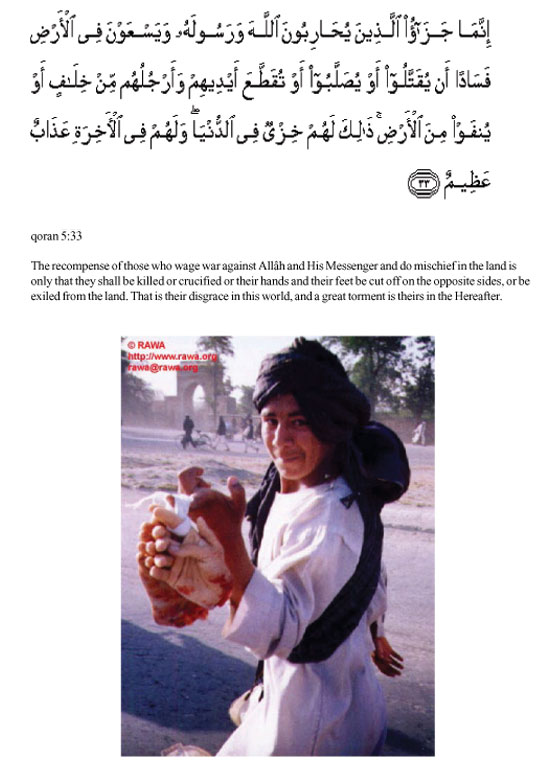
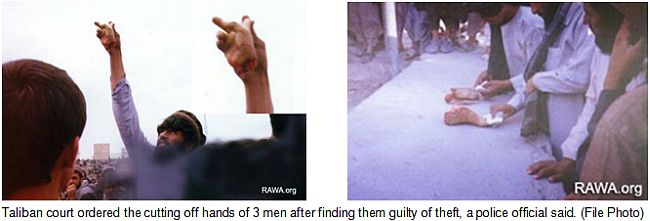
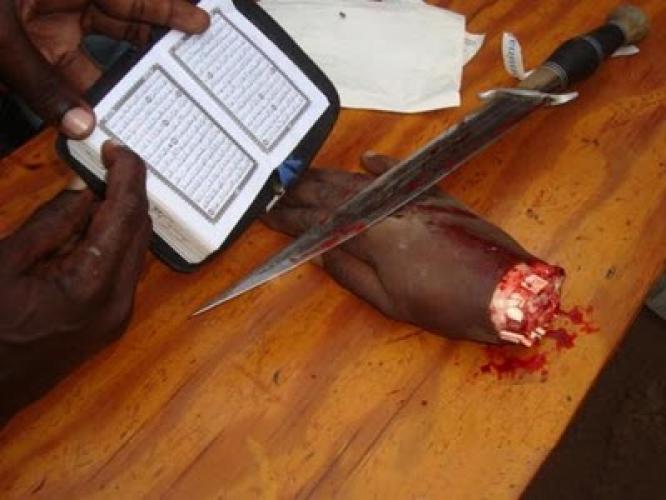
Sharia: the codification of sadism 131

From Bare Naked Islam:
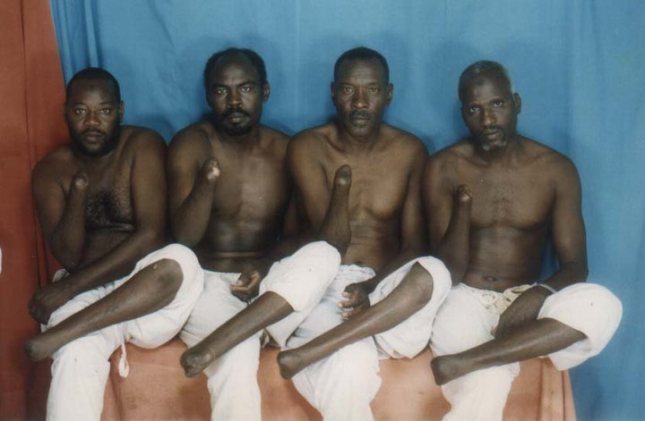
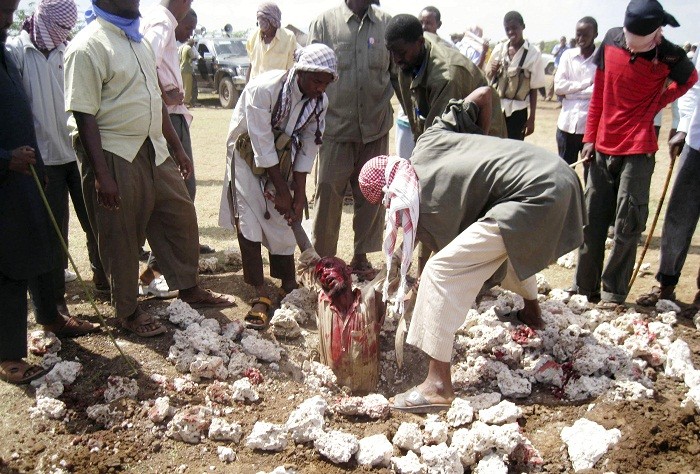
This is the sharia you are now seeing on billboards all over America, telling people that sharia is totally compatible with our Constitutional laws. This is the sharia for which CAIR is spending millions of dollars in court battles against U.S. legislators trying to have it banned in their states. This is the sharia CAIR never talks about in court, because this is the sharia that comes later.
Sharia “the same as the Declaration of Independence” 10
Notice the silly audience laughing agreeably at the propagandist’s little pleasantry about the US being “a sharia compliant state’.