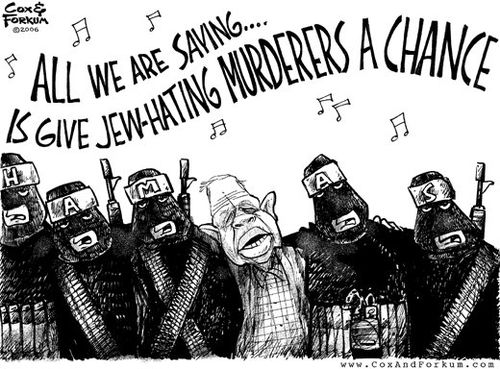
Only the ayatollahs may be laughing 58
From Fox News, via The Religion of Peace which heads this story No Joke :
On Jan. 1, 2010, Hezbollah and its de-facto ruler Iran could have a direct line to the Security Council and gain access to all the confidential information to which Security Council members are privy.
In October the U.N. General Assembly overwhelmingly voted for Lebanon to be the Asian bloc’s new non-permanent member of the United Nations Security Council for a 2-year term.
Earlier today the Lebanese Government endorsed Hezbollah’s demand allowing it to keep its huge weapons arsenal. In doing so the Lebanese government is able to maintain its shaky unity government in which Hezbollah, a designated terrorist group by the U.S. state department, holds two ministries.
Critics worry that the Lebanese will essentially be sitting on the Security Council while ignoring Security Council resolutions that call for the disarming of armed militias, in other words Hezbollah.
Analysts point to the influence wielded by the Iranian-funded Hezbollah in Lebanon as a cause for concern over Lebanon’s acceptance into the Security Council. …
Hezbollah’s acceptance of joining the national unity government came with a promise of not having to disarm as well as receiving the power of veto following months of complicated negotiations.
While repeated calls to the Lebanese foreign ministry in Beirut went unanswered, Lebanon’s ambassador to the U.N., Nawaf Salam, was recently quoted in reports as saying that once on the Security Council, Lebanon would “work for a more just and democratic international system.”
Hezbollah spokesman Ibrahim Moussawi told Fox News that he had no comment as to what the organization wants from the Security Council and denied that his organization was bound by U.N. resolutions that called for disarming militias, telling Fox News that “the organization is not a militia” and to look at Wednesday’s announcement by the Lebanese government that leaves Hezbollah in full control of its arms. …
The group that controls the Lebanese foreign ministry: AMAL, the Lebanese Resistance Detachments … is strongly allied with Hezbollah. It holds influence over Lebanon’s foreign policy, which in turn gives Hezbollah enormous influence over what goes on at places like Lebanon’s United Nations Mission.
Making Islam proud 33
Islam is waging war on the non-Muslim world. The West cannot defend itself only on the battlefields of Afghanistan and the Middle East (though we believe a bombing of Iran’s nuclear installations and strategic centers would shock the whole Islamic world into a long pause at the very least).
There also has to be a new type of warfare, fought within our own Western countries by vigilance, intelligence, legislation and enforcement, and by words. The enemy fighters in our midst have to be found, identified (‘profiled’), disarmed, and put where they can do no harm. In addition, and most importantly, their cause has to be recognized and named for what it is: jihad for the domination of the world by Islam.
At present, the enemy in our midst feels almost invulnerable. Liberalism in power is its ally and protector. Government spokesmen (if not positively sympathetic to the enemy’s cause), military chiefs, religious leaders, journalists and academics and teachers and opinion formers of every kind, are under the spell of political correctness, which distorts their thinking, censors their speech, and ties their hands.
Meanwhile, the enemy speaks out in triumph –
From the Jawa Report:
A U.S. based jihadi forum has issued a statement calling Nidal Hasan [ the Fort Hood army-base murderer] a hero and urged Muslims in the U.S. Army to follow his lead and attack their fellow soldiers:
‘We hope other “Muslims” in the US army repent from their apostasy and take [Nidal Hasan] as a role model, instilling fear in the enemies of Allah and taking them by surprise wherever they may be.’
The statement also condemns Muslims in the West for speaking out against the attack. …
The Ansar al-Mujahideen forum is hosted in Brussels, but the English side of the forum is run out of the US. It is internet based, which means that its editorial staff is decentralized, but we do know that North Carolina’s Samir Khan helps run it. His blog is now hosted by them, he uses it to distribute his internet magazine, and his clique of friends and al Qaeda fellow travelers congregate there. …
Samir doesn’t officially take credit for the statement, but it looks like his work. But given his other treasonous writings, why not take credit?
Inasmuch as this statement is about as far over the line of sedition as they come — they actually urge others to follow in Hasan’s footsteps — I think he’s afraid of legal repurcussions. We all know that no one at the Justice Department has the guts to try a traitor like Samir for sedition, but to the paranoid mind U.S. agents are constantly on the prowl to arrest Muslims for far less. …
‘[We congratulate] our heroic brother Nidal Malik Hasan, for indeed he has raised our heads and made us proud. He realized the truth about the “war on terror”, and waged his own war on terror. When he realized the sin of being in the army, and when he came to know he may be sent overseas to fight Muslims, he instead chose to fight those who truly deserved to be fought. He risked his life to show that the Muslim Ummah is one Ummah indeed, and that Muslims must target their enemies wherever they may be, even in their own lands. We hope other “Muslims” in the US army repent from their apostasy and take him as a role model, instilling fear in the enemies of Allah and taking them by surprise wherever they may be.’
Of witches and supernatural beings 304

'Witch' being decapitated in Saudi Arabia
From Asia News:
Ali Sibat, a Lebanese psychic who made predictions on a satellite TV channel from his home in Beirut, was arrested by religious police in the holy city of Madinah during a pilgrimage in May 2008 and then sentenced to death by decapitation on 9 November this year.
“He was the most popular psychic on the channel,” said May al-Khansa, Sibat’s lawyer. “The number of callers, including from all over the Gulf, spiked in number when he appeared,” she added. “He was told if he confessed to witchcraft, he will be released and allowed to return to Lebanon.”
Seems he ‘confessed’ and was not released.
Sibat’s case is not unique. Dozens of people are arrested each year on charges like witchcraft, recourse to supernatural beings, black magic and fortune telling. These practices are considered polytheistic and severely punished according to Sharia rules.
The Prophet Muhammad claimed that the angel Gabriel dictated the Koran to him. Did Muhammad not have ‘recourse to a supernatural being’?
And Allah himself, ‘the greatest’, what is he if not ‘a supernatural being’?
Ah, well! The religious mind is necessarily an inconsistent mind.
Talking Turkey 151
The Ottoman Empire sided with Germany in World War I, and was broken up by the victorious allies. Parts of it became Iraq, Syria, Jordan, Lebanon, Israel.
Mustafa Kemal, later known as Kemal Atatürk, was the president of the first Turkish republic brought into existence by the Treaty of Lausanne in 1923.
The Turkish sultan had borne the title of Caliph. Under Atatürk the caliphate was abolished in 1924. Turkey became a constitutionally democratic state with an elected parliament. Even women were enfranchised in 1934.
From 1928, Islam ceased to be the state religion. Men were forbidden to grow beards. If they did, Atatürk had them forcibly shaved. He forbade polygamy. Women threw off the veil. In fact, despite the institutions and procedures of democracy, Atatürk wielded dictatorial powers, but he used them to modernize his country.
By the time he died in 1938, the republic was firmly established as a secular state.
In 1952 Turkey became a member of the (then three year old) North Atlantic Treaty Organization (NATO).
The second Turkish republic, established with a new constitution in 1961, proved itself a firm friend and ally of the United States.
After an outbreak of civil violence in 1980, in which more than 2,000 people died, the army intervened, martial law was declared, General Kenan Evren seized control of the government and restored order. A new constitution of 1982 established the autonomy of the army and gave it extraordinary powers over civilian affairs. The army remained the guarantor of Turkey’s secularism, even after martial law was lifted in 1987.
In 1991, when Saddam Hussein invaded Kuwait and the US went to war to force his withdrawal, Turkey permitted the American air force to launch strikes against Iraq from its territory.
A woman, Tansu Çiller, became prime minister in 1993 – to the consternation, no doubt, of the Islamic world. A year later a downturn in the economy led to loss of faith in the secular government among some sections of the population, and Islamic fundamentalism began to spread. In elections of 1995 the largest share of the vote went to an Islamist party, which acquired modified power in a coalition government under Prime Minister Necmettin Erbakan of the Islamist party. This development threatened an end to the secular state.
The army intervened. It forced the resignation of Erbakan and his replacement by a secularist.
In 1991, Turkey took military action to put down an armed rebellion of Kurdish nationalists. The Kurdistan Workers Part (PKK) used terrorist methods, including suicide bombing. In 1999, with the capture of the rebel leader, the conflict died down. In that year Turkey was invited to apply for membership of the European Union (EU).
The invitation did not provide an easy path for Turkey’s accession. First the Brussels bureaucracy objected to Turkey’s ‘human rights’ record. When Turkey made reforms in order to become more acceptable, it was told that the power of the army was an impediment to its joining. Woodenly, the EU decision-makers either didn’t understand or deliberately ignored the fact that the Turkish army was what kept Turkey the sort of country that could co-operate successfully with Western powers, by keeping it from becoming an Islamic state.
Popular support for Islamism grew. Relations between Turkey and the West deteriorated. In 2003 the parliament refused permission to the United States to invade Iraq from US bases in Turkey. At that point Turkey should have been expelled from NATO. It wasn’t, but a rift came between Turkey and the United States. A long-established friendship between Turkey and Israel also began to cool.
Islamism continues to gain popularity in Turkey. An Islamist party is in power. Beards and the veil have made a comeback. The army is losing power. It has not succeeded in opposing a developing alliance between Turkey and Iran. It was almost certainly against the wishes of the army that Turkey recently cancelled joint military exercises with Israel.
On October 28, 2009, the prime minister of Turkey, Tayyep Recep Erdogan, and the president of Iran, Mahmoud Ahmadinejad, met for talks. According to Israeli sources (in a report of November 10, 2009), they agreed that Turkey, still a member of NATO, will pass on intelligence to Tehran concerning any preparations Israel makes for a strike on Iran’s nuclear development facilities. Presumably this would mean that intelligence concerning Israel-US military co-operation can fall into Iranian hands.
What seems certain enough is that Turkey is now aligned with the Islamic enemies of the United States, and NATO is harboring a traitor. The US should be taking damage-limiting action. But we don’t expect Obama to be troubled enough by this development to do anything about it. He’s probably in favor of it.
Jillian Becker November 14, 2009
Abo Abbas 154
The conjugation of two failures – a Barack Obama mess up (or pursuit of an anti-Jew pro-Islam passion) and a Mahmoud Abbas sulky retirement – provides Israel with an opportunity.
Caroline Glick writes:
Today the Fatah movement is in disarray. Last week its leader, Mahmoud Abbas, announced his intention to retire and has placed the blame for his decision on the Obama administration as well as on Israel. Key Palestinian spokesmen like Saeb Erekat have declared the death of the peace process and called for the renewal of the jihad against Israel.
As for the larger Muslim world, a report this week in The New York Times stated that the US’s key Arab allies, Egypt and Saudi Arabia, have been perilously weakened since Obama took office. Their diminished influence has been accompanied by the rapid rise of Iran and Syria. Both of these rogue states have been on the receiving end of continuous wooing by Obama administration officials who seem ready to do just about anything to appease them.
In the meantime, Iran’s Hizbullah proxy in Lebanon has again managed to regain control over Lebanon’s government, despite its defeat in June’s parliamentary election. Making full use of the fact that it fields the most powerful army in the country and owing as well to the US’s decision to abandon the pro-Western March 14 movement in favor of an approach that makes no distinction between America’s friends and foes in Lebanon, Hizbullah strong-armed its way back to the driver’s seat in the new Lebanese government.
As for Hizbullah’s Iranian bosses, far from convincing them to moderate their policies, the Obama administration’s efforts to appease the ayatollahs have emboldened Iran’s theocratic leaders to adopt ever-more radical positions against the US. …
The fact that Obama’s policies have all failed so spectacularly presents a unique opportunity for Israel to move its policies in a bold new direction. …
As Netanyahu knows, there is consensus support among Israelis for his plan to ensure that the country retains defensible borders in perpetuity. This involves establishing permanent Israeli control over the Jordan Valley and the large Jewish population blocs in Judea and Samaria. In light of the well-recognized failure of the two-state solution, Hamas’s takeover of Gaza and the disintegration of Fatah accompanied by the shattering of the myth of Fatah moderation, Israel should strike out on a new course and work toward the integration of Judea and Samaria, including its Palestinian population, into Israeli society. In the first instance, this will require the implementation of Israeli law in the Jordan Valley and the large settlement blocs.
Replacing the military government in these areas with Israel’s more liberal legal code will also advance Netanyahu’s economic peace plan, which envisions expanding the Palestinian economy in Judea and Samaria by among other things reintegrating it into Israel’s booming economy. This plan would reward political moderation while marginalizing terrorists in Palestinian society. In so doing, it will advance the cause of peaceful coexistence over the long-term far better than the failed two-state solution. Far from engendering peace, the two-state paradigm empowered the most corrupt and violent actors in Palestinian society, at the expense of its most productive and moderate citizens.
Obama’s disgraceful treatment of Israel and, for that matter, his atrocious treatment of the majority of America’s allies in the Middle East and throughout the world, has strengthened the hands of America’s worst enemies and made the world a much more dangerous place. But his obvious failures provide Israel with an opportunity to take control of events and change the situation for the betterment of Israel and the Palestinians alike.
Applying Israeli law to the Jordan Valley and the major Israeli population blocs in Judea and Samaria will probably not win Netanyahu many friends in the Obama White House. But if we learned anything from Obama’s insulting treatment of Netanyahu and American Jews this week, we learned that regardless of what Israel does, the Obama administration has no interest in being his friend.
It’s well worth reading the whole article. Glick deals with the unavoidable demographic question. The fact is that, contrary to all prediction, the Jewish population has a higher birth rate than the Arab, and an Israel enlarged as she envisions would still be a Jewish state.
The uses of walls 28
The Berlin Wall was not defensive. It was built by the Communists to keep their serf populations from escaping. As Europe celebrates its fall, a Muslim, Shiraz Maher, writes in Standpoint about barrier walls built by Islamic states, never noticed by those who vituperatively condemn the defensive barrier Israel has erected against suicide bombers and other terrorist attackers:
Today marks the twentieth anniversary of the collapse of the Berlin Wall. During that time scores of other barriers and walls have gone up around the world …
Of course, the one we’ve all heard about is the Israeli security fence which attracted fierce criticism after its construction in 2003. Built in response to the Palestinian intifada which claimed more than 900 lives since September 2000, the fence has dramatically halted the number of terrorist attacks inside the country.
Excuse the pun but from the wall-to-wall coverage it received you could be mistaken for thinking that Israel’s decision to defend itself in this way was unprecedented. Yet, not only is this wrong but, ironically, a lot of the physical barriers currently in place are located in the ‘Muslim world’.
The Saudi-Yemeni border is just one place where a physical barrier is used by a Muslim regime to defend itself against ‘smuggling’ and ‘terrorism’. … Saudi Arabia’s border with Yemen has always been problematic, providing a trafficking route for weapons smuggling. Indeed, the explosives used in the 2003 Riyadh bombings which targeted compounds housing western expatriates were blamed on Yemeni smugglers. It was not the first time Saudi Arabia blamed the Yemenis for not doing enough to stop terrorism. Yemeni smugglers are also believed to have helped facilitate the bombing campaign against US military bases in the mid-1990s.
Once the Saudi government lost confidence in Yemen’s ability to curb domestic terrorism, they decided to build a physical barrier. Much of it runs through contested territory. According to the 2000 Jeddah border treaty between Saudi Arabia and Yemen, a demilitarised ‘buffer zone’ should exist between both countries, protecting the rights of nomadic Bedouin tribes which live in the cross-border area. Yet, parts of the Saudi barrier stand inside the demilitarised zone, violating the 2000 agreement and infuriating Yemen. …
More recently, Saudi Arabia has also built a physical barrier along its border with Iraq to stop jihadists from the Kingdom going over to join the mujahideen. …
Beyond the Middle East, Iran’s 900 km border with Pakistan is currently being replaced by a concrete wall (10 feet high, 3 feet thick), fortified with steel rods. Ostensibly built to thwart drug traffickers and terrorists, the local Baloch people oppose its construction as it cuts across their land and separates communities living on either side of the divide. The opposition leader of Balochistan’s Provincial Assembley, Kachkol Ali, has bitterly opposed the wall saying his people were never consulted about it and that it cuts off families from one another. … A number of Baloch communities, particularly in the Kech district of south-western Balochistan, straddle the Iranian-Pakistani border area. After Iran began construction of its wall, many of those residing on its side were forced back across the border into Pakistan where they are separated from their families and land. …
There are plenty more examples of this within the Muslim world too. In the Western Sahara desert Morocco has built a massive wall, spanning more than 2700 km. Its primary aim is to guard against Sahrawi separatists who organised themselves into the Polisario Front – a political and terrorist movement – which seeks independence for the Sahrawi people. Much of the wall is lined with barbed wire and landmines, which is something it shares in common with parts of the Pakistan-Indian border (particularly in Kashmir).
Twenty years on from the collapse of the Berlin Wall physical barriers continue to be employed around the world. They may not be pretty, but they are effective. Indeed, even Israel’s biggest critics would have to concede that suicide bombings have fallen away sharply ever since the construction of the security fence in parts of Gaza and the West Bank. Yet, Islamists and parts of the political left obsess only about Israel but do not extend similar condemnation to Iran, Saudi Arabia, Morocco, or Pakistan. …
Obama the bicyclist 21
It’s a metaphor from the German-speaking world: a bicyclist – one who treads down hard (as when pedaling) on those he despises while he bows (as over handlebars) to those he respects.
*
Ben Rhodes, who is Obama’s deputy national security adviser for strategic communications and the writer of many of his foreign policy speeches (now you know the name of the culprit), said, according to The Washington Post:
“Our interests are the same with our allies and our adversaries. We’re saying the same thing to everybody. Our interests are the same no matter what country we’re talking to.”
If this were really the Weltanschauung shaping Obama’s foreign policy, it would be not merely misconceived, not just naive, not even simply stupid – it would be lunatic.
But in fact he doesn’t treat friends and foes alike.
Bowing to America’s ‘adversaries’, he –
Gently propitiates the Mullahcracy of Iran and lets it become a nuclear power. Ditto the Despotism of North Korea. Kindly lets Iranian and al-Qaeda terrorists roar back into Iraq. Cozies up to Dictator Hugo Chavez. Literally bows to Saudi Arabia’s tyrant-in-chief who is spreading ‘soft’ jihad throughout America and the whole Western world. Lends a sympathetic hand to the flesh-eating Molloch of the Sudan, Omar al-Bashir, to help him evade trial. Yields graciously to rapacious Russia. Implores the barbaric Taliban to grant him a face-saving peace in Afghanistan [see the post immediately below]. Creeps cap-in-hand to Communist China. Plays nice with the slave-keepers of Cuba.
Stamping on America’s friends, he –
Snaps his fingers at Britain. Bullies Honduras. Cold-shoulders Colombia. Alienates Israel. Refuses to celebrate the 20th anniversary of the fall of the Berlin Wall. Looks the other way while Georgia is invaded and partially occupied by Russia. Breaks US promises of defense shields to Poland and the Czech Republic and, as an afterthought, lets them know his irrevocable decision with a casual midnight phone call – or does he get Hillary to text them the message?
Aid for torturers 36
While politicians in Western democracies, or at least in Britain and the US, interrogate their consciences over how much physical and mental pressure they may allow their agents to use on captured terrorists to elicit vital security information, they choose to overlook the practice of torture in Saudi Arabia, Jordan, Egypt, Gaza, the West Bank …
The West Bank? There Britain has suddenly to take heed of what the following report calls ‘a wave of torture’ because Britain is the paymaster of the torturers. The Mail on Sunday is to be commended for exposing the facts, but calling it a ‘wave’ that has been going on for ‘the past two years’ implies that the practice is unusual, when in truth, as the British Foreign Office knows perfectly well, it is prevalent and customary.
From the MailOnline:
The Government is sending British police and intelligence officers to the West Bank to try to stop a wave of brutal torture by Palestinian security forces funded by UK taxpayers.
Their mission is to set up and train a new ‘internal affairs’ department with sweeping powers to investigate abuse and bring torturers to justice.
The department is being paid for by Britain, with an initial planning budget of £100,000 – a sum set to soar as it becomes established.
Yesterday a senior official from the semi-autonomous Palestinian Authority (PA), which runs the West Bank and its security agencies, admitted for the first time that torture, beatings and extra-judicial killings have been rife for the past two years, with hundreds of torture allegations and at least four murders in custody, the most recent in August. …
Support for the new department follows the disclosure by The Mail on Sunday in January that Britain spends £20million a year funding the forces responsible for the abuse.
Most of their victims are accused of involvement with Hamas, the radical Islamist party that seized power through violence in the Gaza Strip in 2007. The Palestinian Authority in the West Bank is controlled by the rival Fatah party.
Fatah and Hamas are both terrorist organizations. Britain gives millions to Hamas too – though strictly, of course, for ‘humanitarian aid’.
As if money were not fungible!
An answer 9
One of our readers, Hawk2, has commented on our post below, Question, providing the sort of answer we are looking for.
We think his/her comments are so interesting that we are posting them in full here on our front page.
US foreign policy should be grounded in two essential considerations, and only these two:
1. Profitable trade
2. National security
With these in mind, the only recent war that must be seen to have had no justification whatsoever is President Clinton’s war in the Balkans. It did nothing for trade. It gained America nothing. It was not worth what it cost. What is worse, its rationale was the protection of Muslim rebels, at a time when Islam was fast becoming the major enemy of the Western world.
Oil is a very good reason to go to war. It satisfies both considerations. If the US had gone to war to seize the Saudi Arabian oilfields in 1974 when the price of oil was hyped as an attack on the US economy, it would have been right to do so.
If the wars against Saddam Hussein were waged for oil, they were necessary and worth what they cost. Also if they were waged to protect America from WMD, they were necessary and worth what they cost. If, on the other hand, they were waged to protect Kuwait from conquest, or Iraqis from tyranny, they were unnecessary and not worth what they cost.
The war against the Taliban/al-Qaeda was justified by 9/11. But having soundly beaten the Taliban, the US should have withdrawn, leaving a clear message that if the US were struck again the Taliban would be beaten again. Staying on to build schools and clinics which the Taliban will demolish is senseless, and not worth what it costs. There is no saving the Afghans from themselves: from corruption, the subjugation of women, the growing of opium.
As to the argument that it is always in the interests of the US to protect freedom in the wider world, that is true, but the threat to freedom must be a real one. It was why America was right to go to Europe’s aid in the in the First and Second World Wars. It may be a reason for America to go to war again. America’s own freedom was under threat then as it is now, this time by the creeping colonization of Europe by Islam. ‘Spreading democracy’ – another reason given for the wars in Iraq and Afghanistan – does not guarantee the spread of freedom. Germany was a democracy when Hitler came to power by being democratically elected. Zalaya was democratically elected in Honduras, and was deposed because he was trying to establish his dictatorship. But the State Department insists that he should be reinstated. This is staggeringly stupid if not treacherous. The preservation of freedom on the South American continent wherever it exists is plainly essential to US security. Hostile regimes in the hemisphere are a serious threat, as Hugo Chavez proves by his alliance with would-be-nuclear-armed Iran.
This reasoning would fully justify an immediate military attack on Iran and North Korea.