A brief history of libertarian conservatism, and the questionable future of statism 869
This is from Reason, February 27, 2008:
“I share about 90 percent of the views of most libertarians.”
So said the famous conservative William F. Buckley in a 1983 discussion when he “sat down with reason to discuss, among other subjects, libertarianism, Ayn Rand, Milton Friedman, and the decriminalization of marijuana.”
The interview, which must have been interesting, is now hard to find. However, all we need from it is Buckley’s statement that he “shared about 90% of the views of most libertarians”, because we do too. But, like him, we still describe ourselves as conservatives.
Buckley was influenced by Albert Jay Nock, “whose elegant criticism of statism seems to grow more relevant with each passing day”, as Jonah Goldberg wrote in an essay on Nock in the National Review in 2009. Here are some extracts from it:
Albert Jay Nock … was one of the great men of letters of the 20th century. He counted among his friends and admirers H. L. Mencken, Charles Beard, Dwight Macdonald, Oswald Garrison Villard, Frank Chodorov, William F. Buckley Jr., and William Jennings Bryan (for whom he did some work as a special envoy when Bryan was secretary of state). … [He] was born in 1870 … in Scranton, Pa., and raised in Brooklyn, Nock was an autodidact who mastered numerous languages, including French, Latin, and Greek. He spent a good deal of his youth in a small town in upstate New York, where he imbibed from the wellspring of American individualism and gained an enduring appreciation for the power and magisterially ennobling competence of what we would today call civil society (he used the word “society” or “social power” to denote the good and decent realm of life not corrupted or coerced by the state). In 1887 he went to St. Stephen’s College (now Bard), where he was later a professor.
After college he attended divinity school, and he became a minister in the Episcopal Church in 1897. A dozen years later he quit the clergy and became a full-time journalist and editor, first at American Magazine and then at The Nation (which was still a classically liberal publication). In 1920 he became the co-editor of the original Freeman magazine, which, in its four-year run, managed to inspire the men who would one day launch National Review and the second incarnation of The Freeman, run by Nock’s disciple Frank Chodorov. …
He wrote a few books, including biographies of Thomas Jefferson and Rabelais. His most famous and successful works were Our Enemy the Stateand Memoirs of a Superfluous Man. But he was not prolific. As Chodorov put it, he “had a rare gift of editing his ideas so that he wrote only when he had something to say and he said it with dispatch.” …
Among virtually all of the political writers of the Left and the Right in the 1920s and 1930s, Nock shines brightest for seeing from the outset that the differences between the various collectivist schemes then circulating amounted to differences in branding. “Communism, the New Deal, Fascism, Nazism,” he wrote in his Memoirs, “are merely so-many trade-names for collectivist Statism, like the trade-names for tooth-pastes which are all exactly alike except for the flavouring.” …
A cold river of anarchism runs across the landscape of Nock’s work, but … he was not an anarchist, as many fans claim. … Nock understood that the state is not the “proper agency for social welfare, and never will be, for exactly the same reason that an ivory paper-knife is nothing to shave with.” Government intrusions “on the individual should be purely negative in character. It should attend to national defense, safeguard the individual in his civil rights, maintain outward order and decency, enforce the obligations of contract, punish crimes belonging in the order of malum in se [evil in itself] and make justice cheap and easily available.” Such a regime would amount to a government by and for the people, not a state in which the citizens are mere instruments of the statists. …
He denied that the state was the proper object of hope or a worthwhile agent of change. Moreover, he had contempt for the vast bulk of humanity, the “Neolithic mass” and those who spoke to them. In the dark, or at least darkening, age in which he believed himself to live (Nock died two weeks after Hiroshima), he cared only for the Remnant — a tiny slice of humanity he could describe but not locate. … the Remnant was his audience. At times, the idea of the Remnant is unapologetically elitist, but in a thoroughly Jeffersonian way. The Remnant were not the “best and brightest,” the most successful, the richest. Rather, they were those occupying the “substratum of right thinking and well doing” (in Matthew Arnold’s words). “Two things you do know, and no more: First, that they exist; second, that they will find you. Except for these two certainties, working for the Remnant means working in impenetrable darkness.”
And it is here that we find an explanation for why Nock is so admired by liberals such as The New Republic’s Franklin Foer and the New York Times’s Sam Tanenhaus: He openly embraced the idea that he couldn’t change anything. History was driven by forces too large to be affected by politics or punditry. Any revolution would result only in a new crop of exploiters and scoundrels eager to pick up where the deposed ones left off. So, Nock figured, why bother with politics? Now what more could today’s liberals ask for from a conservative pundit? …
He was wrong about many things, and his formulations were often too simple. … He bravely dissented from the overwhelming consensus that collectivism was the most desirable form of social organization. But he in effect surrendered to the same consensus that it was the “wave of the future.” …
He was wrong that statism was inevitable, partly because he was right about the need to speak to the Remnant. Buckley, Chodorov, and countless others took inspiration from Nock or from Nockian ideas, but they did not write for their desk drawers. They shared Nock’s fatalism at times — standing athwart history yelling Stop, and all that — but they actually yelled Stop. Nock did not believe in anything so crude as yelling, even in purely literary terms. His successors did, because they shared Burke’s understanding that “when bad men combine, the good must associate; else they will fall one by one, an unpitied sacrifice in a contemptible struggle.” Likewise, when bad ideas seem good, men who know otherwise must say so, lest society slip under their spell. That was the key lesson the disparate righteous took from Nock the Prophet as they associated to form the modern conservative and libertarian movements — even if, as Nock fully understood, they didn’t know where their ideas came from, or that Nock’s fingerprints were upon many of them. …
And that is why the Right is in so much better shape than it was during Nock’s time, even as liberals are mounting a statist revival. Yes, statism is on the march again, but anti-statism isn’t an amusing pursuit for cape-wearing exotics like Nock anymore; it is the animating spirit of institutions launched and nourished by lovers of liberty.
We are fascinated by this piece of history, glad to learn that “the disparate righteous … associated to form the modern conservative and libertarian movements”.
But is statism not the “wave of the future”?
With the re-election of Obama and the apparent weakness of the Republican Party now, we cannot be confident that statism is a passing phase.
Jonah Goldberg remains full of optimism. Here he is again with a cheerful view. We quote from an article of his at Townhall today:
American conservatism began as a kind of intellectual hobbyist’s group with little hope of changing the broader society. Albert Jay Nock, the cape-wearing libertarian intellectual … who inspired a very young William F. Buckley Jr., argued that political change was impossible because the masses were rubes, goons, fools or sheep, victims of the eternal tendency of the powerful to exploit the powerless.
Buckley, who rightly admired Nock for many things, rightly disagreed on this point. Buckley trusted the people more than the intellectuals … [and believed that] it is possible to rally the public to your cause.
It took time. In an age when conservative books make millions, it’s hard to imagine how difficult it once was to get a right-of-center book published. Henry L. Regnery, the founder of the publishing house that bears his name, started his venture to break the wall of groupthink censorship surrounding the publishing industry. With a few exceptions, Regnery was the only game in town for decades.
That’s hardly the case anymore. While there’s a higher bar for conservative authors at mainstream publishers (which remain overwhelmingly liberal), profit tends to trump ideology.
And publishing is a lagging indicator. In cable news, think tanks, talk radio and, of course, the Internet, conservatives have at least rough parity with, and often superiority to, liberals. It’s only in the legacy institutions — newspapers, the broadcast networks and most especially academia and Hollywood — where conservatism is still largely frozen out. Nonetheless, conservatism is a mass-market enterprise these days, for good and for ill.
The good is obvious. The ill is less understood. For starters, the movement has an unhealthy share of hucksters eager to make money from stirring rage, paranoia and an ill-defined sense of betrayal with little concern for the real political success that can only come with persuading the unconverted.
We have a sinking feeling that we are among the “hucksters … stirring rage, paranoia, and an ill-defined sense of betrayal with little concern for the real political success that can only come with persuading the unconverted”, though we don’t make money out of it, and we would very much like to achieve real political success.
A conservative journalist or activist can now make a decent living while never once bothering to persuade a liberal. Telling people only what they want to hear has become a vocation. Worse, it’s possible to be a rank-and-file conservative without once being exposed to a good liberal argument.
We are amply exposed to liberal arguments, but have yet to hear a good one.
Many liberals lived in such an ideological cocoon for decades, which is one reason conservatives won so many arguments early on. Having the right emulate that echo chamber helps no one.
Ironically, the institution in which conservatives had their greatest success is the one most besieged by conservatives today: the Republican Party. To listen to many grassroots conservatives, the GOP establishment is a cabal of weak-kneed sellouts …
Well, yes. That is how we think of the GOP right now.
It’s not that the GOP isn’t conservative enough, it’s that it isn’t tactically smart or persuasive enough to move the rest of the nation in a more conservative direction. Moreover, thanks in part to the myth that all that stands between conservatives and total victory is a philosophically pure GOP, party leaders suffer from a debilitating lack of trust — some of it well earned — from the rank and file.
But politics is about persuasion, and a party consumed by the need to prove its purity to its base is going to have a very hard time proving anything else to the rest of the country.
We applaud – and often quote – conservative and libertarian writers who attract millions of readers and may be persuading them.
And eagerly – though full of misgiving – we await their success: await the defeat of collectivist statism; the fall from power of the now far left Democratic Party; the final disappointment of the world government fans and the Big Green fanatics; the enlightenment of feminists and pacifists; the stopping of the Islamic onslaught on the West.
And the regeneration of the GOP.
Sharia: the codification of sadism 131

From Bare Naked Islam:
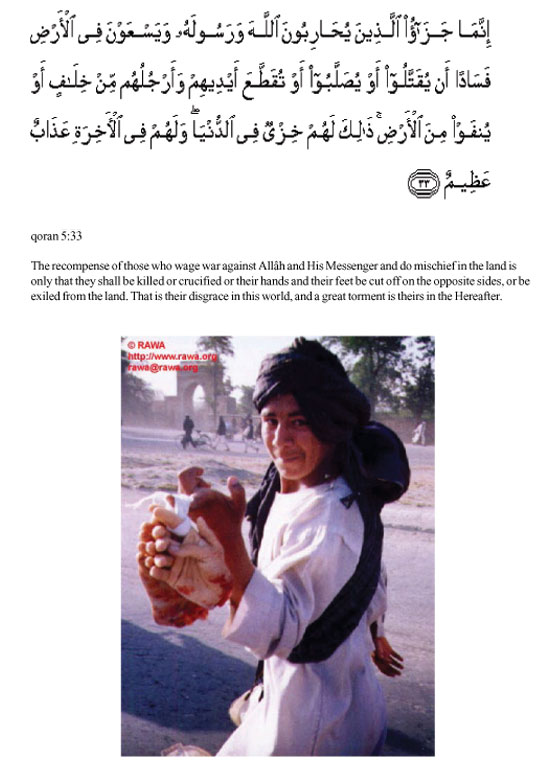
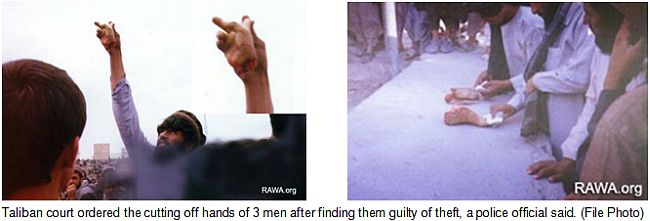
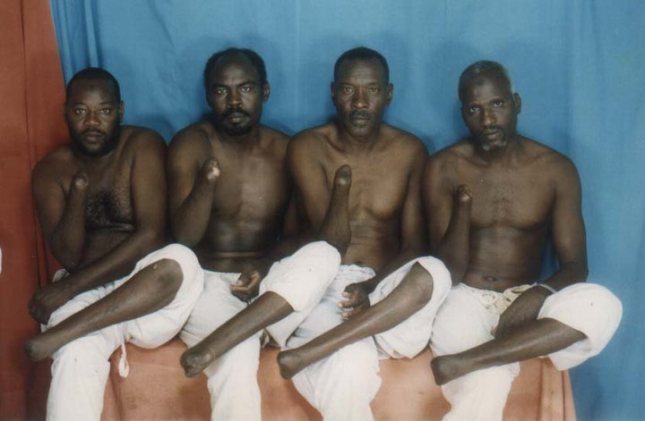
This is the sharia you are now seeing on billboards all over America, telling people that sharia is totally compatible with our Constitutional laws. This is the sharia for which CAIR is spending millions of dollars in court battles against U.S. legislators trying to have it banned in their states. This is the sharia CAIR never talks about in court, because this is the sharia that comes later.


The razor sharp sword of Islam 702
ABC News reports:
Rizana Nafeek, a young nanny from Sri Lanka, was beheaded by sword [in June, 2011] in Saudi Arabia, punishment for allegedly killing a baby in 2007 when she was believed to be just 17.
We are not told whose baby it was or how she killed it. Violently? Accidentally? By abandonment and neglect the way babies are routinely and lawfully killed in China and Britain?
The execution has spurred international outcry, given Nafeek’s age at the time of the incident and her limited access [or no access at all?] to a defense attorney. …
Few details of Nafeek’s execution have leaked from the country’s tightly controlled media, but the interior ministry said her head was severed from her body in public in Dawadmy, a dusty suburb of the capital Riyadh. …I
Some 82 executions were carried out in Saudi Arabia last year … It is unknown how many of them were women or carried out by sword, but the majority of the condemned were foreigners, like Nafeek.
Beheadings in Saudi Arabia are governed by certain rules.
They are conducted in public, typically in town squares or near prisons. The condemned, as well as the executioner, typically wear white. The convict is blindfolded, handcuffed and often given a sedative. A plastic tarp, several feet wide, is sometimes spread out around the convict to make cleaning up the blood and recovering her head easier.
The heads of the condemned can sometimes roll several feet from the body, said Saudi Arabia’s leading executioner in a rare 2003 interview with Saudi newspaper Arab News.
“The criminal was tied and blindfolded. With one stroke of the sword I severed his head. It rolled meters away,” said executioner Muhammad Saad al-Beshi, recalling his first beheading.
Al-Beshi said he has executed as many as 10 people in one day, by sword and by bullet.
“It depends what they ask me to use. Sometimes they ask me to use a sword and sometimes a gun. But most of the time I use the sword,” he said.
He said he keeps his sword razor sharp, and allows his children to help clean it.
“People are amazed how fast it can separate the head from the body,” he said.
Executioners like Al-Beshi are trained professionals who also carry out amputations, severing the hands, feet and tongues, of convicted criminals.
The pain from the cutting of a tongue is extremely intense and persists for weeks or even months.
The executioner said it is not uncommon for spectators to pass out at a beheading.
“There are many people who faint when they witness an execution. I don’t know why they come and watch if they don’t have the stomach for it,” he said.
Four men, four years – to disable America? 96
Barack Obama loves Islam. He has members of the Muslim Brotherhood ( MB) advising his administration. He has advanced the MB to power in North African countries. He will not allow the word “terrorism” to be associated with acts of terrorism carried out by Muslims in America. He has persistently strengthened agressive Islam and weakened Islam’s first and main target, Israel. He does all he can to prevent Israel from destroying the Iranian sites where nuclear weapons are being developed to be used against Israel.
He needs men beside him in power who share his pro-Islam and anti-Israel emotion. He needs them in the three departments of government where they can be most effective in carrying out the policies that arise from his intense pro-Islam bias: State, Defense, Intelligence. He has aptly chosen John Kerry, Chuck Hagel, and John Brennan.
Barry Rubin writes (in part):
This trio in power … along with Obama himself could be called the four horseman of the Apocalypse for U.S. foreign policy. …
Their ideas and views are horrible. This is especially so on Middle Eastern issues but how good are they on anything else? True, they are all hostile to Israel but this isn’t the first time people who think that way held high office. Far worse is that they are pro-Islamist as well as being dim-witted about U.S. interests in a way no foreign policy team has been in the century since America walked onto the world stage.
Brennan is no less than the father of the pro-Islamist policy. What Obama is saying is this: My policy of backing Islamists has worked so well, including in Egypt, that we need to do even more! …
They are all stupid people. Some friends said I shouldn’t write this because it is a subjective judgment and sounds mean-spirited. But honest, it’s true. … Smart people can make bad judgments; regular people with common sense often make bad judgments less often. But stupid, arrogant people with terrible ideas are a disaster.
Brennan’s only life accomplishment has been to propose backing radical Islamists. As a reward he isn’t just being made head of intelligence for the Middle East but for the whole world! Has Brennan any proven administrative skill? Any knowledge of other parts of the world? No. All he has is a proximity to Obama and a very bad policy concept. What’s especially ironic here is that by now the Islamist policy has clearly failed and a lot of people are having second thoughts.
With Brennan running the CIA, though, do you think there will be critical intelligence evaluations of the Muslim Brotherhood, Hizballah, or even Hamas? Is the CIA going to warn U.S. leaders about the repression against women, Christians, and moderates? Will there be warnings that Islamists are taking over Syria or reports on Islamist involvement in killing Americans in Benghazi? Can we have confidence about U.S. policy toward Iran?
To get some insight into his thinking, consider the incident in which a left-wing reporter, forgetting there were people listening, reminded Brennan that in an earlier private conversation he admitted favoring engagement not only with the Lebanese terrorist group Hizballah but also the Palestinian terrorist group Hamas. …
Kerry, of course, was the most energetic backer of sponsoring Syrian dictator Bashir al-Assad before the revolt began. Now he will be the most energetic backer of putting the Muslim Brotherhood into power in Syria. Here is a man who once generalized about American soldiers in Vietnam as being baby-killers and torturers. …
As for Hagel, suffice it to say that the embarrassing quotes and actions from him in the past – including his opposition to sanctions against Iran – fueled a response to his proposed nomination so strong that the administration had to back down for a while.
No, it does not suffice to say just that. There is much more to be said (see below).
Obama has been president of the United States for four years. Yet in foreign policy, having some decent and competent people in high positions mitigated the damage.
Did they? How? And who were they, we wonder.
Well, the reins are now loosed; the muzzle is off. …
To get a sense of his thinking, Brennan [wrote] … “If the United States actually demonstrates that it will work to help advance rather than thwart Iranian interests, the course of Iranian politics as well as the future of U.S.-Iranian relations could be forever altered.”
The Obama Administration followed this advice during its first two years with the result being total failure.
[Brennan] also proposes a U.S. policy, “to tolerate, and even to encourage, greater assimilation of Hezbollah into Lebanon’s political system….” This step, he suggests, will reduce “the influence of violent extremists in the organization.”
Of course, Hizballah does not need to stage terrorist attacks if it holds state power …
Rubin is overlooking something here. Hezbollah does hold state power in Lebanon, and it is still a terrorist organization carrying out acts of terrorism.
What Brennan — and the Obama Administration — fails to understand regarding this point. The danger is not terrorism but a dangerous revolutionary movement that becomes even more dangerous if it controls entire states, their resources, and their military forces.
And here we think Barry Rubin’s pessimism doesn’t take him far enough to touch the appalling truth. We don’t think there is a failure of understanding. We read the signs to indicate pretty plainly that Obama wants the revolutionary movement of Islam to “control entire states, their resources, and their military forces”. And their poisonous gases. And their nuclear arms.
*
About Chuck Hagel: this is from Front Page, by Joseph Klein:
Hagel … has espoused a deep kinship with the radical anti-war Left, advocated reckless foreign policy positions such as direct talks with terrorists and their leading sponsor, Iran, and demonstrated a nasty hostility to Israel and to Jews in general. To have this kind of individual serving as the head of the U.S. Defense Department is to severely jeopardize the security interests of the U.S., our ally Israel and the rest of the free world.
Hagel has become the darling of the radical anti-war crowd … [and] is also beloved by Israel-haters and anti-Semites, including the Muslim Brotherhood-affiliated Council on American-Islamic Relations and the Iranian regime’s TV network mouthpiece, TVPress …
Hagel believes that U.S. foreign policy has been skewed too much in Israel’s favor. He ascribed the pro-Israel tilt to the power of what he called the “Jewish lobby,” which he said had the ability to “intimidate” members of Congress. While serving in the Senate, he boasted that he was not sent to Washington to serve as an “Israeli Senator.” This was an obvious swipe at his Senate colleagues who believed in supporting the only true democracy in the Middle East. Hagel was also using the age-old code words of anti-Semites who accuse Jews of dual loyalties. …
In August 2006, Hagel joined only eleven other senators in refusing to write the European Union asking them to declare Hezbollah a terrorist organization. …
Although the terrorist organization Hamas has yet to renounce violence and its covenant to destroy Israel, Hagel signed a letter delivered just days before Obama was to take office for his first term as president urging Obama to talk to leaders of Hamas.
Israel is surrounded by enemies determined to destroy the Jewish state. It is also a strategic partner in our own war against global Islamist jihadists – sharing intelligence, developing state-of-the art body armor used by our troops and anti-missile defense systems that are more sophisticated than our own. Yet we are facing the prospect of a Secretary of Defense who goes out of his way to antagonize our only true ally in the Middle East and who cannot bring himself to treat Hamas and Hezbollah as the terrorist enemies of all freedom-loving countries that they surely are. …
Even if Hagel had not shown the kind of antipathy towards Israel that has won him praise from the Muslim Brotherhood-affiliated Council on American-Islamic Relations and earned him the “anti-Israel” title on Iranian state TV, Hagel would still be a complete disaster as Secretary of Defense. He is caught in the time warp of the Vietnam syndrome, the national defense paralysis that stemmed from what Ronald Reagan once described as “feelings of guilt as if we were doing something shameful.” …
How would Chuck Hagel’s case of the Vietnam syndrome play out in his dealing as Secretary of Defense with the Iranian nuclear threat? In one word, appeasement. Like Obama, Hagel has called for “unconditional” talks with Iran. … He has opposed economic sanctions … He was one of two senators to oppose the Iran-Libya Sanctions Act in 2001. In 2008, Hagel was reported to have been “solely responsible” for blocking a bill that would have tightened economic sanctions in Iran …
Hagel appears willing to accept a nuclear-armed Iran as a fact of life that we will just have to learn to live with. … Hagel also thinks that the United States should offer to back off any declaratory support for regime change in Iran. While in the Senate, [he] even voted against designating the Iranian Revolutionary Guard Corps as a terrorist organization. …
Before President Obama officially announced his nomination of Chuck Hagel for the position of Secretary of Defense and John Brennan for director of the Central Intelligence Agency, Obama said that protecting the security of the American people was his number one priority. …
Protecting the American people from what? From their own Constitution? From liberty?
*
About John Kerry: this is from Discover the Networks:
After his discharge from the Navy in early 1970, Kerry became a prominent figure in the anti-America, pro-Hanoi crowd of antiwar protesters personified most visibly by Jane Fonda. Like so many of those activists, Kerry publicly maligned U.S. soldiers. He became a spokesman and organizer for the group Vietnam Veterans Against the War (VVAW) …
During an unsuccessful run for Congress in 1970, Kerry, depicting the United States as a country whose aggressive impulses needed to be reined in by outside forces, said: “I’m an internationalist. I’d like to see our troops dispersed through the world only at the directive of theUnited Nations.” …
In May 1970, Kerry met with North Vietnamese/Viet Cong delegations at the Paris Peace Talks, where they discussed a variety of proposals—especially the eight points enumerated by the top [North] Vietnamese delegate, Nguyen Thi Madame Binh. Kerry strongly advised the U.S. Senate to accept those points.
At that time, Kerry himself acknowledged that his visits to Paris were “on the borderline of private individuals negotiating, et cetera.” This was significant because a federal law known as the Uniform Code of Military Justice prescribed severe punishment (including, in some cases, the death penalty) for any person who “without proper authority, knowingly harbors or protects or gives intelligence to or communicates or corresponds with or holds any intercourse with the enemy, either directly or indirectly.”
So what happened? Why no death penalty for John Kerry?
During the ensuing months, Kerry became increasingly strident in his insistence that the U.S. accept Madame Binh’s (i.e., the Viet Cong’s) peace proposals. VVAW went so far as to sign a “People’s Peace Treaty” (reportedly drafted in Communist East Germany in December 1970), whose nine points were all extracted from a list of Viet Cong conditions for ending the war. Kerry fully supported this treaty. …
Kerry marched alongside many revolutionary Communists. Exploiting his presence at such rallies, the Communist publication Daily World prominently published photographs of Kerry addressing anti-war protestors, some of whom were carrying banners with portraits of Communist Party leader Angela Davis. Openly organized by known Communists, these rallies were typified by what the December 12, 1971 edition of the Herald Traveler called an “abundance of Vietcong flags, clenched fists raised in the air, and placards plainly bearing legends in support of China, Cuba, the USSR, North Korea and the Hanoi government.”
The organization Vietnam Veterans Against John Kerry stated:
“As a national leader of VVAW, Kerry campaigned against the effort of the United States to contain the spread of Communism. He used the blood of servicemen still in the field for his own political advancement by claiming that their blood was being shed unnecessarily or in vain. … Under Kerry’s leadership, VVAW members mocked the uniform of United States soldiers by wearing tattered fatigues marked with pro-communist graffiti. They dishonored America by marching in demonstrations under the flag of the Viet Cong enemy.” …
On April 18, 1985, Kerry and fellow Democratic Senator Tom Harkin—in a trip arranged by the Institute for Policy Studies—traveled to Nicaragua to meet with that country’s president, Daniel Ortega, whose communist Sandinista government had strong ties to the Soviet Union and Cuba. …
In 2001, Kerry voted to authorize the use of military force against Saddam Hussein’s Iraq. He took this position based on his firm conviction—which he publicly articulated on numerous occasions—that Saddam was seeking to develop weapons of mass destruction. … But as the political winds shifted, Kerry and his fellow congressional Democrats began to portray, with ever-growing frequency, the Iraq War as a foreign-policy debacle that had been launched without justifiable cause. …
In the summer of 2012, Kerry delivered a speech on the Senate Floor warning of the dangers of “climate change,” which he said was “as dangerous as any of the sort of real crises that we talk about … ”
Since the early 2000s, Kerry has been the federal government’s highest-ranking apologist for Syrian President Bashar Assad. …
In November 2010, disclosures of diplomatic cables by the WikiLeaks website revealed that Kerry had been busy undermining Israel as well: He had told leaders in Qatar that the Golan Heights should be returned to Syria, and that the capital of a Palestinian state should be established in East Jerusalem, as part of the “peace process.”
This is the man, with this record, who is to be the top diplomat representing the United States of America to the world.
The plight of atheists in Egypt 50
This is from the Egyptian website Albawaba:
“An Islamist Egypt is a fascist Egypt. It is an Egypt that will use the faith people have in Islam as a religion to gain political power and to exclude and alienate all who are different,” says a former pious Muslim who now describes himself as “Godless and free.” …
While some Islamists widely attack liberals and Christians, describing them as “infidels” (some even going as far as justifying their killing), nonbelievers are not even acknowledged, let alone guaranteed rights in an Islamist Egypt.
“The Egyptian people are religious by nature, and there are no atheists,” said Yusuf al-Qaradawi, one of the most prominent Islamic scholars, if not the most, a few days ago.
The second article of the new constitution reads: “Islam is the religion of the state, Arabic is the official language and the principles of Islamic Sharia (law) is the main source of legislation.” …
“The Brotherhood themselves do not tolerate atheism. If there was another ruling party with the same constitution, they would not be as strict on atheists as the MB,” an aspiring Egyptian journalist who refers to herself as an “atheist” argues. “Nobody in Egypt made a decision to be an atheist without truly understanding and accepting the consequences.What I am actually worried about are the people who will be mistaken for atheists when all they did was crack a joke or disagree with a popular Muslim figure on a subject.” …
“I am afraid Egypt will slip into a period of ‘medieval Europe’ where the church was the main driving force behind the ignorance, intolerance and abuse to human integrity. History teaches us that there is no progress under religious, dogmatic ideology,” [an Egyptian-Canadian says] .
According to Article 60 of the new constitution, all citizens are required to take religion classes before they apply for university. This is not a new feature in Egyptian schools; religion classes (Islamic and Christian) were always mandatory in all national schools.
It remains to be seen how far the Muslim Brotherhood government will tolerate atheism in newly “democratic” Egypt. Our guess is – not far.
Leading the fight against Islam in Europe 3
Geert Wilders speaks
Creeping Sharia – where we found this video – asks a question to which we too would like to know the answer :
Is there a Geert Wilders in the U.S.?
Is there anyone in America who will stand up not only to the increasing Islamic influence in the U.S. but more importantly to the tyranny of a corrupt, dictator-like government now imposing its will on Americans?
Or will all British women wear the burqa? 10
Douglas Murray, a writer and thinker who is consistently intelligent and just, declares – optimistically – that Britain will not succumb to sharia law.
Can the Left be defeated? 120
Why was Obama, the Islam-loving communist, twice voted into the presidency of the capitalist, Islam-attacked United States?
Why do most Americans “think” that Obama is doing a good job – though they know the economy is bad, millions are unemployed, businesses are overburdened with regulations, travelers are manhandled and humiliated at airports, an American ambassador is killed abroad with impunity, the Taliban is back in business in Afghanistan, the Middle East is in flames since Obama assisted the displacement of allied rulers with Islamic fundamentalists … and so on and on?
Why do millions of Americans “think” that economic equality is morally desirable?
Why are tens of millions content to live on state support without attempting to improve their standard of living by their own efforts?
Why do millions of university students in America admire intellectuals who hate America, such as Howard Zinn, Noam Chomsky, Edward Said, and why do they make an icon out of the sadistic mass-murderer Che Guevara?
The broad general answer is simple. They’ve been told to. They’ve been told that good people do and “think” these things. They want to be good. They believe what they’ve been taught. This is so obvious that the statement “they believe it because they’ve been taught it” could be dismissed as a truism.
It is why Muslim women believe they must put up with being sexually mutilated and enslaved to men. Why multitudes the world over believe that there was a nation called Palestinians who were driven off their land by aggressive usurping Jews. Why Christians believe that a man who once lived and died lives on as one part of a three-part god. Why Muslims and Christians imagine that when you are dead you are still alive in another place. Why Jews believe that their benign and omnipotent God has some unguessable but just purpose in having six million of them enslaved, starved, tortured and murdered by Germans.
They believe it because they were taught it. It was drummed into them. They were raised to know that that is how it is.
Yet few if any ideas are easy to spread. To get an idea accepted by large numbers of people takes patience, persistence, conviction, tireless energy on the part of those who want to spread it. The idea need not make good sense, be reasonable, come with proofs that it will work as its advocates say it will. It doesn’t even have to appeal strongly to the emotions. It just needs to become what “everybody” accepts. How?
If you want your idea to prevail over others, this is what it takes. First the conviction that it is right and everyone should know it. Next, a decision to spread it. Then it takes energy, persistence, patience, time, repetition – and eventually force.
What made Christianity catch on? It wasn’t the life-style – poor, austere, hard, humble. Even the promise of eternal life was not a reliable recommendation as anyone’s eternity could as easily be endless agony as endless bliss (it was a 50-50 tossup). The theology was so hard to make sense of that the Church itself to this day has not settled it. And the morality it demanded was against human nature. So what made it succeed? Energy, persistence, patience, time, repetition, force.
Look how long it took. From the time St Paul invented “Jesus Christ” to the time the emperor of Rome accepted the new god and the doctrines that had accreted to him, thus making it fashionable to be Christian (just a few decades before force was applied and it became compulsory), nearly three hundred years had passed. Three hundred years of persistent, patient, energetic proselytizing. Even then, it was not securely implanted in the minds of the subjects. One Emperor – Julian – came along and actually tried to reverse the trend by suppressing Christianity and re-instating paganism. He didn’t have enough time. He died in battle, his successors went back to favoring Christianity, and finally the Emperor Theodosius decreed that Christianity was to be the religion of the state. With him the last phase of force arrived.
Marxist Communism took less time to get a real grip on the minds of multitudes. Means of communications had speeded up considerably between the 4th and the 19th centuries, but still it took half a century (if one arbitrarily dates it from the first publication of Marx’s Das Kapital in 1867 to the success of the Bolshevik revolution in 1917). And still the same method had to be employed: energetic, patient, persistent, repetitous proselytizing. The fever of enthusiasm had to be caught by two generations of intellectuals before the infection became a pandemic.
The creed must become the norm. So pervasive must the doctrine be that anybody who does not subscribe to it wholeheartedly will appear egregious; an oddball, a rebel, a danger to everyone else and even to himself. The orthodoxy must be accepted without question as good, so anyone who opposes it is ipso facto a bad person.
By the late 20th century communications had become even faster, so the New Left could achieve irreversible success in Europe in less than thirty years, in America in forty (1968 to 2008). It started as a weak revolutionary movement which brought nothing good with it to Western Europe and America, but much that was bad: recreational drugs, AIDS, terrorism as self-expression. New Leftists complained that they had too much freedom, too much choice, that tolerance of their politics was repressive. (That’s what Leftist theorists mean by “the dialectic” – every concept is also its own opposite.) And this irrational case was widely accepted, even while, on the other side of the iron curtain, a young man burnt himself to death to protest against the lack of freedom, choice, and tolerance.
The New Left movement was ignorant, blind, puerile, unreasonable, sadistic – yet it became, it has become, the prevailing belief-system of the greater part of the Western world, and at present in almost all “free” countries the standard ideology (or religion) of the state, no matter what political party is in power. How?
The plan was made. The plan was put into execution. Antonio Gramsci, founder of the Italian Communist Party, proposed the strategy: “The Long March through the Institutions”. It wasn’t enough that the New Left should protest, should threaten and carry out violent attacks, should shout and write and publish, should display their slogans, should bomb their native cities and maim and kill their neighbors. They must take over the institutions of power, every one of them, by achieving a majority of votes in them: from the smallest citizens’ groupings – such as library committees – to town councils, news media, boards of education, the schools, the universities, the civil service, the publishing industry, the legal profession, the law courts, a major political party, the country’s legislative body, and eventually prime-ministerships and presidencies. Police forces and the military were formidable challenges. The tactic with them was first to discredit them, then pressure them from outside by means of public opinion guided by the converted press, then to infiltrate them, and finally to bend them from within to conform to the doctrine and so advance the cause.
Books, films, articles, lessons, lectures, systems of reward, prizes must all promote the cause. It took the three or four decades, but it succeeded.
How otherwise could the free Western world, whose policies and armies opposed the oppressing, enslaving Communist Eastern world, have been successfully converted to the very doctrine that in the East oppressed, enslaved, tortured and mass murdered? The idea itself was no more innately and manifestly true and good than the idea of Christianity. But as in the case of Christianity, it took conviction, decision, planning, energy, persistence, repetition, and finally (now even in America, under the Obama administration) force.
Only Lefist doctrine – government control of the economy, government provision of welfare, confiscatory and punitive taxation – is politically correct now in America. Collectivist thinking is the norm. Good people vote left. (When, in 2008, a Californian woman came upon a stall set up on a main street to canvass votes for the Republican presidential candidate John McCain, she called the police, and was astonished to learn that to solicit public support for the Republican Party was not illegal.) Again, as with Christianity, the allegiance to the doctrine has little or nothing to do with the innate worth of the ideas themselves. Most adherents to either Christianity or Leftism could not explain what the ideas are. But they know that good people find them good, that good people vote for them. And that is all they need to know. Who doesn’t want to think of himself as a good person?
But the question of how did this become the case has not been fully answered. There is another aspect to the story. In order for one doctrine to succeed, it is necessary for counter doctrines to fail. If the ancient world had had enough confidence in paganism, enough enthusiasm for it, hadn’t taken it for granted, hadn’t become bored with it, hadn’t ignored the Christian missionaries with their crazy talk, could the weird, obscure, muddled, sorrowful, other-worldly new religion of Christianity have conquered it?
And the success of Leftism now – would it have happened if the conservative Right had been paying attention? The price of liberty is eternal vigilance, and the Right was not being vigilant. It took little notice of the Long March. It didn’t bother to argue against political correctness. It disregarded the cynical shenanigans going on in the United Nations as if it were nothing but a zoo housing many clamorous beasts who were safely confined and could in no way threaten American life, liberty or happiness. If the Right was made to feel now and then the bullying, deceitful, sly, sometimes violent tactics of the Left, it shrugged them off. Conservatives went on being civil when the world’s mood had changed to favoring crassness, vulgarity and abuse. They put their confidence in the fact that America had been founded as the political embodiment of the idea of personal freedom; had demonstrated to the world – forever, they believed – that freedom brought prosperity and might and stunning innovation. They assumed that the rightness of individual liberty, the capitalist system, and government by the people had been established forever. So strong and free a country could afford to be tolerant. Let some wild, immature, misguided persons preach despotism (Communism, Socialism, Progressivism, Greenism, Feminism, whatever), the system was strong enough to be hospitable to alien ideas, and to allow dissent or even rebellion. Tested, it would prove itself inviolable. It could not only withstand opposition, it could absorb it and dissolve it. No special effort was required. American history was on the side of those who would defend freedom and the Constitution. The separation of powers would protect them. The free press would dilute propaganda. Open enquiry in the academies would ensure that all points of view were argued and the most rational, the most humane, would persuade serious scholars. But they were wrong.
In their complacency they did not even notice the Long March. They could not mark its stations of success. Only now, late in 2012, the Republican Party has woken up with a shock on discovering, in the November presidential election, that most of America likes collectivism; that it doesn’t object to electoral fraud; that it has no objection to a failing economy; that it would rather live on government handouts than become rich; that being rich has become a bad thing; that it’s okay for foreign powers to develop weapons that could kill vast numbers of Americans; that the press does not report what is happening in the world but only what it wants to happen; that courts of law are willing to apply foreign laws; that it doesn’t matter if American representatives abroad are attacked and murdered; that the concept of personal freedom is worthy only of derision; that American history is a trail of shame; that aggressive Islam is being protected by the government.
How did this happen? It happened because people patiently, energetically, persistently planned it and made it happen.
What can we do about it? What needs to be done to change the minds of the people?
Those who would change this state of affairs must first be sure that they want the free republic the founders established; that they want to maintain free markets; that they don’t want a welfare state; that they do want to preserve national defenses; that they want to stop indoctrination in the schools; that they want to forbid the application of foreign law; that they do not want to go on funding an institution – the UN – that consistently works against their interests; that Islam is inimical to their civilization. Then they must decide that their own political philosophy is right, uniquely right, and must be implemented at any and all costs. Then they must start teaching it with energy, persistence, patience and fiery enthusiasm. It will take time. Teach, preach, use every method of persuasion that works. Take back the institutions. Give up the idea that it’s better to be gentlemanly than sink to using the low methods of the opposition. The Left has made the fight low and dirty. Leftists will cheat, lie, turn dirty tricks. Will the Right, before it is to late, get down in the dirt and fight in the same way?
Have they – Republicans, conservatives, libertarians, the Tea Party – got the stomach for it? How badly does the conservative Right want to win power in America? How important is it to them that they should?
Are they prepared to shout down the shouters? Criticize and mock Islam? Make Communists feel passé and nasty? Tolerate only the tolerant and tolerable?
Will they start a process and persist with it, energetically and patiently? Or do they imagine that the innate rightness of their ideas, if politely explained, will win the electorate over to their side?
Will it be enough just to tell them?
Tell them that the free market is the only means of creating general prosperity, and why. Tell them that central planning of an economy cannot work, and why. Tell them why competition is good for everyone, producers and consumers alike. Tell them what profit is and why it is essential for ensuring abundance. Tell them that only where people are free can there be discovery and innovation, improvement in everyone’s daily life, better technology, the advance of civilization. Explain why. Show them the proofs of history.
Tell them the truth about life in other countries. Not politically correct sentimental drivel, but the actual awful facts about life in most other countries.
Tell them why impartial justice is the only justice. Why all sane adult citizens must be treated equally by the law. That people must be judged by their actions, not their intentions or feelings.
Tell them why government should be kept small and its powers limited. Tell them what the essential tasks of government are: protection of the nation, of the individual, of the rule of law itself. And why government should not be allowed more powers and money than it needs to fulfill its few essential functions.
Will that do the trick?
No. It will not be enough just to tell them.
Just how low and dirty the fight will have to be, just how hard the task necessarily is, can be learnt from David Horowitz’s book Radicals*. Here are a few indicators to be found in it:
Lenin “declared that the purpose of a political argument was not to refute one’s opponent but to wipe him off the face of the earth”.
“Because the left is inspired by the fantasy of a future that can never be realized, it is never defeated by its defeats.”
Alinskyites [eg Hillary Clinton and Barack Obama] “will say anything (and pretend to be anything) to get what they want, which is power.”
Alinsky’s advice: “Advance your radical goals by camouflaging them.”
“[Lenin] was always engaged in a total war, which he used to justify every means he thought might advance his goals. These included summary executions, concentration camps that provided a model for Hitler, and the physical ‘liquidation’ of entire social classes. Lenin was the most dangerous kind of political fanatic – ready to resort to any means to get what he wanted, even if it meant pretending to be a democrat.”
“This is the art [Alinsky] taught to radicals trying to impose socialism on a country whose people understand that socialism destroys freedom: Don’t sell it as socialism. Sell it as ‘Progressivism’, ‘economic democracy’, ‘fairness’, and ‘social justice’.”
“[I]dentify one’s political enemies as instruments of evil and thus … justify the total war against them.”
“[Alinsky explains] to idealistic radicals who think of themselves as creating a world of perfect justice and harmony that the means they must use to achieve that world are dishonest, deceitful, and ruthless – and therefore indefensible by the moral standards they claim to be upholding. The radical organizer has no such standards … he ‘does not have a fixed truth – truth to him is relative and changing; everything to him is relative and changing. He is a political relativist.’” [Italics in the original.]
“[Alinsky writes;] ’To say that corrupt means corrupt the ends is to believe in the immaculate conception of ends and principles. The real arena is corrupt and bloody. Life is a corrupting process … he who fears corruption fears life.’”
Terrible, terrible! And of course immoral means pervert the ends.
The moral Right cannot do as the immoral Left does.
So how will the Left be defeated?
Jillian Becker December 17, 2012
* Radicals: Portraits of a Destructive Passion by David Horowitz, Regnery,Washington D.C., 2012