Against the tyranny of the majority 24
Clark M. Neily III and his colleagues at the libertarian Institute for Justice believe the United States would be more just if judges were less deferential to legislatures. In his book Terms of Engagement: How Our Courts Should Enforce the Constitution’s Promise of Limited Government, Neily writes that the United States is not “a fundamentally majoritarian nation in which the ability to impose one’s will on others through law is a sacred right that courts should take great pains not to impede.” America’s defining value is not majority rule but individual liberty.
Democracy may be better than all other systems of government, but it has a serious flaw. It allows a majority of the electorate to exert its will over the rest. A majority does not by virtue of sheer numbers know what’s best for the nation. A majority can be dangerously wrong – as when it elects a Hitler, an Allende, a Putin, a Mugabe, a Chavez, a Carter, an Obama.
Democracy needs to be restrained. Americans look to their courts to preserve them from the tyranny of the majority. Conservatives, whether in power or not, should be firmest in upholding the power of the judicial branch. Knowing this, many conservatives speak out against “judicial activism”, thinking that all activist judges are creatures of the Left. But judicial activism could be a protection against the Left.
Our introductory paragraph comes from an article by George Will, who further writes at the Washington Post where he is one of a very few voices of conservatism and reason:
Many judges … in practicing what conservatives have unwisely celebrated as “judicial restraint,” have subordinated liberty to majority rule. Today, a perverse conservative populism panders to two dubious notions — that majorities should enjoy a largely untrammeled right to make rules for everyone, and that most things legislatures do reflect the will of a majority.
Conservatives’ advocacy of judicial restraint serves liberalism by leaving government’s growth unrestrained.
This leaves people such as Sandy Meadows at the mercy of government acting as protector of the strong. Meadows was a Baton Rouge widow who had little education and no resources but was skillful at creating flower arrangements, which a grocery store hired her to do. Then Louisiana’s Horticulture Commission pounced. It threatened to close the store as punishment for hiring an unlicensed flower arranger. Meadows failed to get a license, which required a written test and the making of four flower arrangements in four hours, arrangements judged by licensed florists functioning as gatekeepers to their own profession, restricting the entry of competitors. Meadows, denied reentry into the profession from which the government had expelled her, died in poverty, but Louisianans were protected by their government from the menace of unlicensed flower arrangers.
What Louisiana does, and all states do in conferring favors through regulations that violate individuals’ rights, is obviously unjust and would be declared unconstitutional if courts would do their duty. Their duty is to protect individual liberty, including the right to earn a living, against special-interest legislation. Instead, since judicial abdication became normal during the New Deal, courts almost invariably defer to legislatures’ economic regulations, which frequently are rent-seeking by private factions.
Courts justify dereliction of judicial duty as genuflection at the altar of majority rule, as long as the court can discern, or even imagine, a “rational basis” for a regulation — even if the legislature never articulated it. …
Conservatives clamoring for judicial restraint, meaning deference to legislatures, are waving a banner unfurled a century ago by progressives eager to emancipate government, freeing it to pursue whatever collective endeavors it fancies, sacrificing individual rights to a spurious majoritarian ethic.
The beginning of wisdom is recognizing the implications of this fact: Government is almost never disinterested. Today’s administrative state is a congeries of interests, each of which has a metabolic urge to enlarge its dominion and that of the private-sector faction with which it collaborates. …
Judge Janice Rogers Brown of the U.S. Court of Appeals for the District of Columbia Circuit says of “rational basis” jurisprudence: “The judiciary justifies its reluctance to intervene by claiming incompetence — apparently, judges lack the acumen to recognize corruption, self-interest, or arbitrariness in the economic realm — or deferring to the majoritarian imperative,” which means “the absence of any check on the group interests that all too often control the democratic process.”
This process, Neily rightly insists, is not self-legitimizing, which is why judicial passivity is inconsistent with constitutional government. [And he] argues that to say that judicial invalidations of legislative acts should be rare is no more sensible than saying NFL referees should rarely penalize players for holding.
Conservatism’s task, politically hazardous but constitutionally essential, is to urge courts to throw as many flags as there are infractions.
If conservatives never forgive Chief Justice Roberts for validating the anti-American “Affordable Care Act”, they will be exercising better judgment than he did when he disregarded the essential fact that “America’s defining value is not majority rule but individual liberty”.
The woman who cannot tell the difference 3
… between the true and the false.
Judge Jeanine Pirro talks about the dishonest woman who wants to be president.
Government is bad for the economy 117
A truth that should be universally acknowledged is that everything a government does it does badly. Sure, there are some things only government can do, or should do: first and foremost, if not only, defend the nation and protect individual liberty. And those are two things Obama doesn’t want to do.
Government meddling in the economy is at the very least a brake on prosperity, at worst a wrecker. (Vide Greece and Detroit.)
Thomas Sowell writes:
Since this year will mark the 50th anniversary of the “war on poverty,” we can expect many comments and commemorations of this landmark legislation in the development of the American welfare state. The actual signing of the “war on poverty” legislation took place in August 1964, so the 50th anniversary is some months away. But there have already been statements in the media and in politics proclaiming that this vast and costly array of anti-poverty programs “worked.”
Of course everything “works” by sufficiently low standards, and everything “fails” by sufficiently high standards. The real question is: What did the “war on poverty” set out to do — and how well did it do it, if at all?
Without some idea of what a person or a program is trying to do, there is no way to know whether what actually happened represented a success or a failure. When the hard facts show that a policy has failed, nothing is easier for its defenders than to make up a new set of criteria, by which it can be said to have succeeded.
That’s what has happened with the “war on poverty.” It has failed, but the government and its hallelujah chorus will pretend otherwise.
Both President John F. Kennedy, who launched the proposal for a “war on poverty” and his successor, Lyndon B. Johnson, who guided the legislation through Congress and then signed it into law, were very explicit as to what the “war on poverty” was intended to accomplish.
Its mission was not simply to prove that spending money on the poor led to some economic benefits to the poor. Nobody ever doubted that. How could they?
What the war on poverty was intended to end was mass dependency on government. President Kennedy said, “We must find ways of returning far more of our dependent people to independence.” The same theme was repeated endlessly by President Johnson. The purpose of the “war on poverty,” he said, was to make “taxpayers out of taxeaters.” Its slogan was “Give a hand up, not a handout.” When Lyndon Johnson signed the landmark legislation into law, he declared: “The days of the dole in our country are numbered.”
Now, 50 years and trillions of dollars later, it is painfully clear that there is more dependency than ever.
Ironically, dependency on government to raise people above the poverty line had been going down for years before the “war on poverty” began. The hard facts showed that the number of people who lived below the official poverty line had been declining since 1960, and was only half of what it had been in 1950.
On the more fundamental question of dependency, the facts were even clearer. The proportion of people whose earnings put them below the poverty level – without counting government benefits – declined by about one-third from 1950 to 1965.
All this was happening before the “war on poverty” went into effect – and all these trends reversed after it went into effect.
The more the government does to “fight poverty”, the more poverty grows and spreads. Year after year, under the Obama administration, the number who “need” government assistance has increased, so that, according to the US Department of Agriculture (USDA) as reported by CNS News –
A record 20% of American households, one in five, were on food stamps in 2013 … and … the cost of the Supplemental Nutrition Assistance Program (SNAP), was at an all-time high.
The USDA says that there were 23,052,388 households on food stamps in the average month of fiscal 2013, an increase of 722,675 from fiscal year 2012, when there were 22,329,713 households on food stamps in the average month. …
In the past five years alone, the number of households on food stamps has greatly increased. In fiscal year 2009 – Oct. 1, 2008 through Sept. 30, 2009 — the number of households on food stamps was 15,232,115. Five years later, in 2013, that amount had increased by 51.3% to reach 23,052,388 households.
It should be remembered that most of “the poor” in America are comparatively well off, the least poor of the world’s poor.
But if government would stop interfering, the economy would grow faster and people would have a better chance of doing well, and even becoming really (maybe gloriously) rich.
Always, figuratively speaking, the fatter the government, the thinner the people.

Yes, there are atheist politicians 77
… but they fear to confess their atheism.
This is from the State Journal-Register:
Many lawmakers feel a sense of pride when asked to give the invocation to open a House session, but state Rep. Juan Mendez of Arizona was gripped by a different emotion.
“I came in with a little bit of fear — not wanting to let myself be known,” said Mendez, a freshman Democrat from Tempe.
“Known,” that is, as an atheist.
Even as Americans become less religious and their tolerance for atheism is growing, there are still very few politicians who are openly nonreligious. They have to walk the thin line between their personal feelings and public image.
“There is such a stigma attached to being a nonbeliever,” said Lauren Youngblood, spokeswoman for the Secular Coalition for America.
This despite the fact that the fastest-growing religious group in the U.S. from 2007 to 2012 was religiously unaffiliated — or “nones” — according to a 2012 Pew Research report. It said the percentage of religiously unaffiliated U.S. adults grew from 15.3 to 19.6 percent in that time.
Nonreligious includes everything from atheists and agnostics to people who simply do not affiliate with any particular religion. But Pew said atheists and agnostics made up 5.7 percent of the adult population in 2012, accounting for about 13 million people.
But there is only one member of Congress who has gone on record as nonreligious: Rep. Kyrsten Sinema, D-Ariz., was the only one to answer “none” when a 2013 Pew Research poll asked members of Congress about their religion. …
“When she first got elected, everybody in our movement was very enthusiastic,” said Bishop McNeill, coordinator for a new secular political action committee. “But unfortunately … she has gotten some advice to stray away from that label.”
Bishop is Mr McNeill’s first name, not his title. Unsuitable for a secularist, of course, but we rather relish the irony.
Experts say such reticence is understandable given the often-negative perception of atheists in this country and the long history of religion and politics….
Ever since George Washington talked in his first inaugural address about “fervent supplication to that almighty being,” … presidents and other politicians have felt inclined to talk about religious faith.
Even though the Constitution bans a religious test for elected office, … a de facto test is whether or not a candidate openly speaks to his or her beliefs.
It’s only fair that candidates share their religious beliefs [opined Brent Walker, the executive director of the Baptist Joint Committee for Religious Liberty], so voters can know where politicians stand morally. …
– Which is just the sort of statement that gives believers away as non-thinkers. Why would knowing someone’s religion tell you what their morals are? A religious person is far more likely to be intolerant than a secularist, just to start with.
In 2007, then-Rep. Fortney “Pete” Stark, D-Calif., became the first member of Congress to declare his atheism. …
Stark won two more elections as an atheist, but was beat in a 2012 primary race …
Youngblood claims that 32 members of the current Congress have told her or others in the Secular Coalition for America that they are atheist but cannot admit it for fear of political backlash. …[She] said the coalition is encouraging atheists [in politics] to “come out” — much as gays and lesbians did in the past. …
Chances for non-believing politicians are better [than they were] — but still not good.
A 2012 Gallup poll found that 54 percent of voters would vote for an atheist in a presidential election, well above the 18 percent who said in 1958 that they would vote for an atheist.
But the same 2012 Gallup poll said 95 percent would vote for a woman, 94 percent for a Catholic, 80 percent for a Mormon and 68 would vote for [a] homosexual. Atheist was the least-popular option.
[Rep. Juan] Mendez said he does not shy away from the word atheist — but he did not want to be labeled the atheist lawmaker, either.
When [Mendez] was called to offer the prayer in May, he first tried to get a secular lobbying group to give the invocation in his place, but that fell through. So he gave an invocation that started by asking all present at the Arizona House of Representatives not to bow their heads, but to look around at the others in the room.
“Let us cherish and celebrate our shared humanness,” Mendez said, “our shared ability for reason and compassion, our shared love for the people of our state, for our constitution and for our democracy.”
The next day, Arizona state Rep. Steve Smith, a Republican, asked House members to join him in prayer for “repentance of yesterday”.
A Republican did that. A Republican believer. There hisses intolerance!
But Mendez said that was the only thing “that made it feel like I was doing something that I wasn’t supposed to be doing”. Otherwise, he said, he got positive emails and phone calls, and was stopped on the street by people thanking him for his prayer and message.
No prayer. Message only.
But we need atheist conservatives in Congress. And that may not happen for a long time yet, we reckon.
(Hat-tip our Facebook commenter, Pat Sisson-Kelley)
The rule of men, not law 70
Undoing what America was founded to be – a free nation ruled by law and not men – the present administration is becoming more and more arbitrary, arrogant, and despotic.
This is from an Investor’s Business Daily editorial:
The FBI says it won’t prosecute anyone at the IRS for its admitted targeting of the president’s political foes. This just as the agency claims the law is no longer its main mission. So it’s a political goon squad now.
According to a leak to the Wall Street Journal, the Federal Bureau of Investigation “didn’t find the kind of political bias or ‘enemy hunting’ that would amount to a violation of criminal law.” And so, nobody was likely to be prosecuted for the most blatant politicization of a federal agency within memory.
All the Bureau found was a “mismanaged” agency that enforced rules “it didn’t understand.” In other words, nothing to see here, move along.
That’s strange stuff for an agency whose most implicated regulator, Lois Lerner, invoked her Fifth Amendment rights against self incrimination in congressional testimony last year. That she came to congressional attention was only because of her calculated announcement that the IRS had in fact targeted Tea Party groups for special scrutiny — that’s right, admitted to breaking the law — in a preemptive attempt to paint her abuse of power as a customer service problem.
Her minions lied that it was only the work of low-level bureaucratic bumblers in Cincinnati. And after that sleazy string of favors that coincidentally benefited her president, she was permitted to retire on a full pension.
The reality is, the acts reeked of political targeting, the most illegal of acts, a corrupt use of government power, and a worthy target of checks and balances provided by the FBI in the name of law and order.
But for some reason, the FBI has neither interviewed the Tea Party activists targeted for intrusive scrutiny, nor has it noticed anything amiss in light of the White House’s rabid attacks on Tea Party activists. It hasn’t noticed the Tea Party’s demonstrable political strength in its large gatherings during the most intense period of its political targeting, nor noted the president’s record of “joking” about investigating political opponents.
And it hasn’t picked up the clue from the Center for Responsive Politics showing that IRS employees donated to Obama’s campaign by more than 2 to 1 over Tea Party-tied Republicans — let alone that the prosecutor chosen by the president to look into this case is a fat-cat donor to Obama.
If New Jersey Gov. Chris Christie can be criticized for a traffic jam, then the White House’s attacks on political opponents are in a league with what goes on in Venezuela. That the FBI won’t get involved in this and is willing to wreck its reputation for apolitical probity suggests this investigation is leading to a place the bureau would rather not go — namely, the White House.
It’s interesting to note that Rep. Darrell Issa of California announced Tuesday that a top FBI official suddenly won’t cooperate with the House Oversight Committee after meeting with a top Justice Department political appointee. Issa says the FBI is stonewalling. The FBI … was once was known for its squeaky clean image and willingness to enforce the law without fear or favor. Today, it’s slid so far into the Washington morass it no longer considers law enforcement its prime mission. About a week ago, it quite questionably declared its top mission “national security” — an abrogation of its congressionally mandated mission.
Can the public now trust the FBI or the IRS? …
If the FBI won’t enforce the law anymore, who will?
Reality heaps coals of fire on Green heads 92
Obama wants wind, sun, and algae to provide the energy needed by the nation. He hates coal. Coal mines are being closed, or operating under ever more onerous regulations and restrictions.
But – as Steven Hayward of PowerLine reports , quoting various sources –
If you draw back a bit and take a look around the world, what you find is that the fastest growing source of energy continues to be: Coal. …
China approved the construction of more than 100 million tonnes of new coal production capacity in 2013 – six times more than a year earlier and equal to 10 percent of U.S. annual usage – flying in the face of plans to tackle choking air pollution. The scale of the increase, which only includes major mines, reflects Beijing’s aim to put 860 million tonnes of new coal production capacity into operation over the five years to 2015, more than the entire annual output of India.
Germany too is mining more coal. Much more.
Some windless and cloudy days last month rendered Germany almost entirely dependent on old-fashioned fossil fuels and nuclear to provide their electricity …
Germany’s wind and solar power production came to an almost complete standstill in early December. More than 23,000 wind turbines stood still. One million photovoltaic systems stopped work nearly completely. For a whole week coal, nuclear and gas power plants had to generate an estimated 95 percent of Germany’s electricity supply.
But what will happen when Germany shuts down all its nukes because they fear a tsunami from the North Sea? They’re going to build more coal plants:
Germany’s energy transition has also been a transition to coal: Despite multi-billion subsidies for renewable energy sources, power generation from brown coal (lignite) has climbed to its highest level in Germany since 1990. It is especially coal-fired power plants that are replacing the eight nuclear power plants that were shutdown, while less CO2-intensive, but more expensive gas-fired power plants are currently barely competitive. Energy expert Patrick Graichen speaks of Germany’s “energy transition paradox”: the development of solar and wind farms, yet rising carbon dioxide-emissions.
Europe as a whole is turning, or returning, to coal.
Europe’s appetite for cheaper electricity is reviving mines that produce the dirtiest type of coal …
Across the continent’s mining belt, from Germany to Poland and the Czech Republic, utilities … are expanding open-pit mines that produce lignite. The moist, brown form of the fossil fuel packs less energy and more carbon than more frequently burned hard coal.
The projects go against the grain of European Union rules limiting emissions and pushing cleaner energy. Alarmed at power prices [that are] about double U.S. levels, policy makers are allowing the expansion of coal mines that were scaled back in the past two decades …
And in the US, coal – loved or hated – still fuels the nation:
Coal remains the biggest source of fuel for generating electricity in the U.S. and coal exports are growing fast. Demand is being stoked by the rise of power-hungry middle classes in emerging economies, led by China and India. By the end of this decade, coal is expected to surpass oil as the world’s dominant fuel source …
The moral of the story is, as Steven Hayward says: “Reality intrudes on green dreams.”
Or, in the words of another familiar but too often ignored aphorism: “You can’t buck the market.”
When an irresistible force meets a wobbly object 165
The Democrats sweep on to establish their tyranny over every aspect of our lives, and the Republican “opposition” flaps in the breeze.
This commentary comes from Investor’s Business Daily:
As Republicans watch from the sidelines, pinning their hopes on 2016, the president and his radical troops are storming local school and zoning boards in an unprecedented federal invasion.
Last week, after the attorney general and education secretary jointly announced an alarming new witch hunt against local school officials over allegedly racist disciplinary policies, we watched with keen interest Republican reaction. Disappointingly, barely a whimper was registered from the opposition party. …
We can’t imagine a more important kitchen-table issue — one that will directly affect middle class families — than school discipline.
By demanding schools suspend suspensions of school thugs, the administration’s race-mongers are threatening the safety and security of classrooms across the nation. They’re also threatening learning for white and minority students alike.
See our post, The Obama administration promotes race discrimination in schools, January 13, 2014 (two days ago).
You’d think this new policy, which ties compliance to education funding, would warrant endless debate on the airwaves. It’s already having real consequences, with dozens of school districts coming under federal investigation, and many others proactively easing punishment for even the most violent students.
Has the Republican Party to all intents and purposes given up opposing the Democrats in power? Or do Republicans not understand the gravity of what Obama and his cohorts are doing?
On another vital matter – housing – the Republicans seem equally quiescent.
There’s also been a TV blackout on what federal housing officials are doing to commandeer local zoning, another huge kitchen-table issue.
The administration claims building codes in the suburbs erect racist “barriers” to the mobility of urban minorities. A new HUD regulation demands city officials remove them or lose federal funding and face prosecution for discrimination.
They want to reduce regulations on building? They’d even do that in the interests of “diversity”? Truly leftism trumps all!
And is the sub-prime disaster starting all over again?
These policies will impact schools, crime and home values for years to come, yet the big media are not covering them. And Republicans are not raising a fuss.
There’s no talk of the housing bubble the administration’s social engineers are dangerously re-inflating, either, thanks to their quiet loosening of mortgage underwriting standards amid “financial reform” hype.
Average Americans are in the dark, under-informed and ill-served by not just the talking heads paid well to inform them, but also by the officials elected to represent their interests in Congress.
Regulation by regulation, rule by rule, executive order by order, consent decree by decree, this radical regime is quietly gaining increasing power over state and local policies, effectively ending federalism.
Under the Constitution, power to govern is shared between national and state governments, but this administration is trying to grab powers reserved for the people. It’s trying to control everything from school discipline to suburban development to even the location of grocery stores.
These same control freaks are micromanaging private business and financial affairs. The attorney general, housing secretary and Obama’s new credit czar know nothing about the qualifications of car and home loan applicants yet are acting like the nation’s loan officers.
They’re literally rewriting lending policies through consent orders. And few in Congress are questioning their authority.
All these court-approved decrees will remain in force, and the next crew will have to enforce them whether they like it or not (assuming Republicans can even get back into the White House).
So will all the regulations they’re packing into the Federal Register. The next administration would have to rescind every one of them, one at a time.
That won’t be easy even if they had the political will to do it. Obama’s embedding radicals in the federal bureaucracy who will make a career of fighting to keep those rules in place.
If Republicans think the only battle that matters is 2016, they are sorely mistaken.
The radical policies Obama’s pushing through now, with little resistance, will outlast his regime. The battle that should be joined is the battle right now.
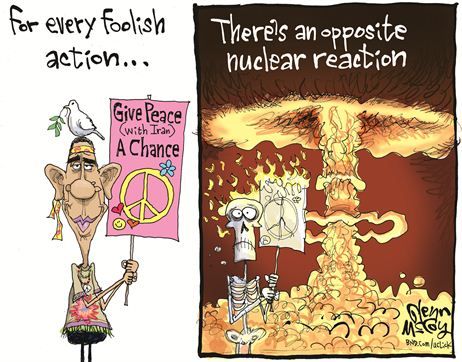
Obama has threatened to veto any legislation that would keep sanctions on Iran until and unless the threat of it becoming nuclear-armed is lifted. Could it be any clearer that Obama wants Iran to become nuclear armed? Do we hear protest from the Republicans? Are they launching campaigns to inform the public, to rouse awareness, indignation, protest? Not that we’ve heard.
Democrats are urging Obama – not that he needs much urging – to bypass Congress and rule by executive order. Republican outcry?
In the middle of last year, Attorney General Eric Holder was held in criminal contempt by the House for refusing its demands to turn over documents relating to his “Fast and Furious” gun-running operation. He still hasn’t complied. Are the Republicans letting him get away with it?
Health and Human Services Secretary Kathleen Sebelius – she who is in charge of making the implementation of the “Affordable Care Act” go so smoothly – has been stonewalling a congressional investigation. Are the Republicans letting her get away with it?
Have the Republicans decided to do nothing until it’s time for another one of their insipid number to stand – if a wobbly stance on all issues can be called “standing” – for the presidency in 2016?
What would a Republican do if he got into the White House? Who knows?
*
This is part of our Facebook summary of an article by Thomas Sowell on the need for Republicans to SPEAK:
The first time I saw New Jersey Governor Chris Christie on television, a few years ago, my first reaction was astonishment: “A talking Republican!” It would scarcely have been more astonishing if there had been a talking giraffe. For reasons unknown, most Republican leaders seem to pay very little attention to articulation – certainly as compared to leading Democrats, who seem to pay little attention to anything else. Governor Christie is in a class by himself when it comes to Republicans who can express themselves in the heat of political battle. When it comes to policies, I might prefer some other Republican as a 2016 presidential candidate. But the bottom line in politics is that you have to get elected in order to have the power to accomplish anything. It doesn’t matter how good your ideas are, if you can’t be bothered to articulate them. The fact that Christie is the current frontrunner for the Republican presidential nomination in 2016 – and is ahead of Hillary Clinton in the polls – makes him a target for a partisan media. Given that blatant partisanship, the need for a Republican candidate in 2016 who can make his case to the public, in spite of the media, is especially acute – even though it is much too early to try to predict who that candidate will be. At least Governor Christie has provided an example of the kind of articulation that is needed – indeed, imperative – if the Republicans are to have any chance of rescuing this country from the ruinous policies of the past few years.
The Obama administration promotes race discrimination in schools 14
The attorney-general Eric Holder infamously refused to prosecute Black Panther intimidators at a polling place in 2008, and became irritated when questioned about his leniency. Defending them, he called them “my people”.
“His people” – by which he means black people – must not, it seems, be held as responsible for breaking the rules as other people.
That a US attorney-general should favor discrimination under the law, and practice it, is outrageous.
There was too little outrage, apparently, over the Black Panther incident to make him reconsider. Now he wants black children to be treated differently from others when they break the rules or behave intolerably at school.
This is from National Review, by Roger Clegg:
The Education and Justice Departments of the Obama administration today issued extensive joint guidance to K–12 schools on student discipline and, in particular, on how the administration will determine if school-discipline policies are discriminatory on the basis of race or ethnicity. …
On the grounds of needing to make sure that punishment is not meted out unfairly, the DOJ is asking for punishment to be meted out unfairly.
Predictably, the administration promises to be extremely aggressive in using the “disparate impact” approach to its civil-rights enforcement — that is, in ensuring that school-discipline policies that have disproportionate results across races are severely scrutinized.
It’s a fair question whether the federal government in 2014 needs to be micromanaging schools to ensure there is no actual discrimination, but certainly it’s a bad thing that the administration is going to be insisting on racial proportionality. …
Which is to say, even if black students misbehave more than others, they should not be punished more than others.
The idea is absurd, preposterous, STUPID.
The fact of the matter is that not all racial and ethnic groups (not to mention boys versus girls) are equally likely to be discipline problems. There are a variety of reasons for this, but I will just note here what is probably the main one. There are huge differences among groups in out-of-wedlock birthrates — more than seven out of ten African Americans, six out of ten Native Americans, and five out of ten Hispanics, versus fewer than three out of ten non-Hispanic whites and two out of ten Asian Americans are born to unmarried women — and children growing up in homes without fathers are much more likely to get into all kinds of trouble, including at school.
If schools are pressured to “get their numbers” right in this area, they will either start disciplining students who shouldn’t be or, more likely, will not discipline some students who ought to be.
We anticipate that both those measures will be taken.
If unruly students are not disciplined, the kids who will lose out the most will be well-behaved students in classes with undisciplined classmates, and those well-behaved students are themselves likely to be poor black or Latino kids. Somehow the Left always forgets about them in its eagerness to show compassion. …
It is true that there are difficult issues in the school-discipline area … But it profits nothing to view these problems through a racial lens.
Now look and listen for outrage, for protest, for reminders that the worst form of racism is discrimination under the law. It may be a long vigil.