Götterdämmerung: Jehovah, Jesus, Allah 232
We need to engage the argument raised by Mark Tapson in a review article titled Christianity, Islam, Atheism. It is also the title of a book he is reviewing. We have not read the book, and we trust him to be giving a fair representation of what the author says in it. We examine the ideas as Mark Tapson presents them to us:
Now that the Boston bombers have turned out, contrary to the fervent hope of the left, to be not Tea Partiers but Muslims, the media are spinning the terrorists’ motive away from jihad and shrugging, helplessly mystified, about the “senseless” attacks. And so our willful blindness about Islam continues. Nearly a dozen years after the 9/11 attacks, too many Americans still cling to militant denial about the clear and present danger of an Islamic fundamentalism surging against an anemic Western culture. What will it take to educate them? And once awakened, what steps can we take to reverse the tide?
Good question.
The vicious Boston attack makes these questions and William “Kirk” Kilpatrick’s new book Christianity, Islam, and Atheism: The Struggle for the Soul of the West all the more timely. [The book is] intended not only as a wake-up call to the West about Islam, but also as a practical guide, especially for Christians, to push back against its spread and to countering Islam’s Western apologists.
Christianity, Islam, and Atheism opens with a section titled “The Islamic Threat,” in which Kilpatrick describes the rise of supremacist Islam and our correspondingly tepid defense of Western values.
It is true that supremacist Islam is rising, and that the West is defending its values only tepidly.
Our collapse in the face of Islam, he says, is due in large part to our abandonment of Christianity, which has led to “a population vacuum and a spiritual vacuum” that Islam has rushed to fill.
None of that is true. The West has not yet “collapsed in the face of Islam”, it has just ceded too much ground. By “population vacuum” we suppose he means the shrinking populations of the European countries, which are importing population (the wrong – Muslim – population) to compensate for a shortage of workers, but whose socialist economies cannot provide enough jobs for the immigrants once they’re there.
As for “a spiritual vacuum”, it exists only in the eyes of these Christians who notice that once-Christian Europe has become largely non-religious. Europeans who still want to believe in a skylord have not shown a new fascination with Allah; most of them have stuck to Jesus or the Trinity.
It seems that a lot of prisoners convert to Islam. Some say that’s because they get better food and other privileges that the European authorities have been intimidated into conceding to Muslims. It may be, of course, that the cruel and blood-thirsty god Allah* exerts an irresistible pull on villainous men, but it’s a bit of a stretch to call that “filling a spiritual vacuum”.
“A secular society… can’t fight a spiritual war,” Kilpatrick writes. Contrary to the multiculturalist fantasy dominant in the West today, “cultures aren’t the same because religions aren’t the same. Some religions are more rational, more compassionate, more forgiving, and more peaceful than others.” …
That depends on what historical era you are looking at. Today most Christian sects are usually peaceful. But that hasn’t always been the case, and may not be the case in the future.
As for Christianity being more compassionate, sure it is in theory but again has not always been in practice. And whether compassion is as desirable a value as Christianity insists it is, remains philosophically open to question.
The same can be said of forgiveness. In our view forgiveness is not a very good idea. First, it makes no difference to what has been done. Second, and more important, it is contrary to justice.
As for some religions being more rational than others, all religions depend on faith, not reason. It is impossible to argue that one irrationality is superior to another.
Kilpatrick notes that Christians today have lost all cultural confidence and are suffering a “crisis of masculinity,” thanks to the feminizing influences of multiculturalism and feminism. He devotes significant space to encouraging Christians to, well, grow a pair, to put it indelicately, in order to confront Islam, the “most hypermasculine religion in history”:
“On the one hand, you have a growing population of Muslim believers brimming with masculine self-confidence and assertiveness about their faith, and on the other hand, you have a dwindling population of Christians who are long on nurturance and sensitivity but short on manpower. Who seems more likely to prevail?”
We take his point. We would be happy to see well armed muscular Christian men marching to war – literally, not figuratively – against Islam.
Kilpatrick devotes a chapter to “The Comparison” between Islam and Christianity, in which he points out that Christians who buy into the concept of interfaith unity with Muslims would do well to look more closely at our irreconcilable differences instead of our limited common ground; he demonstrates, for example, that the imitation of Christ and the imitation of Muhammad lead a believer in radically different directions.
Again, not always. Leaving aside the question of whether Christians killing other Christians and non-Christians believed they were acting as their Christ would have acted in the same circumstances, there were centuries during which multitudes of Christians “imitated Christ” by rejecting this world and deliberately seeking hideous martyrdoms. Some still do. As Muslims do.
In “The Culture War and the Terror War” section, Kilpatrick notes that Christianity is on the losing side of the many fronts of our own culture war, and this doesn’t bode well for the West’s clash with a resurgent Islam. An obsession with the shallow, ephemeral distractions of pop culture isn’t helping to shore up our cultural foundations. “Our survival,” he writes, “hinges not on generating a succession of momentary sensations, but on finding narratives that tell us who we are, where we have come from, and where we are going”:
“Our ability to resist aggression – whether cultural or military – depends on the conviction that we have something worth defending: something that ought to be preserved not only for our own sake but also for the sake of those who attack us.”
Yes. But that something doesn’t have to be the irrational beliefs and moral sentimentalities of Christianity. It could, for instance, be one’s country. And for Americans that could mean the high values that America was founded to embody, above all individual freedom under the law.
In the section “Islam’s Enablers,” Kilpatrick addresses the multiculturalists, secularists, atheists, and Christian apologists for Islam whose intellectual influences have contributed to the moral decline and Islamization of the West. In a chapter with the great title “Multiculturalists: Why Johnny Can’t Read the Writing on the Wall,” Kilpatrick comments on the indoctrinating impact of multicultural educators and their whitewashing of Islam and denigration of our own culture:
“[O]ur students would have been better served if they had spent less time studying the Battle of Wounded Knee and more time studying the Battle of Lepanto, less time understanding the beauty of diversity and more time understanding the misery of dhimmitude.”
We wholly agree with this statement. We too see multiculturalism as as an evil. We see Christian apologists for Islam as fools. But how are secularists and atheists – as such – contributing to the moral decline of the West? Mark Tapson does not tell us, and we wonder if the book does.
Finally, in “The Cold War with Islam,” Kilpatrick is pessimistic of our desire to win the hearts and minds of “moderate Muslims.” He examines at length just what that label actually means, and then notes that such a strategy isn’t an especially helpful one:
The promotion of the moderate myth is counterproductive because it misleads the West into thinking that its problem is only with a small slice of Islam and because it strengthens the hand of traditional Islam, which is the source of radicalism, not the solution to it.
Again,we secularists-and-atheists agree.
Then comes this:
What are his recommendations for mounting a defense of our values against the aggressive spread of Islamic ones?
Reviving the commitment to our own Judeo-Christian values for starters, and then, “instead of a constant yielding to Islamic sensitivities, it may be time for some containment. Sharia… should not be allowed to spread through Western societies.” He touches on immigration, noting that it’s a problematic issue but suggesting that it’s reasonable to question the motives and agendas of immigrant groups. The message we must send? “Islam will not prevail. The West will not yield. You must accommodate to our values and way of life if you choose to live among us.”
As for going on the offensive, “instead of making excuses for Islam… we should be devoting our energies to exposing its hollowness,” relentlessly sowing the seeds of doubt among Muslims and encouraging them to abandon the faith.
In all of which we heartily concur except “reviving the commitment to our own Judeo-Christian values”. To which we will return.
Finally, there is this:
Taking that to the next level, Kilpatrick urges Christians to undertake the daunting task of mounting a widespread evangelizing of Muslims, luring them to Christianity with the liberating message of the Gospel. He concedes that this is a long-term strategy and we have no time to lose, but “both Islam and the left stand on very shaky ideological ground… Christians should take courage from knowing that in this war of ideas, all the best ideas are on their side.”
Yes, Islam and the left do stand on very shaky ideological ground. But so does Christianity. Its theology to start with is so super-absurd that it’s a wonder the early Christians managed to sell such a bill of goods even to ignorant slaves and women in the declining years of the Roman Empire.
But what are the moral-philosophical ideas of Christianity? Let’s look at a few of them, the ones that contemporary Christians commonly say they hold.
To love all mankind? Impossible. An encouragement to hypocrisy.
Forgiving wrongdoing? Unjust. Kindness to the guilty is cruelty to the righteous.
Loving the sinner while hating the sin? A refusal to hold individuals responsible for their actions.
Acting humble? Self-abasement is an act of pride, not humility. Pride is not bad, but dissimulation is.
Teaching Christian theology and mythology as “the Truth”? Not only wrong but self-defeating, as doctrines were never even settled, disputes over them being the cause of wars and persecution throughout Christian history.
Omitted from the discussion in the review article is the fact that multitudes of Christians are also devout leftists. While it is true that the left is coddling and kow-towing to Islam, it is also true that Christian churches are teaching Marxism, often under the name of “liberation theology”.
To speak of a “Judeo-Christian” tradition is to ignore the hideous fact that Christendom has been actively persecuting the Jews from the time its gospels were written. What is meant is that Christianity, after some initial hesitation, accepted part of the Jewish moral code. But citing a “Judeo-Christian tradition” ignores the fact that Christianity was a revolt against Judaism, and owes more to Greek mysticism and cosmogony, Greek other-worldliness, and Greek religious rites – the unrespectable side of classical culture – than it does to Judaism. It also ignores the thousand years of darkness that Christianity brought down on Europe. Europe owed its greatness not to a “Judeo-Christian” tradition, but to the classical enlightenment Christianity eclipsed, and its eventual rebirth.
We too would like the West to be true to the values and practices of its highly evolved civilization, which we would name not as compassion, forgiveness, charity, love, but as freedom, democratically elected government, law and order, tolerance, reason, the pursuit of science, and an endless striving to make human existence happy, long, informed, exploratory, and innovative.
Its passed time that those old bug-a-boo superstitions, shrouded in the cobwebs of the ages, were swept away.
Enough of Jehovah, the sometimes over-vengeful, sometimes just, tribal-chief type of tyrant.
He was dropped by the Christians, though they might pretend that he somehow weakened and mutated into their God the Father or dissolved into the whole of their mystical Greek-style Triune Godhead. As God the Father he’s been so inconspicuous as to be best pictured dozing if not comatose these last two thousand years. Enough of him.
Jesus the Christ, whether as plump European baby, or as golden-curled Caucasian male model in a full-length white nightgown, or as a tortured body executed for sedition by the Romans on a wooden cross, or as well-nourished judge seated on a stump with a cloud for a footstool condemning multitudes to Hell, has nothing of interest to offer enquiring minds. Enough of him.
As for Allah with his side-kick Muhammad – the savage bully and his mouthpiece – he could be dispelled with more certainty and speed if the West would give up religion, and all respect for religion as such.
The downfall of the gods began quite some time ago and is overdue. (No nod to Nazism-inspiring Wagner should be inferred.) They – the gods – should all have disappeared in the Enlightenment. But they’ve been allowed to hang about far too long. Away with them.
Let the West defend itself with confidence in its intellectual, secular-moral, economic, and military superiority; with guns, drones, Specter bombers, and nuclear war capability; with science, technology, intelligence, and the Constitution of the United States; and always above all with unrelenting critical analysis of all ideas.
* Quotation from the linked source: “There are 493 passages that either endorse violence or talk about the hatred of Allah for the infidels, meaning all non-Muslims. The Quran is a book mainly concerned with how Muslims are to think and act towards those outside of Islam; that is, either kill them or force them to live as second-class citizens and pay [special punitive] taxes (Jizya).” It explicitly commands Muslims to “kill the infidel” (eg. Koran 9:5). It prescribes atrocious punishments for such “crimes” as adultery, homosexuality and apostasy. It is a manual of instruction in barbaric aggression.
The conservation of liberty 277
At the Conservative Political Action Conference (CPAC) yesterday, March 14, 2012, two potential leaders of the Republican Party described their visions of the Party’s future. (Videos of their speeches in full here.)
We quote from a report /opinion column in Time magazine:
The back-to-back pairing of Rubio and Rand was seen as the most significant matchup of the annual conference, pitting two likely 2016 Republican contenders before the party’s conservative base. The result pointed to the growing schism in the Republican Party between resurgent libertarians and more traditional Republicans.
The two men – Paul age 50, Rubio just 41 – laid out divergent visions of an inclusive Republican Party. Rubio called for a focus on economic opportunity and a muscular role overseas. Paul called for a reduction in the size of the U.S. government … [and for] the Republican Party to shift away from neoconservative foreign policy.
Actually, Paul did not “call for the Republican Party to shift away from neoconservative policy”. At least, not on this occasion. “Neoconservative foreign policy” means “the US acting in the world at large, including militarily”. The phrase also implies criticism of President Bush’s foreign policy which some libertarians and the Left believe was unduly influenced by “neoconservatives”. Time’s use of the word may convey, as some libertarians have intended it to convey, a flicker of antisemitism (though Rand Paul would almost certainly deny that he ever intends any such thing).
With almost all of what Rand Paul said we agree:
He warned that the Republican Party is “encumbered by an inconsistent approach to freedom”.
“The GOP of old has grown stale and moss-covered — I don’t think we need to name any names, do we?” he said, though the target, Sen. John McCain, was clear.
‘The new GOP,” Paul said advocating for … a smaller government …, “will need to embrace liberty in both the economic and the personal sphere. If we’re going to have a Republican Party that can win, liberty needs to be the backbone of the GOP.”
He pledged to introduce a budget in the coming weeks to balance the budget in five years that would also slash the income tax in half, and create a flat tax at 17 percent.
The contrast between the pair couldn’t be more obvious or consequential for the party struggling to remake itself after two straight presidential defeats.
On foreign policy we agree with Marco Rubio. In general we like Rand Paul’s ideas.
An unavoidable question is: could a more libertarian Republican Party still be the party of conservatism?
Roger L. Simon, writing at PJ Media, considers the question.
He starts on a personal note:
Last month my ninth-grade daughter attended a conference for the Junior State of America. Almost none of the high school students, she told me, caucused with the Republicans. A throng went to the libertarians.
He makes the same criticism of libertarians as we do:
I can’t totally identify as a libertarian, since I find some of their more extreme views silly. (Someone does have to pay for the interstate highway system. And Islamic jihadists are quite serious about a world caliphate. Declaring ourselves the purest of free marketers and rolling up the gangplank will not deter them in the slightest. In fact, it will only encourage them.)
All this is the long way around to saying that the problems creating the current dissension [among conservatives] stem in part from the word “conservative” itself. It seems mired in the past — even when it is not. …
Young people particularly (and even some older folks like myself) like to see themselves as oriented toward the future. …
What should conservatives do? Declare themselves to be “classical liberals,” which many are? That seems a bit academic.
Whatever the case, new terminology should and must be found. And whatever it is, it should be forward looking. …
Conservatives and libertarians — whatever they are now called — should market themselves as the party of the future. Respecting the Constitution is important, but something more than that is necessary.
We don’t think the word “conservative” needs to be replaced. Not in America. The United States was founded on the ideal of liberty. It is supremely important that it stays that way. An American conservative is someone who believes in liberty and will act to keep his country and everyone in it free. (A point implied by Marco Rubio in his speech.)
Respecting and defending the Constitution is vital to that end. If more is needed, it is in pruning away dead wood rather than tacking on “something more”.
Conservatives who drag in extraneous ideas – religion and stuffy views on sex, marriage, and drug control – are the element needing to be changed.
It is up to a new generation of Republican conservatives to effect the change.
*
There has been criticism of this year’s CPAC which we think is justified:
This is a condensation (which we quote from our own Facebook page) of an article by Robert Spencer, the indispensable expert on Islam. Read the article itself here for the author’s full explanation of why he is and yet is not a conservative.
I am generally considered to be a conservative. It is a label I have used myself, as a way of distinguishing my position from that of the liberals and Leftists who have generally sold out to the jihad, so blind in their hatred of Western civilization and the United States of America that they eagerly cast their lot with the foremost enemies of both. Nonetheless, for all that, I am not a conservative. Mitt Romney is a conservative. He called for the creation of a Palestinian state and said that “jihadism” has nothing to do with Islam. Grover Norquist is even more of a conservative than Mitt Romney. His conservative bona fides are impeccable as the leader of Americans for Tax Reform, but he also has extensive ties to Islamic supremacists, supporters of Hamas and other terrorist organizations that are sworn enemies of the United States and our ally Israel. So I must not be a conservative. Then what am I? I am an advocate of freedom: of the freedom of speech, of the equal treatment of all people under the law. Consequently, I am a foe of the global jihad and Islamic supremacism, which are enemies of both those principles. I know that there are many others like me, but neither party seems interested in us right now, and neither does the conservative movement, such as it is. It is time for a new movement, a genuine movement of freedom, one that is not compromised, not beholden, and not corrupted. Are there enough free Americans left to mount such a movement? That I do not know. But I do know that if there aren’t, all is lost, and the denouement will come quickly – more quickly than most people expect.
We sympathize with Robert Spencer’s position. We are equally exasperated by Romney’s and (far worse) Norquist’s position vis-a-vis Islam and jihad.
But why should they be allowed to define what conservatism is?
We define it as loyalty to the Constitution; to five core principles; and above all to the ideal of freedom on which the USA was founded.
The five core principles of our conservatism are: individual freedom, small government, low taxes, the free market, strong defense.
Islam is the enemy waging a war of conquest against America. How conservative can Americans be who do not even acknowledge that that is the case?
It’s past time for real conservatives to fight back with passion against its enemies: Islam, and the pro-Islam anti-America Left which managed to get one of its own elected to the presidency.
Environmentalism versus Conservation 60
On our Facebook page, Leila Howell Cook writes:
I would like to see someone write a good post on the differences between conservation and environmentalism because I think too many people consider them one and the same and they’re not. I don’t think there is anyone that considers taking care of our natural resources a bad idea. If we want it there for use in the future, especially for our children, then we have to preserve it now. That concept goes back as far as human time, I think. It just makes good sense to take care of what is around us and to try and not misuse it. Environmentalism is a politically driven movement that uses as its facade the concept of conservation but only as a smoke screen for a bigger agenda. To me, providing incentives for companies to adopt practices that don’t pollute is much more positive than limiting commerce. You catch more flies with honey. Educating the public on why they need to be mindful of resources and the positive benefits it provides is much nicer than being shamed into it. Education has always proven to offer the most progress in society – not the government acting as the mean nanny.
As we’re in full agreement with her opinion, and as she asks …
I don’t suppose the Atheist Conservative would want to write one, would you?
… we take up her suggestion.
*
Conservation is a conservative cause.
But conservation of what exactly?
We speak of conserving what has been achieved by our civilization: ideas and inventions from classical Greece and Rome, from the Enlightenment, from the Industrial Revolution, from our own Age of Science and the Computer and the Internet; and what we hold to be the greatest product of history, the idea of individual liberty under the rule of law realized in the establishment of the United States of America.
But the subject in hand is conservation of the natural environment.
Russ Harding, director of the Property Rights Network at the Mackinac Center for Public Policy, a research and educational institute headquartered in Midland, Michigan, wrote an essay in October, 2008, in which he came to the conclusion that conservationists and environmentalists viewed the relationship of human beings and nature so differently, it’s hard to see how they can come to any agreement or act together to look after the environment.
His essay is titled Conservationist or Environmentalist? Here’s an extract:
The impetus for the conservation and environmental movements may be similar, but the two movements have developed distinctly different value systems, the result of very different world views.
Conservationism, properly understood, employs traditional values of environmental stewardship. A good steward takes care of what has been entrusted to him or her, thereby leaving an inheritance for the next generation. This worldview allows that it is ethical to employ natural resources for the betterment of humankind, as long as they are properly cared for and managed with a concern for future generations.
It is permissible to cut trees, for example, as long as new ones are planted in their place.
Similarly, wildlife and fish can be harvested as long as they are left in sufficient numbers to ensure future populations.
Humanity is seen as an integral part of the ecosystem rather than an intruder in the natural world.
By contrast, the worldview of many modern-day environmentalists is much different. The mindset of such adherents is pantheistic – in which nature is deified and worshipped while the welfare of humans is prioritized beneath the animal and plant kingdoms and other aspects of the natural world.
According to this worldview, humans exist separate from nature and act immorally when they disturb or disrupt nature. Even the slightest disturbance – such as cutting and replanting trees – represents a violation of nature by humans.
But –
Everything man does impacts the earth.
So let’s try conservationism. Conservationism recognizes that mankind is on the earth and is part of the system. It asks that we think before we slash and burn a rain forest in the Amazon and seeks to find ways of preserving forests and people.
The differing worldviews between conservationists and environmentalists makes agreement on environmental and natural resource public policy all but impossible. …
When clean air, water and land are not as important as protecting the sanctity of nature from human intrusion, agreement on practical solutions to real environmental threats becomes difficult. …
Let us hope that the traditional worldview of the conservationists prevails. A future based on the environmentalist worldview is too bleak to contemplate”
There are environmentalists who believe that the “health” of the planet requires the total elimination of the human race. (See our post Fresh wild raw uninhabited world, January 2, 2012.)
No ideal could be more radical. It is true nihilism. Those who hold it fail to understand that if there are no human beings, if there is no human consciousness, not only is there is no “health” or “sickness”, there is no “earth”, no “nature”. These are concepts, and (as far as we know) ours is the only conceiving consciousness in the universe. We are the namers and arrangers of our world, the inventors and granters of meaning and value. As well as using and nursing the physical world and other beings that it contains, we endow it for our kind with ideas and creations: language, knowledge, explorations, music, mathematics, inventions, artifacts, commerce, laws, institutions, philosophies, history, fantasies (including gods), and jokes.
To extreme environmentalists all that counts for nothing. Pfui! Away with it!
For the milder sort, we may exist as a species but in small numbers, disturbing the wild as little as possible, content to be little more than food for beasts or worms.
Environmentalists with their contempt for humanity are devotees of Leftism. They are not sure whether they want to control us in order to foster wild nature, or use the pretext of caring for wild nature in order to control us.
Conservatives are the real conservationists. A good conservative is a good conserver. He practices good stewardship by looking after, in his time, in his turn, the home he inherited and will hand on to the generations coming after him. The Greek word for a Home is Oikia, from which we get our words economy and ecology. Most of us want the house we live in to be pleasantly clean and in reasonable order. We want the greater Oikia wherein we dwell, the natural world that sustains us, to be pleasant too. We want the air we breathe and the water we drink to be fresh, the soil to be fruitful, the climate benign.
It’s enough. It’s good. And our huge planet, largely unpeopled, is not only oblivious to our doctrines and feelings, but also not much altered or long harmed by what we do.
Sabotage 58
John Brennan, picked by President Obama to head the CIA, has his Senate confirmation hearing today.
Andrew C. McCarthy writes at PJ Media:
A country that was serious about its national security would never put John Brennan in charge of its premier intelligence service.
Of course, it is by no means clear that the United States is any longer a serious country in this regard. Serious countries do not fund, arm and “partner with” hostile regimes. They do not recruit enemy sympathizers to fill key governmental policy positions. They do not erect barriers impeding their intelligence services from understanding an enemy’s threat doctrine … All of these malfeasances have become staples of Obama policy, under the guidance of Brennan, the president’s counterterrorism guru.
Still, the installation of a Beltway operator whose métier is misinformation as director of central intelligence would be an epic mismatch of man and mission. It would expand unseriousness to new frontiers of self-inflicted peril.
The reason is as elementary as it gets: The purpose of intelligence is to see what your enemy is trying to hide, to grasp how your enemy thinks, and how he cleverly camouflages what he thinks. That, to be certain, is the only security against stealthy foes who specialize in sabotage, in exploiting the liberties that make free societies as vulnerable as they are worth defending.
Mr. Brennan, to the contrary, is the incarnation of willful blindness. His tenure as Obama’s top national security advisor has been about helping our enemies throw sand in our eyes and thus enabling the sabotage. …
Sabotage is the [Muslim] Brotherhood’s defining practice. Indeed, “sabotage” is the word the Brothers themselves use to describe their work. It appears in an internal memorandum, which elaborates that the organization sees its mission in the United States as “eliminating and destroying Western civilization from within.” Besides that long-term goal, the Brotherhood’s network of American affiliates have pursued the more immediate aim of materially supporting Hamas, a formally designated terrorist organization to which the provision of material support is a felony under federal law.
None of that is new. It was not merely well known but had been proved in court by the Justice Department a year before Obama took office. I refer to the Justice Department’s 2008 Hamas financing prosecution, the Holy Land Foundation case. Yet, counterterrorism czar Brennan remains undeterred, a driving force of the Obama administration’s “Islamic outreach” – a campaign to give Islamist organizations influence over U.S. policy. That several of those organizations were proved in the HLF case to be members of the Muslim Brotherhood’s American network is clearly of no moment.
Two such organizations are the Council on American-Islamic Relations (CAIR) and the Islamic Society of North America (ISNA). They were among a slew of Islamist groups who wrote to Brennan in October 2011 to demand a purge of information about Islamist ideology that was being used to train U.S. intelligence and law-enforcement agents. Much of that information was developed in federal investigations that have led to the convictions of violent jihadists. Nevertheless, the Obama administration has slavishly complied …
The training materials the Islamist groups insisted be removed include documentation of the fact that terrorism committed by Muslims is driven by an ideology rooted in Islamic scripture. …
Maybe the State Department and the White House press office have the luxury of trading in convenient fictions in order to reduce international tensions. Not intelligence agencies. The point of intelligence – a bedrock of national security – is to see the world as it is, not as we wish it to be.
Here is how it is: Islamic supremacism, the sharia-based ideology of Islamists, is an interpretation of Muslim doctrine that is entirely mainstream among the world’s Muslims. That is why Islamists are winning elections in the Middle East even as they are found aligning with violent jihadists. Islamic supremacism is, in fact, widely promoted by the Brotherhood, and by such tentacles of its American network as CAIR and ISNA, when they are not otherwise deceptively disavowing its existence.
This Islamist ideology is incorrigibly anti-Western and anti-Semitic. It is deeply hostile to principles of equality and individual liberty (free speech, freedom of conscience, privacy, economic freedom, etc.) that undergird our Constitution, the American conception of civil rights, and the West’s conception of human rights. Understand Islamist ideology and you will readily understand the ferocity of Islamic resistance to American efforts to promote democracy in the Middle East – not merely jihadist resistance but broad Islamic resistance.
Yet, in a propaganda campaign reminiscent of those waged by the Nazis and the Soviets, Islamists and their fellow travelers (Brennan-types who might be thought of as “anti-anti-Islamists”) purport to be champions of human rights. When it suits them, they even feign reverence for individual liberties (particularly when it comes to the rights of Muslim in America … but don’t you dare ask them how non-Muslims fare in, say, Saudi Arabia).
The counter to such a propaganda campaign is a job for intelligence agencies. The point of having a sprawling intelligence community on which American taxpayers annually lavish $55 billion – far more than the vast majority of countries spend on national defense – is precisely to see through the deceptions of those who mean us harm, to perceive the threats against us for what they are. That the competent performance of this essential function may be fraught with political complications is supposed to be a challenge for our politicians, not our intelligence agents. The latter’s mission of unearthing hidden and often excruciating truths is hard enough.
Brennan’s agenda is the antithesis of the intelligence mission. His goal has been to portray our enemies as a small, unthreatening fringe of charlatan “violent extremists,” who kill wantonly and are unconnected to any “legitimate” Islam. Thus, he maintains for example that the only “legitimate” interpretation of the “tenet of Islam” known as jihad is: a “holy struggle … to purify oneself or one’s community.”
Even taken at face value, Brennan’s assertion is absurd. There is between Islam and the West no common understanding of the good, and thus no consensus about “purity.” In Islam, to “purify” something means to make it more compliant with sharia, Islam’s legal code and societal framework. Sharia is anti-freedom and anti-equality, so to purify oneself in an Islamic sense would necessarily mean something very different from what we in the West would think of as struggling to become a better person.
But there is an even more fundamental reason not to take Brennan’s remarks at face value: they run afoul of what mainstream Islam itself says about jihad. … It is quite straightforward on the matter: “Jihad means to war against non-Muslims.” …
In Brennan’s world, there is … no need to fret over anti-American terrorists who return to the jihad with alarming regularity once they are released from Guantanamo Bay. After all, Brennan observes, common criminals have high recidivism rates, too. Mass-murderers, pick-pockets … as they say in the administration, “What difference does it make?”
And then there’s the skill of offending our friends while enabling our enemies. Brennan refers to Jerusalem, the Israeli capital, as “al-Quds.” That is the name used by Islamists who reject the Jewish state’s right to exist, who claim Jerusalem and the rest of Israel as their own. …
Brennan’s sense of outrage, unnoticeable in response to slights against a faithful U.S. ally, is instead reserved for the “ignorant feelings” of Americans riled by jihadist attacks against our country. For Brennan, Americans’ anger at Islamists, our perception that the ideology that breeds terrorists is just as much a problem as the terrorists themselves, is “Islamophobia” – a smear cleverly concocted by Islamists to deflect examination. Brennan claims to have seen Islamophobia rear its racist head in the public reaction to the Fort Hood attack – the worst jihadist mass-murder in America since 9/11, but one the Obama administration prefers to think of as “workplace violence”.
Brennan claims that Hezbollah, Iran’s Lebanese terror militia, is a “very interesting organization,” whose “moderate elements” have evolved it from “purely a terrorist organization” into a political party whose members now serve in the Lebanese government. This, again, is rose-tinted nonsense, bespeaking breathtaking ignorance about the history and operations of jihadists who, until 9/11, had killed more Americans than any other terror network. … Its objective … is to advance the Islamic revolution at the expense of non-Muslims by any method that shows promise under the circumstances.
Hezbollah is part of the Islamist vanguard waging a global campaign against liberty. But with their Brennan blinders on, the Obama administration chooses not to see it. They see “moderates” committed to participating in a “political process.” This same thinking has led the administration to issue a visa to an admitted member of the Blind Sheikh’s terrorist organization (the Islamic Group) so he could come to the White House with other newly minted Egyptian “parliamentarians” to discuss U.S. policy in the Middle East.
This mindset also explains why the administration negotiates with the Taliban …
There is no place … for deceiving the American people by politicizing intelligence. That Brennan specialty, an exhaustive effort to miniaturize the threats against our nation and appease the president’s Islamist allies, is the antithesis of what we have a CIA for. …
If intelligence is to be politicized so that we let our guard down, then the United States would be better off with no CIA than with a CIA headed by John Brennan.
Andrew McCarthy believes, however, that feeble Republicans will let him be appointed.
Chuck Hagel’s confirmation hearing last week only bolstered concerns that he is utterly unfit to serve as secretary of defense. Yet, some Republicans have announced that they will vote for him anyway, and some others who purport to oppose him have signaled that they have no intention of mounting a filibuster, the only procedure that could derail him. Consequently, they’ve ensured that he will be confirmed. So let’s not kid ourselves: Senate Republicans who will let Hagel take control of the Defense Department, and who just joined Democrats in a 94-3 landslide confirmation of John Kerry – a devotee of Obama’s Muslim Brotherhood empowerment strategy – are not going to put up a fight over Brennan.
Such Republicans are also in the business of sabotage. They sabotage Republican principles. They sabotage liberty, of which the USA was meant to be the political embodiment. Thus they sabotage America.
*
How can all that Andrew McCarthy accurately reports about John Brennan be reconciled with the fact that the policy of going after Taliban and al-Qaeda leaders with drones* is his brainchild?
Come to that, how does President Obama reconcile his generally pro-Islam policies with his endorsement of the drones tactic?
Leaving aside for the moment the rights and wrongs of using drones to target American traitors fighting with the Islamic enemy, the present question is: what makes Barack Obama and John Brennan, both of whom do all they can in every other way to encourage and assist America’s Islamic enemies, so persistently pursue and kill jihadis – and anyone who happens to be with them – with drones?
We are all for eliminating as many of the enemy as possible by all available means. But Brennan and Obama are not. So the question needs an answer.
Theories that answer it are welcome.
So are opinions on the targeting with drones of American traitors abroad.
*There are known US drone bases in Afghanistan, Turkey, Djibouti, the Seychelles, Qatar, the Philippines, the United Arab Emirates, Yemen and Ethiopia.
Private cities and the problem of government 323
This fascinating article is from Canada Free Press, by Kelly O’Connell:
In Honduras, a novel undertaking has been constructed—private cities whose purpose is to maximize safety and happiness (also referred to as “Free Cities”, “Charter Cities”, “Model Cities”, or in Spanish, “RED—Regiones Especiales de Desarollo”, and “Ciudades Modelo”.). This idea is a capitalist’s dream, but a liberal’s nightmare. And in a most fascinating manner, the idea of a privately owned commons has brought to the surface the multifarious contradictions of the modern age—with our continual demand for “liberty” while the deified state grows into a malignant colossus. …
The full 18-member Honduran Supreme Court must still rule on President Lorbo’s agreement. But even if the idea does die in Honduras, private cities—like those modeled in early colonial America, Singapore and India’s old British empire, are still an option for virtuous, libertarian minded souls. …
The real questions raised by the rise of private cities is what is the nature of the city, man, law and moral authority. Specifically, what is the meaning of law and the state? Further, what gives a country moral authority in which to erect statutes, establish courts, prisons and pass and enforce sentences? …
The idea — a city built by private funds, with rules not derived from a state legislature, but the settlement’s founders. Add to that a private security force and strong walls. And so a libertarian entrepreneur answered the call for action:
Last Tuesday, the government signed an agreement with private investors led by Michael Strong—a libertarian entrepreneur and close associate of Whole Foods co-founder and CEO John Mackey—to construct a city-from-scratch in one of at least three special development regions (“las Regiones Especiales de Desarrollo” or “REDs”) scattered around the country. REDs possess the legal right to establish—or outsource to foreign governments and companies as necessary—their own hospitals [for profit], schools, judges, and even police, all independent of Honduran law. …
The REDs are the brainchild of Paul Romer, the New York University economist who has proposed building “charter cities” as a solution to endemic poverty. Romer believes that importing sound laws and policies into small corners of badly run countries will help leaders reform their governments from the inside-out. Honduras certainly qualifies—the original banana republic is still grappling with the political fallout of a 2009 coup while cocaine traffickers have pushed its murder rate to the highest in the world.
In early 2011, aides to Honduran president Porfirio Lobo invited Romer to the capital of Tegucigalpa to make his case to Congress. Within weeks, Congress passed a constitutional amendment granting Lobo’s government the power to create and administer the REDs.
Is it inherently immoral for private citizens to buy land, recruit residents, write their own laws, and then begin operating as a franchise community? If so, why? After all, what is it that makes a city, state or country legitimate? On the alternative, given the socialist direction many countries in the West are following, is it possible that only a self-derived city could chart a course against the political grain here? Or does mankind have to bow and scrape at the feet of the modern government colossus irrespective of whether it is just, moral, or effective—simply because it is called “government”? …
It’s certainly not “immoral” to establish a private city and “operate as a franchise community”. Morality doesn’t come into it.The first question is: will states, will governments – all to a greater or lesser extent in the hands of statists, liberals, collectivists – allow it? Will the Honduran Supreme Court allow it? We wait to see.
If private cities are inherently illegal, what about the foundations of America, which were done along these same lines? Interestingly enough, the debate in the American colonies was over whether an immoral government had the right to dictate to men how to act. The Founders decided it did not. So the question raised is whether immoral modern governments can derail moral private communities? After all, what is a government in the first place?
What would characterize a “moral government”? If by “moral” is meant “democratically elected and not oppressive”, aren’t all governments in actuality oppressive to some degree and so to some degree “immoral”? And if so, is it not because oppression is inherent in the nature of government and therefore inescapable?
We think that even if the answer to that question is yes, state government is nevertheless necessary – to uphold the rule of law and protect the nation from foreign invasion. Which is where we part company with libertarians (while remaining sympathetic to libertarianism) and anarchists.
Certain anarchists declare their position somewhat confusedly on this question:
A group of writers calling themselves Private-Property Anarchists have taken on [ie challenged] the theory that only the state possesses the inherent ability to organize a government or police its citizens. In a most obvious way this makes perfect sense since government will always be assembled from some group of residents who then decide upon rules, structure and powers of government. Why must we assume one group of freely assembled persons are more acceptable than another? Further, with the failure of much of modern government to address basic needs, how can anyone help but try to find a better way to manage the affairs of men? …
Several aspects of law should be mentioned on this issue. The first is that it is a fairly recent development for the state to own all official policing powers. According to Bruce Benson’s The Enterprise of Law, Justice Without the State, the Anglo-Saxon law was fixated on protecting property. Further, with the development of English lex mercatoria, ie mercantile law, much enforcement and many remedies to this day were created for enforcement by private parties.
In fact, even the criminal code was mainly enforced by private parties in the history of Anglo-Saxon law. … Englishmen also resisted public prosecution because “a private prosecutorial system was necessary to check the powers of the Crown. If not so limited the power of criminal prosecution could be used for politically oppressive purposes.”
The great fear in the liberal establishment is that a private system of government and law will be antinomian, that is—lawless and a mere tool for the use of greedy capitalists and megalomaniacs. Yet, the opposite is true. In fact, people allowed to build their own justice systems for their own small city-states are apt to be more motivated to create justice and order than those presiding over the legislatures of far-flung empires.
But to build a justice system, big or small, is to establish government.
American citizens are certainly not pleased with the state of our justice system. For example, Edward P. Stringham in Anarchy and the Law argues, if the American legal system and police powers are so successful, and in effect the only game in town, why do private police, i.e. security guards, outnumber official state police?
The debate over private cities begs the question of what is a government in the first place. Let’s remember Jefferson’s sublime words from the Declaration:
We hold these truths to be self-evident, that all men are created equal, that they are endowed by their Creator with certain unalienable Rights, that among these are Life, Liberty and the pursuit of Happiness.—That to secure these rights, Governments are instituted among Men, deriving their just powers from the consent of the governed,—That whenever any Form of Government becomes destructive of these ends, it is the Right of the People to alter or to abolish it, and to institute new Government, laying its foundation on such principles and organizing its powers in such form, as to them shall seem most likely to effect their Safety and Happiness….But when a long train of abuses and usurpations, pursuing invariably the same Object evinces a design to reduce them under absolute Despotism, it is their right, it is their duty, to throw off such Government, and to provide new Guards for their future security.—Such has been the patient sufferance of these Colonies; and such is now the necessity which constrains them to alter their former Systems of Government.
If critics attack the lack of inherent authority of private communities, what is their basis? If a private city creates a better economy, a more just police and legal system, and a safer environment than public communities—is it not the latter which are truly the immoral and lawless frauds? We do well to ponder the foundation of legitimate, God-given government. This can only be established upon the rule of law, civil rights and respect by the leaders for the consent of the governed—or all we have left is an illegitimate tyranny.
While we cannot fathom what the meaning of “God-given” can be here (it makes no sense at all, even if everyone who founds a nation and everyone in power is a believer in “God”), we see the writer’s point. “Legitimacy” as commonly perceived on whatever grounds does not in itself make for good governance.
What we wonder is: How would the forum, whatever it is called, set up in a private city to “create a better economy” (ie let an economy run itself, we hope) and establish a police and legal system, be different from any other democratically elected government? If the people as a whole retain too much power over it, will it not soon fall apart under the pressures of conflicting expectations and demands? And if they retain too little, won’t it gather power, grow, and become the enemy of the people just as every government does, even those democratically elected?
We are all for private cities. We like the idea immensely. We would like to see them established. We would like to live in one. We don’t see why they shouldn’t be self-governing. We think the government that such property owners would elect stands a good chance of doing a better job of governing than existing governments do. But we do not think that, given the minimum power it would need to be effective, it would be immune from avarice for power, or resist the temptation to find a compelling necessity to expand and oppress. How to prevent that; how to limit the power of government, is the perpetual problem of all democracies, great and small.
The great intellectual revolt against Christian tyranny 35
In a discussion of a book titled Christianity, Islam, and Atheism: The Struggle for the Soul of the West by William Kilpatrick, this passage occurs:
Some atheists have called for a humanitarian response to Islamic violence. For example, Ayaan Hirsi Ali spoke against harsh Muslim practices that defy “universal rights” and called for “promotion of freedom, equal opportunity, and secular values for all.” However, Kilpatrick points out that secular values simply cannot stand up to a totalitarian Islam because the fruits of the Enlightenment (free speech, free press, democracy, reason) depend on the Christian roots. Atheists often claim religion causes the world’s problems and removing such “superstition” will increase respect of humans.
Kilpatrick’s own conclusion is that “ultimately only Christianity can stop Muslim growth”.
To prescribe one religion as a cure for another is like infecting a person with measles to cure his mumps.
But that is not the issue we are engaging now.
The notion that “the fruits of the Enlightenment (free speech, free press, democracy, reason) depend on the Christian roots” is what concerns us here. It has become a standard assertion of Christian apologists, needled by the secularist contention that the Enlightenment was the bright morning come at last after the centuries-long night Christianity had brought down on Europe.
To support the claim, its advocates insist that Christianity stands for and has always stood for individual freedom, hence for free speech and freedom of the press.
Its assertion that all persons are equal “before God” implies – the Christian argument goes – an endorsement of democracy.
As for reason, they claim that although their creed is to be accepted on faith and not subjected to rational analysis, to believe in Christian doctrine and to act according to Christian teaching is reasonable.
It is not hard to dispel these rosy fancies in the court of an impartial judge.
Individual freedom? The medieval Catholic Church was as totalitarian in its tyranny as it could possibly be in its long age of power; and the Calvinists, Lutherans, Anabaptists, Puritans … the Protestant churches in general, crushed and punished the expression of free thought wherever their power was established, as zealously and cruelly as the Catholic Inquisitors. Calvin, for instance, declared: “When the papists are so harsh and violent in defense of their superstitions, are not Christ’s magistrates shamed to show themselves less ardent in defense of the sure truth?”*
Equality in Christendom? Not on the earth of Europe. It wasn’t even thought of.
In terms of power:
[T]he lawlessness and disorders of the Dark Ages led churchmen first to collaborate with secular rulers, and then to seek their subjugation. … [The] Vicars of Christ became indistinguishable from the nobility.**
In terms of wealth:
The everyday dinner of a man of rank ran from fifteen to twenty dishes. … [For the peasants] the years of hunger were terrible. [They] might be forced to sell all that they owned, including their pitifully inadequate clothing, and be reduced to nudity in all seasons. In the hardest times they devoured bark, roots, grass; even white clay. Cannibalism was not unknown. Strangers and travelers were waylaid and killed to be eaten, and there are tales of gallows being torn down … by men frantic to eat the warm flesh raw.***
Reason? As it is not rational to believe in a superhuman Lord of the Universe, it is not reasonable to trust the teaching of his priests.
Furthermore, for centuries –
The Church encouraged superstitions, recommended trust in faith healers, and spread tales of satyrs, incubi, sirens, cyclops, tritons, and giants, exlaining that they all were manifestations of Satan. The Prince of Darkness, it taught, was as real as the Holy Trinity.**** [With that last sentence we concur.]
The Enlightenment, far from being a product of Christianity, was its antidote. It was a revolt against the intellectual arrogance of the Christian ages.
It was a revolution: the quietest, the most important, and the most successful revolution that ever happened. It was a movement of intellectuals who dared to challenge orthodoxy by questioning the dogmatic “truths” of the Christian Churches. Its defiant values encouraged dissent – to the acute chagrin of the Christian powers. It revived classical doubt – the very essence of reason – in European man, and so began the revival of scientific enquiry and experiment. And it inspired the founding of a new nation in America where all citizens would be equal and free under laws they made themselves.
Only where there is doubt is there tolerance. And where there is doubt there is questioning of authority – of popes and cardinals and kings.
Christians argue that American law enshrines laws which occur in the “Christian bible” (by which they mean the Jewish bible, where the proscriptions against murder, theft, and perjury were listed, and which the Church adopted after some initial reluctance). Therefore, they say, this is a debt that the secular law owes to Christianity. But in fact such laws are much older even than the legendary Moses and his engraved tablets (circa 1250 BCE). They are assumed, for instance, by the Code of Hammurabi (circa 1770 BCE).
If the apologists want to sweep all that aside and base their claim on a pure Christianity that pre-dated the corrupt pontiffs, their case is still hard to defend. To quote from our own post, Tread on me: the making of Christian morality (all sources provided in the notes to the essay):
Briefly, but including all salient points, here is Paul’s moral teaching [and thus the first recorded moral teaching of his invention, Jesus Christ, later interpreted and elaborated by the gospel writers]:
We are the filth of the world, the scum, the muck that is scoured from things. The lowest of the low.
Let us abase ourselves; be fools; be humble, and associate with the lowly.
Do only the most menial work for a living.
Bear affliction with patience, even with joy.
You must consider all others to be greater than yourselves.
Love one another, love all. Then you will be harmless and blameless. That is what I ask you to do to make me proud of you.
Present your bodies as a living sacrifice. Bless those who persecute you. Let them do the most evil things to you, and return only good to them. We glory in our suffering. However hard your life is, rejoice and give thanks. Never seek revenge.
Obey the government. Pay your taxes.
Women, be silent in church.
Marry if you must, but I would rather you remained unmarried and chaste as I am.
Pray constantly. Never feast or carouse, and stay sober. Do not commit sexual immorality. Attend quietly to what you must do, and mind your own business. Be patient always, even when you need to admonish those among you who do not work hard enough.
Share all you have so that you’ll all be equal in worldly possessions.
Do all this for the sake of Christ. Because he died for you, because he suffered on the cross for you, you must bear all things for his sake. You belong to him because he bought you for a price.
This comment follows:
It is a morality that demands and glorifies self-abasement and self-abnegation, as a perpetual repayment of a debt imposed on all humanity by Jesus’s “self-sacrifice”.
It scorns talent, disregards personal ambition, forbids individual self-fulfillment.
So when conservative Christians claim – as they often do – that Christianity initiated and promotes individualism, they are plainly wrong. To the contrary: from its inception Christianity has been the enemy of individualism.
It planted the perverse value of subservience in Western culture; a value that was to re-emerge as an ideal in other collectivist ideologies. Paul’s idea that it was greatly good for the individual to subjugate himself to the community contributed even more profoundly to the ideology of Communism than did his doctrine of sharing and equality [in possessions, subjugation and abasement].
A morality that makes cruel and unnatural demands on human nature will nurture hypocrisy and breed despair: hypocrisy because sustained self-denial is impossible, so lip-service is substituted for obedience; and despair because to strive for the impossible is to ensure failure.
Of course there was a backlash against the Enlightenment. The ever present tendency in human nature to let emotion overrule reason asserted itself early in the writings of Jean-Jacques Rousseau, father of Romanticism, grandfather of Socialism, and great-grandfather of Environmentalism. It is through those channels that Christian values flowed into the age of reason, and survive, along with a decrepit Christianity itself, to trouble us now.
* Quoted in translation by William Manchester in his book A World Lit Only By Fire, Back Bay Books, Little Brown, 1993, p 190.
** Manchester pp 40-41
*** Manchester pp 52, 54
**** Manchester p 62
Jillian Becker January 22, 2013
Sharia: the codification of sadism 131

From Bare Naked Islam:
This is the sharia you are now seeing on billboards all over America, telling people that sharia is totally compatible with our Constitutional laws. This is the sharia for which CAIR is spending millions of dollars in court battles against U.S. legislators trying to have it banned in their states. This is the sharia CAIR never talks about in court, because this is the sharia that comes later.
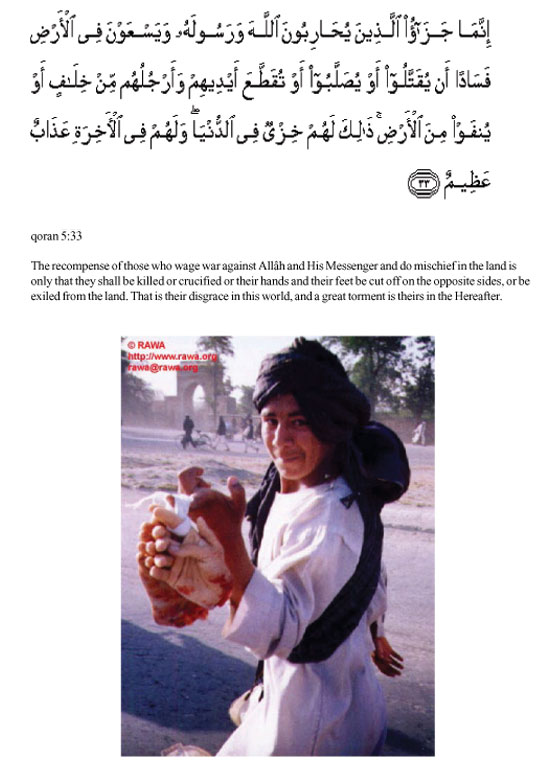
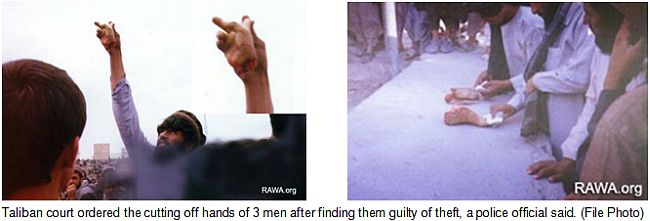

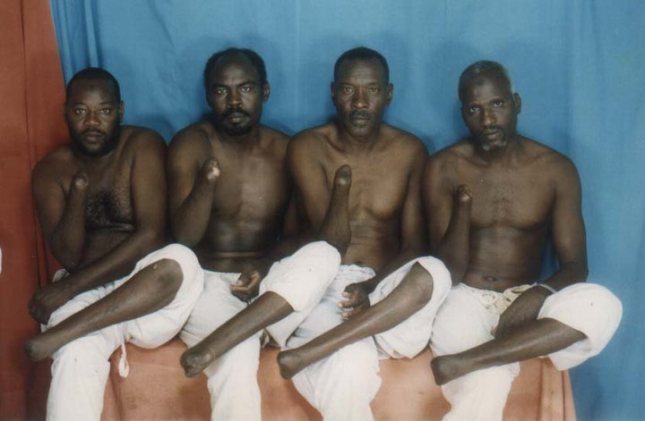

Sharia “the same as the Declaration of Independence” 10
Notice the silly audience laughing agreeably at the propagandist’s little pleasantry about the US being “a sharia compliant state’.
Four men, four years – to disable America? 96
Barack Obama loves Islam. He has members of the Muslim Brotherhood ( MB) advising his administration. He has advanced the MB to power in North African countries. He will not allow the word “terrorism” to be associated with acts of terrorism carried out by Muslims in America. He has persistently strengthened agressive Islam and weakened Islam’s first and main target, Israel. He does all he can to prevent Israel from destroying the Iranian sites where nuclear weapons are being developed to be used against Israel.
He needs men beside him in power who share his pro-Islam and anti-Israel emotion. He needs them in the three departments of government where they can be most effective in carrying out the policies that arise from his intense pro-Islam bias: State, Defense, Intelligence. He has aptly chosen John Kerry, Chuck Hagel, and John Brennan.
Barry Rubin writes (in part):
This trio in power … along with Obama himself could be called the four horseman of the Apocalypse for U.S. foreign policy. …
Their ideas and views are horrible. This is especially so on Middle Eastern issues but how good are they on anything else? True, they are all hostile to Israel but this isn’t the first time people who think that way held high office. Far worse is that they are pro-Islamist as well as being dim-witted about U.S. interests in a way no foreign policy team has been in the century since America walked onto the world stage.
Brennan is no less than the father of the pro-Islamist policy. What Obama is saying is this: My policy of backing Islamists has worked so well, including in Egypt, that we need to do even more! …
They are all stupid people. Some friends said I shouldn’t write this because it is a subjective judgment and sounds mean-spirited. But honest, it’s true. … Smart people can make bad judgments; regular people with common sense often make bad judgments less often. But stupid, arrogant people with terrible ideas are a disaster.
Brennan’s only life accomplishment has been to propose backing radical Islamists. As a reward he isn’t just being made head of intelligence for the Middle East but for the whole world! Has Brennan any proven administrative skill? Any knowledge of other parts of the world? No. All he has is a proximity to Obama and a very bad policy concept. What’s especially ironic here is that by now the Islamist policy has clearly failed and a lot of people are having second thoughts.
With Brennan running the CIA, though, do you think there will be critical intelligence evaluations of the Muslim Brotherhood, Hizballah, or even Hamas? Is the CIA going to warn U.S. leaders about the repression against women, Christians, and moderates? Will there be warnings that Islamists are taking over Syria or reports on Islamist involvement in killing Americans in Benghazi? Can we have confidence about U.S. policy toward Iran?
To get some insight into his thinking, consider the incident in which a left-wing reporter, forgetting there were people listening, reminded Brennan that in an earlier private conversation he admitted favoring engagement not only with the Lebanese terrorist group Hizballah but also the Palestinian terrorist group Hamas. …
Kerry, of course, was the most energetic backer of sponsoring Syrian dictator Bashir al-Assad before the revolt began. Now he will be the most energetic backer of putting the Muslim Brotherhood into power in Syria. Here is a man who once generalized about American soldiers in Vietnam as being baby-killers and torturers. …
As for Hagel, suffice it to say that the embarrassing quotes and actions from him in the past – including his opposition to sanctions against Iran – fueled a response to his proposed nomination so strong that the administration had to back down for a while.
No, it does not suffice to say just that. There is much more to be said (see below).
Obama has been president of the United States for four years. Yet in foreign policy, having some decent and competent people in high positions mitigated the damage.
Did they? How? And who were they, we wonder.
Well, the reins are now loosed; the muzzle is off. …
To get a sense of his thinking, Brennan [wrote] … “If the United States actually demonstrates that it will work to help advance rather than thwart Iranian interests, the course of Iranian politics as well as the future of U.S.-Iranian relations could be forever altered.”
The Obama Administration followed this advice during its first two years with the result being total failure.
[Brennan] also proposes a U.S. policy, “to tolerate, and even to encourage, greater assimilation of Hezbollah into Lebanon’s political system….” This step, he suggests, will reduce “the influence of violent extremists in the organization.”
Of course, Hizballah does not need to stage terrorist attacks if it holds state power …
Rubin is overlooking something here. Hezbollah does hold state power in Lebanon, and it is still a terrorist organization carrying out acts of terrorism.
What Brennan — and the Obama Administration — fails to understand regarding this point. The danger is not terrorism but a dangerous revolutionary movement that becomes even more dangerous if it controls entire states, their resources, and their military forces.
And here we think Barry Rubin’s pessimism doesn’t take him far enough to touch the appalling truth. We don’t think there is a failure of understanding. We read the signs to indicate pretty plainly that Obama wants the revolutionary movement of Islam to “control entire states, their resources, and their military forces”. And their poisonous gases. And their nuclear arms.
*
About Chuck Hagel: this is from Front Page, by Joseph Klein:
Hagel … has espoused a deep kinship with the radical anti-war Left, advocated reckless foreign policy positions such as direct talks with terrorists and their leading sponsor, Iran, and demonstrated a nasty hostility to Israel and to Jews in general. To have this kind of individual serving as the head of the U.S. Defense Department is to severely jeopardize the security interests of the U.S., our ally Israel and the rest of the free world.
Hagel has become the darling of the radical anti-war crowd … [and] is also beloved by Israel-haters and anti-Semites, including the Muslim Brotherhood-affiliated Council on American-Islamic Relations and the Iranian regime’s TV network mouthpiece, TVPress …
Hagel believes that U.S. foreign policy has been skewed too much in Israel’s favor. He ascribed the pro-Israel tilt to the power of what he called the “Jewish lobby,” which he said had the ability to “intimidate” members of Congress. While serving in the Senate, he boasted that he was not sent to Washington to serve as an “Israeli Senator.” This was an obvious swipe at his Senate colleagues who believed in supporting the only true democracy in the Middle East. Hagel was also using the age-old code words of anti-Semites who accuse Jews of dual loyalties. …
In August 2006, Hagel joined only eleven other senators in refusing to write the European Union asking them to declare Hezbollah a terrorist organization. …
Although the terrorist organization Hamas has yet to renounce violence and its covenant to destroy Israel, Hagel signed a letter delivered just days before Obama was to take office for his first term as president urging Obama to talk to leaders of Hamas.
Israel is surrounded by enemies determined to destroy the Jewish state. It is also a strategic partner in our own war against global Islamist jihadists – sharing intelligence, developing state-of-the art body armor used by our troops and anti-missile defense systems that are more sophisticated than our own. Yet we are facing the prospect of a Secretary of Defense who goes out of his way to antagonize our only true ally in the Middle East and who cannot bring himself to treat Hamas and Hezbollah as the terrorist enemies of all freedom-loving countries that they surely are. …
Even if Hagel had not shown the kind of antipathy towards Israel that has won him praise from the Muslim Brotherhood-affiliated Council on American-Islamic Relations and earned him the “anti-Israel” title on Iranian state TV, Hagel would still be a complete disaster as Secretary of Defense. He is caught in the time warp of the Vietnam syndrome, the national defense paralysis that stemmed from what Ronald Reagan once described as “feelings of guilt as if we were doing something shameful.” …
How would Chuck Hagel’s case of the Vietnam syndrome play out in his dealing as Secretary of Defense with the Iranian nuclear threat? In one word, appeasement. Like Obama, Hagel has called for “unconditional” talks with Iran. … He has opposed economic sanctions … He was one of two senators to oppose the Iran-Libya Sanctions Act in 2001. In 2008, Hagel was reported to have been “solely responsible” for blocking a bill that would have tightened economic sanctions in Iran …
Hagel appears willing to accept a nuclear-armed Iran as a fact of life that we will just have to learn to live with. … Hagel also thinks that the United States should offer to back off any declaratory support for regime change in Iran. While in the Senate, [he] even voted against designating the Iranian Revolutionary Guard Corps as a terrorist organization. …
Before President Obama officially announced his nomination of Chuck Hagel for the position of Secretary of Defense and John Brennan for director of the Central Intelligence Agency, Obama said that protecting the security of the American people was his number one priority. …
Protecting the American people from what? From their own Constitution? From liberty?
*
About John Kerry: this is from Discover the Networks:
After his discharge from the Navy in early 1970, Kerry became a prominent figure in the anti-America, pro-Hanoi crowd of antiwar protesters personified most visibly by Jane Fonda. Like so many of those activists, Kerry publicly maligned U.S. soldiers. He became a spokesman and organizer for the group Vietnam Veterans Against the War (VVAW) …
During an unsuccessful run for Congress in 1970, Kerry, depicting the United States as a country whose aggressive impulses needed to be reined in by outside forces, said: “I’m an internationalist. I’d like to see our troops dispersed through the world only at the directive of theUnited Nations.” …
In May 1970, Kerry met with North Vietnamese/Viet Cong delegations at the Paris Peace Talks, where they discussed a variety of proposals—especially the eight points enumerated by the top [North] Vietnamese delegate, Nguyen Thi Madame Binh. Kerry strongly advised the U.S. Senate to accept those points.
At that time, Kerry himself acknowledged that his visits to Paris were “on the borderline of private individuals negotiating, et cetera.” This was significant because a federal law known as the Uniform Code of Military Justice prescribed severe punishment (including, in some cases, the death penalty) for any person who “without proper authority, knowingly harbors or protects or gives intelligence to or communicates or corresponds with or holds any intercourse with the enemy, either directly or indirectly.”
So what happened? Why no death penalty for John Kerry?
During the ensuing months, Kerry became increasingly strident in his insistence that the U.S. accept Madame Binh’s (i.e., the Viet Cong’s) peace proposals. VVAW went so far as to sign a “People’s Peace Treaty” (reportedly drafted in Communist East Germany in December 1970), whose nine points were all extracted from a list of Viet Cong conditions for ending the war. Kerry fully supported this treaty. …
Kerry marched alongside many revolutionary Communists. Exploiting his presence at such rallies, the Communist publication Daily World prominently published photographs of Kerry addressing anti-war protestors, some of whom were carrying banners with portraits of Communist Party leader Angela Davis. Openly organized by known Communists, these rallies were typified by what the December 12, 1971 edition of the Herald Traveler called an “abundance of Vietcong flags, clenched fists raised in the air, and placards plainly bearing legends in support of China, Cuba, the USSR, North Korea and the Hanoi government.”
The organization Vietnam Veterans Against John Kerry stated:
“As a national leader of VVAW, Kerry campaigned against the effort of the United States to contain the spread of Communism. He used the blood of servicemen still in the field for his own political advancement by claiming that their blood was being shed unnecessarily or in vain. … Under Kerry’s leadership, VVAW members mocked the uniform of United States soldiers by wearing tattered fatigues marked with pro-communist graffiti. They dishonored America by marching in demonstrations under the flag of the Viet Cong enemy.” …
On April 18, 1985, Kerry and fellow Democratic Senator Tom Harkin—in a trip arranged by the Institute for Policy Studies—traveled to Nicaragua to meet with that country’s president, Daniel Ortega, whose communist Sandinista government had strong ties to the Soviet Union and Cuba. …
In 2001, Kerry voted to authorize the use of military force against Saddam Hussein’s Iraq. He took this position based on his firm conviction—which he publicly articulated on numerous occasions—that Saddam was seeking to develop weapons of mass destruction. … But as the political winds shifted, Kerry and his fellow congressional Democrats began to portray, with ever-growing frequency, the Iraq War as a foreign-policy debacle that had been launched without justifiable cause. …
In the summer of 2012, Kerry delivered a speech on the Senate Floor warning of the dangers of “climate change,” which he said was “as dangerous as any of the sort of real crises that we talk about … ”
Since the early 2000s, Kerry has been the federal government’s highest-ranking apologist for Syrian President Bashar Assad. …
In November 2010, disclosures of diplomatic cables by the WikiLeaks website revealed that Kerry had been busy undermining Israel as well: He had told leaders in Qatar that the Golan Heights should be returned to Syria, and that the capital of a Palestinian state should be established in East Jerusalem, as part of the “peace process.”
This is the man, with this record, who is to be the top diplomat representing the United States of America to the world.
The battle of Athens, Tennessee: why citizens should be armed 44
In support of the Second Amendment:
Alexander Hamilton: “The best we can hope for concerning the people at large is that they be properly armed,” adding later, “If the representatives of the people betray their constituents, there is then no recourse left but in the exertion of that original right of self-defense which is paramount to all positive forms of government.”
James Madison: “(The Constitution preserves) the advantage of being armed, which the Americans possess over the people of almost every other nation … (where) the governments are afraid to trust the people with arms.”
Thomas Jefferson: “What country can preserve its liberties if its rulers are not warned from time to time that their people preserve the spirit of resistance? Let them take arms.”
George Mason, author of the Virginia Bill of Rights, which inspired our Constitution’s Bill of Rights, said, “To disarm the people – that was the best and most effectual way to enslave them.”
Vice President Hubert H. Humphrey: “Certainly, one of the chief guarantees of freedom under any government, no matter how popular and respected, is the right of the citizen to keep and bear arms. … The right of the citizen to bear arms is just one guarantee against arbitrary government, one more safeguard against the tyranny which now appears remote in America but which historically has proven to be always possible.”
We took these quotations from an article by Walter Williams. In addition he reminds us:
Notice that the people who support gun control are the very people who want to control and dictate our lives.
And arbitrary government no longer “appears remote in America” under the Obama regime.