California choice: salad bowl not melting pot 19
It is a thing passing strange that many – a big majority – of the successful Silicon Valley billionaires, who achieved what they did precisely because their inventiveness and enterprise were nurtured by capitalism and freedom, vote for socialism with its restrictions and regulations, its discouragement of individual effort, its confiscation of wealth by punitive taxation, its infertility for innovation. The same could be said of the elites of the east coast, and wherever else the children of Liberty have grown to despise her.
How explain the cognitive dissonance?
Victor Davis Hanson explores the contradictions that are writ so large in California. He writes at PJ Media:
We keep trying to understand the enigma of California, mostly why it still breathes for a while longer, given the efforts to destroy the sources of its success. Let’s try to navigate through its sociology and politics to grasp why something that should not survive is surviving quite well — at least in some places.
The old blue/red war for California is over. Conservatives lost. Liberals won — by a combination of flooding the state with government-supplied stuff, and welcoming millions in while showing the exit to others. The only mystery is … how high will taxes go, how many will leave, how happy will the majority be at their departure?
California has changed not due to race but due to culture, most prominently because the recent generation of immigrants from Latin America did not — as in the past, for the most part — come legally in manageable numbers and integrate under the host’s assimilationist paradigm.
Which is to say, the melting-pot, that worked so well for a few hundred years.
Instead, in the last three decades huge arrivals of illegal aliens from Mexico and Latin America saw Democrats as the party of multiculturalism, separatism, entitlements, open borders, non-enforcement of immigration laws, and eventually plentiful state employment.
Given the numbers, the multicultural paradigm of the salad bowl that focused on “diversity” rather than unity, and the massive new government assistance, how could the old American tonic of assimilation, intermarriage, and integration keep up with the new influxes? It could not. …
There were, of course, other parallel demographic developments. Hundreds of thousands of the working and upper-middle class, mostly from the interior of the state, have fled — maybe four million in all over the last thirty years, taking with them $1 trillion in capital and income-producing education and expertise. Apparently, they tired of high taxes, poor schools, crime, and the culture of serial blame-gaming and victimhood. In this reverse Dust Bowl migration, a barren no-tax Nevada or humid Texas was a bargain.
Their California is long gone … and a Stockton, Fresno, or Visalia misses their presence, because they had skills, education, and were net pluses to the California economy.
Add in a hip, youth, and gay influx to the Bay Area, Silicon Valley, and coastal Los Angeles that saw California as a sort of upscale, metrosexual lifestyle … and California now has an enormous number of single-person households, childless couples, and one-child families. Without the lifetime obligation to raise $1 million in capital to pay for bringing up and educating two kids from birth to 21 … the non-traditional classes have plenty of disposable income for entertainment, housing, and high taxes. …
Finally, there is our huge affluent public work force. It is the new aristocracy; landing a job with the state is like hitting the lottery. Californians have discovered that, in today’s low/non-interest economy, a $70,000 salary with defined benefit public pension for life is far better than having the income from a lifetime savings of $3 million. …
And with money came political clout. To freeze the pension contribution of a highway patrolman is a mortal sin; but no one worries much about the private security’s guard minimum wage and zero retirement, whose nightly duties are often just as dangerous. The former is sacrosanct; the latter a mere loser.
The result of 30 years of illegal immigration, the reigning culture of the coastal childless households, the exodus of the overtaxed, and the rule of public employees is not just Democratic, but hyper-liberal supermajorities in the legislature. In the most naturally wealthy state in the union with a rich endowment from prior generations, California is serially broke — the master now of its own fate. It has the highest menu of income, sales, and gas taxes in the nation, and about the worst infrastructure, business climate, and public education. Is the latter fact despite or because of the former?
How, then, does California continue? Read on, but in a nutshell, natural and inherited wealth are so great on the coast that a destructive state government must work overtime to ruin what others wrought. …
Somehow, in just thirty years we created obstacles to public learning that produce results approaching the two-century horrific legacy of slavery and Jim Crow. About half the resources of the California State University system are devoted to remedial schooling for underperforming high school students (well over half who enter take remediation courses; half don’t graduate even in six years; and well over half have sizable financial aid). … The majority of the once-vaunted upper-tier University of California campuses now resemble second-tier CSU of old. Yet I think a Fresno State graduate of 1965 was far better educated than a UC Irvine or UC Santa Cruz student of today.
The state’s wealthiest and best-prepared students are perhaps only well-taught at its elite schools — the two UC campuses at Berkeley and UCLA, Stanford, Caltech, USC, Pepperdine, or Santa Clara — while the poorer but still serious students increasingly enroll in the new private online and tech schools that sprout up around failed CSU campuses. …
The coastal elites unite politically with the interior poor … Along the coast, elites have harvested well California’s natural and acquired wealth. I’ll again just toss out a few brands; you can imagine the lucre and jobs that are generated from Santa Rosa to San Diego: Apple, Chevron, Disney, DreamWorks, Facebook, Google, Hewlett-Packard, Hollywood, Napa Valley, Oracle, PG&E, Stanford, UC Berkeley, Wells Fargo, the ports of Los Angeles, San Diego, and Oakland.
So let us not speak of California decline, but of California’s decline and another California boom — one of 6% unemployment and another of 16%, one of $100,000 per capita income and another of $15,000, one of cottages sold on the first day on the market in Newport and another of vacant McMansions molding away in Stockton.
Success continues on the coast and is managed by very wealthy and mostly liberal residents of the sprawl that surrounds Los Angeles and San Francisco. For the five million or so who are enriched in enterprise zones like these — and there are thousands more spin-off and smaller such companies — life is pretty good if you keep your household small, inherited a house, or make enough money to buy something at about $500 to $1,000 dollars a square foot. In Selma, new 1800 sq. foot homes sell for $140,000; in Palo Alto, dollhouses go for $1.5 million. …
Coastal folk seem to view high taxes like Mafia protection money, but in the sense of psychological satisfaction and freedom from guilt. For now, sales, gas, and income taxes are not so high as to matter to those who voted for them, at least in view of the social and political advantages of coastal living: the beautiful weather, the Pacific panorama, the hip culture …
To the extent that “they” (i.e. you, reader) exist, the distant others are nebulous, rarely thought-about souls. Perhaps they really do enjoy polluting the planet as they generate the electricity, pipe in the natural gas and oil, refine the fuels, grow the food, and cut and haul the lumber that gives a Palo Alto or Santa Barbara the stuff to go on …
One of the questions I always hear from strangers: “Why doesn’t everyone leave?” The answer is simple: for the coastal overdogs there is nowhere else where the money is as good and the weather and scenery are as enjoyable. [But] yes, the middle-class small farmers, hardware-store owners, company retirees, and electricians are leaving in droves.
The Latino population, I would imagine, would be in revolt over the elitist nature of California politics. Of course, thousands of second-generation Latinos have become public employees, from teachers to DMV clerks, and understandably so vote a straight Democrat-public union ticket. But millions are not working for the state, and they suffer dramatically from the ruling Bay Area left-wing political agenda of regulations, green quackery, and legal gymnastics. It is not just that the foreign national illegally entered the U.S. from Oaxaca, but entered the most complex, over-regulated, over-taxed, and over-lawyered state in the nation — hence the disconnects.
Take energy. California may have reserves of 35 billion barrels of oil in its newly discovered shale formations, and even more natural gas — the best way to provide clean electricity and, perhaps soon, transportation energy for the state. Tens of thousands of young Latino immigrants — given that agriculture is increasingly mechanizing, construction is flat, and the state is broke — could be making high wages from Salinas to Paso Robles, and along the I-5 corridor, if fracking and horizontal drilling took off. Even more jobs could accrue in subsidiary construction and trucking. And for a cynic, billions of dollars in state energy taxes from gas and oil revenue would ensure that the state’s generous handouts would be funded for a generation. Did someone forget that the California boom of the 1930s and 1940s was fueled by cheap, in-state oil?
More importantly, our power companies have the highest energy bills in the nation, given all sorts of green and redistributionist mandates. The costs fall most heavily on the cold winter/hot summer interior residents, who are the poorest in the state. Those who insist that the utilities invest in costly alternate energy and other green fantasies live mostly in 65-70 degree coastal weather year-round and enjoy low power bills.
Yet the liberal coastal political lock-hold on the state continues.
No one in San Joaquin or Tranquility cares about a baitfish in the delta, but they do vote nonetheless for the elites who divert water from farms, put the poor farm worker out of work, and feel good about saving the smelt in the process. …
How then does the California coalition work, and in some sense work so well?
The coastal elite offers an agenda for more welfare funding, scholarships, class warfare, public unions, diversity, affirmative action, open borders, and amnesty, and in response the interior voter signs off on everything from gay marriage, solar and wind subsidies, gun restrictions, mass transit schemes, and the entire progressive tax-and-spend agenda. Most of this coalition never much sees one another.
The young Mountain View programmer keeps clear of Woodlake. He even has only a vague idea of what life is like for those who live in nearby Redwood City and make his arugula salad at the hip pasta bar in Palo Alto. In turn, the Redwood City dishwasher has an equally murky sense that the wealthy kid who works at Google does not wish to deport his uncle — and so the two become unspoken political partners of sorts. One of the state’s wealthiest cities, a gated Atherton, is juxtaposed to one of its most Latinate communities, Redwood City. But they might as well be Mercury and Pluto. Or should we applaud that the owner of the manor and his grass cutter vote identically — and against the interests of the guy who sold and serviced the Honda lawn mower? …
The liberal aristocracy is as class-bound as the old Republican blue-stockings, but saved from populist ostracism by what I have called the “hip” exemption — liberalism’s new veneer that allows one to be both consumer and critic of the Westernized good life, to praise the people and to stay as far away from them as possible.
California is a tired idea.
Is America a tired idea? Are Americans becoming tired of the idea on which America was founded – liberty itself? Do they really want a different America, a country more like socialist Europe? Or are they just blind to where their votes are taking them?
“Social justice” has no meaning 174
“Justice is essentially an attribute of individual human action. A state of affairs cannot be either just or unjust.”
Friedrich Hayek’s own words. Here is the great economist of the Austrian School saying them in contradiction to John Rawls in an interview with James Buchanan.
Greens with red faces 181
Big Green is losing some of its politburo members, and the High Priest of the Church of Gaia is sort of beating his breast in remorse.
This is from PowerLine by Steven Hayward:
The defectors from the True Church of Green Religion (i.e., environmentalism) are starting to line up faster than defectors from Soviet Communism in the late 1980s and early 1990s. A few weeks ago, the reliably green British journalist Mark Lynas issued a mea culpa about his longtime opposition to genetically modified organisms (GMOs). Here’s Lynas, from his lecture at the Oxford Farming Conference on January 3:
“I want to start with some apologies. For the record, here and upfront, I apologise for having spent several years ripping up GM crops. I am also sorry that I helped to start the anti-GM movement back in the mid 1990s, and that I thereby assisted in demonising an important technological option which can be used to benefit the environment. As an environmentalist, and someone who believes that everyone in this world has a right to a healthy and nutritious diet of their choosing, I could not have chosen a more counter-productive path. I now regret it completely.”
Everyone may have “a right” to the foods they want, but the question is how do they get them? Not a question that even now these dreamy kids are raising.
Mark Lynas goes on:
“So I guess you’ll be wondering – what happened between 1995 and now that made me not only change my mind but come here and admit it? Well, the answer is fairly simple: I discovered science, and in the process I hope I became a better environmentalist.”
Ah-hah!
Steven Hayward has more to tell:
This week another icon of modern environmentalism defected from the party line: James Lovelock, the inventor of the famous “Gaia hypothesis” beloved of environmentalists and fruit-juice drinkers everywhere. The proximate cause of his defection is his quite proper reaction against the wind power fanatics who are desecrating the English countryside. But as you’ll see his critique goes beyond contesting the wind-breaking nuttery of the greens. Here’s the relevant part of what Lovelock wrote a few days ago:
“I am James Lovelock, scientist and author, known as the originator of Gaia theory, a view of the Earth that sees it as a self-regulating entity that keeps the surface environment always fit for life… I am an environmentalist and founder member of the Greens but I bow my head in shame at the thought that our original good intentions should have been so misunderstood and misapplied. We never intended a fundamentalist Green movement that rejected all energy sources other than renewable, nor did we expect the Greens to cast aside our priceless ecological heritage because of their failure to understand that the needs of the Earth are not separable from human needs. We need take care that the spinning windmills do not become like the statues on Easter Island, monuments of a failed civilisation.
How long now before the Green cult fades away?
Four years at least. Obama plans to lavish more borrowed money on it. More lethal windmills. More bankrupt solar panel makers. More rises in energy charges.
And eventually – more beaten breasts?
The art of tyranny and the heart of desire 104
Here is Bret Stephens delivering a captivating speech.
The video runs for over 40 minutes, and deserves to be watched for every moment of it.
*
Jillian Becker comments on just one point:
“It is a cruel misunderstanding of youth to imagine that the heart of man’s desire is to be free. The heart of man’s desire is to obey.”
Bret Stephens quotes this aperçu from Thomas Mann’s huge novel The Magic Mountain. It is spoken by one of the characters, and Stephens believes it to be true.
Yes, many people – even most perhaps – like to be told what to do. They seek leaders, authorities who can and will instruct and direct them, and take responsibility for what then happens; who will give them purposes and causes and reasons, a meaning for their existence.
But it is also true that there is in human nature a perpetual, irrepressible longing for freedom, for self-determination; an impulse to shake off shackles and restrictions, to spread wings and fly.
The contradictions within human nature contend with each other in The Magic Mountain. It is the great novel of the twentieth century, and I endorse what Stephens says about its relevance to our time. A monumental achievement, it is one of the rare works of fiction to which the word “profound” can be – must be – applied.
The story is set in and around a Swiss alpine sanatorium for the treatment of tuberculosis.
The most important themes Thomas Mann deals with are raised in a debate, carried on day after day through many seasons, between two men who have come to the mountain to be cured of the disease: an Italian rationalist named Settembrini and a Jewish Jesuit (sic) named Naphta. They argue in the presence of the protagonist of the novel, a young man who comes in good health to visit a cousin undergoing the cure at the sanatorium, but stays too long and becomes infected. Settembrini and Naphta vie with each other to win him over, each to his own vision. Their argument is a dialogue of reason with faith, of humanism with nihilism, of science with mysticism, of candor with dissimulation, of restraint with voluptuousness, of classical skepticism with romantic passion, of Life with Death. The statement Stephens quotes is made by Naphta. Youth “feels its deepest pleasure in obedience”, he opines. He means obedience not to the benign orders of a just elder, but to a sinister force: “The order for the day is terror.” Finally, their altercations and rivalry lead them to a duel with pistols. Settembrini, unwilling to kill, fires into the air, upon which Naphta is convulsed with fury and turns his gun on himself. It is the completely logical, only possible, denouement.
Naphta is not, of course, the author’s mouthpiece, though Mann provides him with powerful arguments. Settembrini’s case, though a far better one, is not allowed to be indisputably right in every respect – idealism and reality never being in perfect harmony.
The book ends with the outbreak of the First World War. The reader is brought to ponder the idea that that vast slaughter was an outcome of a deep Settembrini-Naphta conflict in the heart of European man. A failure of reason and an infection of incurable depravity prepared a feast for Death.
A final note: Thomas Mann based Naphta on Georg Lukács, the Hungarian Communist, literary critic, theatre director, and Commissar for Education and Culture in the short-lived red republic set up in Hungary in 1919. In my own slight satirical novel L: A Novel History, I based my anti-hero Louis Zander also on Georg Lukács. My fascination with him was aroused in the first place by the character of Naphta. This post is linked to the Facebook page of L: A Novel History, where much more about the book may be found.
The marriage of Julia 189
The prime lesson of the last 100 years for political leaders and heads of government is: if you go left you will take your country to economic failure.
It is a lesson that President Obama either has not learnt, or has learnt well and wants just that result.
At his second inauguration (painful words!), “the apostle of the ever-expanding state” delivered “an ode to collectivity”. So Charles Krauthammer writes.
The media herd is stunned to discover that Barack Obama is a man of the left. After 699 teleprompted presidential speeches, the commentariat was apparently still oblivious. Until Monday’s inaugural address, that is.
Where has everyone been these four years? The only surprise is that Obama chose his second inaugural, generally an occasion for “malice toward none” ecumenism, to unveil so uncompromising a left-liberal manifesto.
But the substance was no surprise.
After all, Obama had unveiled his transformational agenda in his very first address to Congress, four years ago. It was, I wrote at the time, “the boldest social democratic manifesto ever issued by a U.S. president.”
Nor was it mere talk. Obama went on to essentially nationalize health care, 18% of the U.S. economy — after passing an $833 billion stimulus that precipitated an unprecedented expansion of government spending.
Washington now spends 24% of GDP, fully one-fifth higher than the postwar norm of 20%.
Obama’s ambitions were derailed by the 2010 midterm shellacking that cost him the House. But now that he’s won again, the revolution is back, as announced in Monday’s inaugural address.
It was a paean to big government. At its heart was Obama’s pledge to (1) defend unyieldingly the 20th century welfare state and (2) expand it unrelentingly for the 21st.
The first part of that agenda — clinging zealously to the increasingly obsolete structures of Social Security, Medicare and Medicaid — is the very definition of reactionary liberalism.
Social Security was created when life expectancy was 62. Medicare was created when modern medical technology was in its infancy. Today’s radically different demographics and technology have rendered these programs, as structured, unsustainable. Everyone knows that without reform they’ll swallow up the rest of the budget.
As for the second part — enlargement — Obama had already begun that in his first term with ObamaCare.
Monday’s address reinstated yet another grand Obama project — healing the planet. It promised a state-created green energy sector, massively subsidized (even as the state’s regulatory apparatus squeezes fossil fuels, killing coal today, shale gas tomorrow).
The playbook is well known. As Czech President (and economist) Vaclav Klaus once explained, environmentalism is the successor to failed socialism as justification for all-pervasive rule by a politburo of experts. Only now, it acts in the name of not the proletariat but the planet.
Monday’s address also served to disabuse the fantasists of any Obama interest in fiscal reform or debt reduction. This speech was spectacularly devoid of any acknowledgment of the central threat to the postindustrial democracies (as already seen in Europe) — the crisis of an increasingly insolvent entitlement state.
On the contrary. Obama is the apostle of the ever-expanding state. His speech was an ode to the collectivity. …
For Obama, nothing lies between citizen and state. It is a desert, within which the isolated citizen finds protection only in the shadow of Leviathan.
Put another way, this speech is the perfect homily for the marriage of Julia — the Obama campaign’s atomized citizen, coddled from cradle to grave — and the state.
In the eye of history, Obama’s second inaugural is a direct response to Ronald Reagan’s first. On Jan. 20, 1981, Reagan had proclaimed: “Government is not the solution to our problem, government is the problem.”
And then he succeeded in bending the national consensus to his ideology — as confirmed 15 years later when the next Democratic president declared, “The era of big government is over.”
So said Bill Clinton, who then proceeded to abolish welfare. Obama is no Clinton. He doesn’t abolish entitlements; he keeps old ones and creates new ones to pursue a vision of a more just social order where fighting inequality and leveling social differences are government’s great task.
Obama said in 2008 that Reagan “changed the trajectory of America” in a way that Clinton did not.
He meant that Reagan had transformed the political zeitgeist, while Clinton accepted and validated the new Reaganite norm.
Not Obama. His mission is to redeem and resurrect the 50-year pre-Reagan liberal ascendancy.
And take it as far left as he possibly can. To mold a poorer, more subservient, more weakly defended, mediocre America under dictatorial government.
How far will Americans let him take them in that direction?
The great, the bad, and the funny 20
The great comedian Rowan Atkinson, disgusted with Islam, asks a serious question:
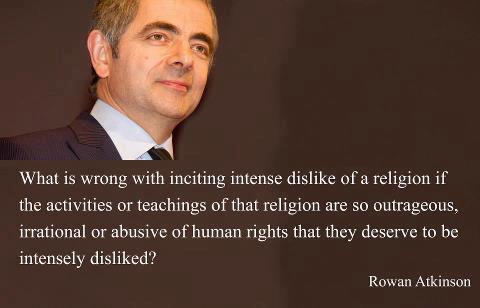
Here he is taking Christianity unseriously. The skit is called Amazing Jesus.
Private cities and the problem of government 323
This fascinating article is from Canada Free Press, by Kelly O’Connell:
In Honduras, a novel undertaking has been constructed—private cities whose purpose is to maximize safety and happiness (also referred to as “Free Cities”, “Charter Cities”, “Model Cities”, or in Spanish, “RED—Regiones Especiales de Desarollo”, and “Ciudades Modelo”.). This idea is a capitalist’s dream, but a liberal’s nightmare. And in a most fascinating manner, the idea of a privately owned commons has brought to the surface the multifarious contradictions of the modern age—with our continual demand for “liberty” while the deified state grows into a malignant colossus. …
The full 18-member Honduran Supreme Court must still rule on President Lorbo’s agreement. But even if the idea does die in Honduras, private cities—like those modeled in early colonial America, Singapore and India’s old British empire, are still an option for virtuous, libertarian minded souls. …
The real questions raised by the rise of private cities is what is the nature of the city, man, law and moral authority. Specifically, what is the meaning of law and the state? Further, what gives a country moral authority in which to erect statutes, establish courts, prisons and pass and enforce sentences? …
The idea — a city built by private funds, with rules not derived from a state legislature, but the settlement’s founders. Add to that a private security force and strong walls. And so a libertarian entrepreneur answered the call for action:
Last Tuesday, the government signed an agreement with private investors led by Michael Strong—a libertarian entrepreneur and close associate of Whole Foods co-founder and CEO John Mackey—to construct a city-from-scratch in one of at least three special development regions (“las Regiones Especiales de Desarrollo” or “REDs”) scattered around the country. REDs possess the legal right to establish—or outsource to foreign governments and companies as necessary—their own hospitals [for profit], schools, judges, and even police, all independent of Honduran law. …
The REDs are the brainchild of Paul Romer, the New York University economist who has proposed building “charter cities” as a solution to endemic poverty. Romer believes that importing sound laws and policies into small corners of badly run countries will help leaders reform their governments from the inside-out. Honduras certainly qualifies—the original banana republic is still grappling with the political fallout of a 2009 coup while cocaine traffickers have pushed its murder rate to the highest in the world.
In early 2011, aides to Honduran president Porfirio Lobo invited Romer to the capital of Tegucigalpa to make his case to Congress. Within weeks, Congress passed a constitutional amendment granting Lobo’s government the power to create and administer the REDs.
Is it inherently immoral for private citizens to buy land, recruit residents, write their own laws, and then begin operating as a franchise community? If so, why? After all, what is it that makes a city, state or country legitimate? On the alternative, given the socialist direction many countries in the West are following, is it possible that only a self-derived city could chart a course against the political grain here? Or does mankind have to bow and scrape at the feet of the modern government colossus irrespective of whether it is just, moral, or effective—simply because it is called “government”? …
It’s certainly not “immoral” to establish a private city and “operate as a franchise community”. Morality doesn’t come into it.The first question is: will states, will governments – all to a greater or lesser extent in the hands of statists, liberals, collectivists – allow it? Will the Honduran Supreme Court allow it? We wait to see.
If private cities are inherently illegal, what about the foundations of America, which were done along these same lines? Interestingly enough, the debate in the American colonies was over whether an immoral government had the right to dictate to men how to act. The Founders decided it did not. So the question raised is whether immoral modern governments can derail moral private communities? After all, what is a government in the first place?
What would characterize a “moral government”? If by “moral” is meant “democratically elected and not oppressive”, aren’t all governments in actuality oppressive to some degree and so to some degree “immoral”? And if so, is it not because oppression is inherent in the nature of government and therefore inescapable?
We think that even if the answer to that question is yes, state government is nevertheless necessary – to uphold the rule of law and protect the nation from foreign invasion. Which is where we part company with libertarians (while remaining sympathetic to libertarianism) and anarchists.
Certain anarchists declare their position somewhat confusedly on this question:
A group of writers calling themselves Private-Property Anarchists have taken on [ie challenged] the theory that only the state possesses the inherent ability to organize a government or police its citizens. In a most obvious way this makes perfect sense since government will always be assembled from some group of residents who then decide upon rules, structure and powers of government. Why must we assume one group of freely assembled persons are more acceptable than another? Further, with the failure of much of modern government to address basic needs, how can anyone help but try to find a better way to manage the affairs of men? …
Several aspects of law should be mentioned on this issue. The first is that it is a fairly recent development for the state to own all official policing powers. According to Bruce Benson’s The Enterprise of Law, Justice Without the State, the Anglo-Saxon law was fixated on protecting property. Further, with the development of English lex mercatoria, ie mercantile law, much enforcement and many remedies to this day were created for enforcement by private parties.
In fact, even the criminal code was mainly enforced by private parties in the history of Anglo-Saxon law. … Englishmen also resisted public prosecution because “a private prosecutorial system was necessary to check the powers of the Crown. If not so limited the power of criminal prosecution could be used for politically oppressive purposes.”
The great fear in the liberal establishment is that a private system of government and law will be antinomian, that is—lawless and a mere tool for the use of greedy capitalists and megalomaniacs. Yet, the opposite is true. In fact, people allowed to build their own justice systems for their own small city-states are apt to be more motivated to create justice and order than those presiding over the legislatures of far-flung empires.
But to build a justice system, big or small, is to establish government.
American citizens are certainly not pleased with the state of our justice system. For example, Edward P. Stringham in Anarchy and the Law argues, if the American legal system and police powers are so successful, and in effect the only game in town, why do private police, i.e. security guards, outnumber official state police?
The debate over private cities begs the question of what is a government in the first place. Let’s remember Jefferson’s sublime words from the Declaration:
We hold these truths to be self-evident, that all men are created equal, that they are endowed by their Creator with certain unalienable Rights, that among these are Life, Liberty and the pursuit of Happiness.—That to secure these rights, Governments are instituted among Men, deriving their just powers from the consent of the governed,—That whenever any Form of Government becomes destructive of these ends, it is the Right of the People to alter or to abolish it, and to institute new Government, laying its foundation on such principles and organizing its powers in such form, as to them shall seem most likely to effect their Safety and Happiness….But when a long train of abuses and usurpations, pursuing invariably the same Object evinces a design to reduce them under absolute Despotism, it is their right, it is their duty, to throw off such Government, and to provide new Guards for their future security.—Such has been the patient sufferance of these Colonies; and such is now the necessity which constrains them to alter their former Systems of Government.
If critics attack the lack of inherent authority of private communities, what is their basis? If a private city creates a better economy, a more just police and legal system, and a safer environment than public communities—is it not the latter which are truly the immoral and lawless frauds? We do well to ponder the foundation of legitimate, God-given government. This can only be established upon the rule of law, civil rights and respect by the leaders for the consent of the governed—or all we have left is an illegitimate tyranny.
While we cannot fathom what the meaning of “God-given” can be here (it makes no sense at all, even if everyone who founds a nation and everyone in power is a believer in “God”), we see the writer’s point. “Legitimacy” as commonly perceived on whatever grounds does not in itself make for good governance.
What we wonder is: How would the forum, whatever it is called, set up in a private city to “create a better economy” (ie let an economy run itself, we hope) and establish a police and legal system, be different from any other democratically elected government? If the people as a whole retain too much power over it, will it not soon fall apart under the pressures of conflicting expectations and demands? And if they retain too little, won’t it gather power, grow, and become the enemy of the people just as every government does, even those democratically elected?
We are all for private cities. We like the idea immensely. We would like to see them established. We would like to live in one. We don’t see why they shouldn’t be self-governing. We think the government that such property owners would elect stands a good chance of doing a better job of governing than existing governments do. But we do not think that, given the minimum power it would need to be effective, it would be immune from avarice for power, or resist the temptation to find a compelling necessity to expand and oppress. How to prevent that; how to limit the power of government, is the perpetual problem of all democracies, great and small.
Atheist attacked in Bangladesh 99
Bad news, but not surprising…
This is from CP World (CP = Christian Post):
An atheist blogger in Bangladesh has been stabbed repeatedly by three suspected Islamist fundamentalists and is currently in critical condition in a local hospital.
Asif Mohiuddin, 29, was attacked earlier this week as he was leaving work at night in Dhaka, when a group of unidentified men jumped him and stabbed him repeatedly. Mohiuddin is one of the nation’s most well-known atheists, and runs a Bengali blog titled “Almighty only in name, but impotent in reality,” which is one of Bangladesh’s most visited websites. …
Now that is surprising!
The news has been met with widespread condemnation especially among secularists, who are demanding that the Muslim-dominated country, where Islam is a state religion, do more to protect the human rights of its citizens. Although the perpetrators have not yet been found, many suspect that Mohiuddin’s atheist posts and his commentaries on free speech and human right issues are most likely the reason for the attack. …
“Asif did absolutely nothing to deserve this. Even if he had insulted people instead of ideas, he wouldn’t have deserved this. This is faith-based madness, and every decent person should stand in his defense. To accuse him of doing anything wrong means supporting his attackers for using violent methods to control non-violent speech,” wrote Hemant Mehta, who runs the Friendly Atheist blog.
The Committee to Protect Journalist (CPJ) reported that this is not the first time the Bengali blogger has been targeted. In Oct. 2011, Mohiuddin was arrested and reportedly abused by police who accused him of inciting a student protest through his blog. The activist was allegedly blindfolded, starved, and kept awake as a form of torture, while authorities tried to have him sign a statement pledging never to use social media again.
The report doesn’t say whether he signed the pledge or not. The suggestion (“tried to have him sign”) is that he didn’t. But in any case we know that even if he did, it made no difference: he went on blogging as an atheist. Bravo, Asif Mohiuddin! We salute your courage and determination.
We also acknowledge a debt to CP World for bringing us the story.
The great intellectual revolt against Christian tyranny 35
In a discussion of a book titled Christianity, Islam, and Atheism: The Struggle for the Soul of the West by William Kilpatrick, this passage occurs:
Some atheists have called for a humanitarian response to Islamic violence. For example, Ayaan Hirsi Ali spoke against harsh Muslim practices that defy “universal rights” and called for “promotion of freedom, equal opportunity, and secular values for all.” However, Kilpatrick points out that secular values simply cannot stand up to a totalitarian Islam because the fruits of the Enlightenment (free speech, free press, democracy, reason) depend on the Christian roots. Atheists often claim religion causes the world’s problems and removing such “superstition” will increase respect of humans.
Kilpatrick’s own conclusion is that “ultimately only Christianity can stop Muslim growth”.
To prescribe one religion as a cure for another is like infecting a person with measles to cure his mumps.
But that is not the issue we are engaging now.
The notion that “the fruits of the Enlightenment (free speech, free press, democracy, reason) depend on the Christian roots” is what concerns us here. It has become a standard assertion of Christian apologists, needled by the secularist contention that the Enlightenment was the bright morning come at last after the centuries-long night Christianity had brought down on Europe.
To support the claim, its advocates insist that Christianity stands for and has always stood for individual freedom, hence for free speech and freedom of the press.
Its assertion that all persons are equal “before God” implies – the Christian argument goes – an endorsement of democracy.
As for reason, they claim that although their creed is to be accepted on faith and not subjected to rational analysis, to believe in Christian doctrine and to act according to Christian teaching is reasonable.
It is not hard to dispel these rosy fancies in the court of an impartial judge.
Individual freedom? The medieval Catholic Church was as totalitarian in its tyranny as it could possibly be in its long age of power; and the Calvinists, Lutherans, Anabaptists, Puritans … the Protestant churches in general, crushed and punished the expression of free thought wherever their power was established, as zealously and cruelly as the Catholic Inquisitors. Calvin, for instance, declared: “When the papists are so harsh and violent in defense of their superstitions, are not Christ’s magistrates shamed to show themselves less ardent in defense of the sure truth?”*
Equality in Christendom? Not on the earth of Europe. It wasn’t even thought of.
In terms of power:
[T]he lawlessness and disorders of the Dark Ages led churchmen first to collaborate with secular rulers, and then to seek their subjugation. … [The] Vicars of Christ became indistinguishable from the nobility.**
In terms of wealth:
The everyday dinner of a man of rank ran from fifteen to twenty dishes. … [For the peasants] the years of hunger were terrible. [They] might be forced to sell all that they owned, including their pitifully inadequate clothing, and be reduced to nudity in all seasons. In the hardest times they devoured bark, roots, grass; even white clay. Cannibalism was not unknown. Strangers and travelers were waylaid and killed to be eaten, and there are tales of gallows being torn down … by men frantic to eat the warm flesh raw.***
Reason? As it is not rational to believe in a superhuman Lord of the Universe, it is not reasonable to trust the teaching of his priests.
Furthermore, for centuries –
The Church encouraged superstitions, recommended trust in faith healers, and spread tales of satyrs, incubi, sirens, cyclops, tritons, and giants, exlaining that they all were manifestations of Satan. The Prince of Darkness, it taught, was as real as the Holy Trinity.**** [With that last sentence we concur.]
The Enlightenment, far from being a product of Christianity, was its antidote. It was a revolt against the intellectual arrogance of the Christian ages.
It was a revolution: the quietest, the most important, and the most successful revolution that ever happened. It was a movement of intellectuals who dared to challenge orthodoxy by questioning the dogmatic “truths” of the Christian Churches. Its defiant values encouraged dissent – to the acute chagrin of the Christian powers. It revived classical doubt – the very essence of reason – in European man, and so began the revival of scientific enquiry and experiment. And it inspired the founding of a new nation in America where all citizens would be equal and free under laws they made themselves.
Only where there is doubt is there tolerance. And where there is doubt there is questioning of authority – of popes and cardinals and kings.
Christians argue that American law enshrines laws which occur in the “Christian bible” (by which they mean the Jewish bible, where the proscriptions against murder, theft, and perjury were listed, and which the Church adopted after some initial reluctance). Therefore, they say, this is a debt that the secular law owes to Christianity. But in fact such laws are much older even than the legendary Moses and his engraved tablets (circa 1250 BCE). They are assumed, for instance, by the Code of Hammurabi (circa 1770 BCE).
If the apologists want to sweep all that aside and base their claim on a pure Christianity that pre-dated the corrupt pontiffs, their case is still hard to defend. To quote from our own post, Tread on me: the making of Christian morality (all sources provided in the notes to the essay):
Briefly, but including all salient points, here is Paul’s moral teaching [and thus the first recorded moral teaching of his invention, Jesus Christ, later interpreted and elaborated by the gospel writers]:
We are the filth of the world, the scum, the muck that is scoured from things. The lowest of the low.
Let us abase ourselves; be fools; be humble, and associate with the lowly.
Do only the most menial work for a living.
Bear affliction with patience, even with joy.
You must consider all others to be greater than yourselves.
Love one another, love all. Then you will be harmless and blameless. That is what I ask you to do to make me proud of you.
Present your bodies as a living sacrifice. Bless those who persecute you. Let them do the most evil things to you, and return only good to them. We glory in our suffering. However hard your life is, rejoice and give thanks. Never seek revenge.
Obey the government. Pay your taxes.
Women, be silent in church.
Marry if you must, but I would rather you remained unmarried and chaste as I am.
Pray constantly. Never feast or carouse, and stay sober. Do not commit sexual immorality. Attend quietly to what you must do, and mind your own business. Be patient always, even when you need to admonish those among you who do not work hard enough.
Share all you have so that you’ll all be equal in worldly possessions.
Do all this for the sake of Christ. Because he died for you, because he suffered on the cross for you, you must bear all things for his sake. You belong to him because he bought you for a price.
This comment follows:
It is a morality that demands and glorifies self-abasement and self-abnegation, as a perpetual repayment of a debt imposed on all humanity by Jesus’s “self-sacrifice”.
It scorns talent, disregards personal ambition, forbids individual self-fulfillment.
So when conservative Christians claim – as they often do – that Christianity initiated and promotes individualism, they are plainly wrong. To the contrary: from its inception Christianity has been the enemy of individualism.
It planted the perverse value of subservience in Western culture; a value that was to re-emerge as an ideal in other collectivist ideologies. Paul’s idea that it was greatly good for the individual to subjugate himself to the community contributed even more profoundly to the ideology of Communism than did his doctrine of sharing and equality [in possessions, subjugation and abasement].
A morality that makes cruel and unnatural demands on human nature will nurture hypocrisy and breed despair: hypocrisy because sustained self-denial is impossible, so lip-service is substituted for obedience; and despair because to strive for the impossible is to ensure failure.
Of course there was a backlash against the Enlightenment. The ever present tendency in human nature to let emotion overrule reason asserted itself early in the writings of Jean-Jacques Rousseau, father of Romanticism, grandfather of Socialism, and great-grandfather of Environmentalism. It is through those channels that Christian values flowed into the age of reason, and survive, along with a decrepit Christianity itself, to trouble us now.
* Quoted in translation by William Manchester in his book A World Lit Only By Fire, Back Bay Books, Little Brown, 1993, p 190.
** Manchester pp 40-41
*** Manchester pp 52, 54
**** Manchester p 62
Jillian Becker January 22, 2013
“Nurse our children on hatred” 197
The new president of Egypt, Mohamed Morsi, propounds his political philosophy grounded in hatred.
He also speaks out loud and clear against Obama. But Obama continues to support him with vast sums of American taxpayers’ money.