“Christian America” coming to an end? 204
John Daniel Davidson, who often writes interestingly about political issues, has an article at The Federalist in which he attributes the past success and greatness of America to Christianity, and the present decline of the country to the fading away of the faith.
The Federalist title of the article is: America’s Stunning Embrace Of Paganism Signals The End Of This Country As We Know It.
Here are some extracts from it in italics, each followed by my comment:
Recall that ancient pagans ascribed sacred or divine status to the here and now, to things or activities, even to human beings if they were powerful enough (like a pharaoh or a Roman emperor).
Don’t Christians ascribe divine status – and superhuman powers – to a human being?
They rejected the notion of an omnipotent, transcendent God — and all that the existence of God would imply.
Who did? When? Even before the Roman Empire adopted Christianity as a state religion, some Greek and Roman philosophers had propounded the idea of a godhead as the genesis of the universe.
Western civilization and its accoutrements depend on Christianity, not just in the abstract but in practice. Liberalism relies on a source of vitality that does not originate from it and that it cannot replenish. That source is the Christian faith, in the absence of which we will revert to an older form of civilization, one in which power alone matters and the weak and the vulnerable count for nothing.
Christianity sent Western civilization into a long nightmarish sleep, or death. Why is the Renaissance called by that name – a re-birth? Why is the Enlightenment called by that name – the return of light after darkness? How did the weak and vulnerable fare in the centuries between the fall of Rome in the West and the Age of Reason? Christians often do not choose to remember the centuries of the terrible Inquisition, its uncountable victims whom it impoverished, tortured, burned to death at the stake.
What awaits us on the other side of Christendom, in other words, is a pagan dark age.
Worse than the Christian dark age behind us?
Here, in the second decade of the 21st century, we can say with some confidence that this dark age has begun. … The principles Americans have always asserted against this kind of moral and political tyranny — freedom of speech, equal protection under the law, government by consent of the governed — depend for their sustenance on the Christian faith, alive and active among the people, shaping their private and family lives as much as the social and political life of the nation.
The Christian faith fostered freedom of speech, equality under the law, government by consent of the governed? No. O Christian apologist, remember the Inquisition (the Papal one and the Spanish one); remember that Christians kept slaves; remember feudalism. It was the Enlightenment – the intellectual revolution against Christian tyranny – that “fostered” those ideas.
The classical liberal order, so long protected and preserved by the Christian civilization from which it sprang, is already being systematically destroyed and replaced with something new.
No, the classical liberal order “sprang” from the Enlightenment, not from Christianity. All the main Cristian churches opposed and punished liberalism, as they opposed free speech, scientific discovery, and tolerance for as long as they had the power to do so.
It was, after all, Christianity that united morality and religion, and without it, they will be separated once more.
The pre-Christian Greeks and Romans thought about morality, philosophized about ethics, established systems of law that were based on moral concepts, but – right! – their gods did not insist on human moral behavior, except towards the divinities themselves. However, Zoroastrianism and Judaism were moral religions before Christianity was invented. St. Paul was against any part of the Jewish law being preserved in his Christianity. He preached that Jesus Christ had superseded the law. After him, there were many other (comparatively short-lived) Christianities in the early centuries C.E. that passionately opposed the moral teachings of the Jews. After St. Paul’s time, Roman Catholic Christianity somewhat reluctantly began to adopt the moral law of Judaism in the second century of our common era.
The new paganism will not necessarily come with the outward trappings of the old, but it will be no less pagan for all that. It will be defined, as it always was, by the belief that nothing is true, everything is permitted. [To prove this, he quotes a 9th century Muslim: “Hasan i-Sabbah, the ninth-century Arab warlord whose group gave us the word “assassins”, summed up the pagan ethos in his famous last words: Nothing is true, everything is permitted.”]
What Greek or Roman philosopher ever taught that “nothing is true”, or that “everything is permitted”? Roman law had much to do with moral right and wrong – and Roman law persisted, in modified form, in some Christian countries in modern times.
[T]he radical moral relativism we see everywhere today represents a thoroughly post-Christian worldview that is best understood as the return of paganism, which, as the Romans well understood, is fundamentally incompatible with the Christian faith. Christianity after all does not allow for such relativism but insists on hard definitions of truth and what is — and is not — sacred and divine.
What is the Christian “hard definition of truth”? When did the numerous Christian sects agree on what is and is not sacred and divine? If they had agreed, would there have been sects?
Without a national culture shaped by the Christian faith, without a majority consensus in favor of traditional Christian morality, America as we know it will come to an end. Instead of free citizens in a republic, we will be slaves in a pagan empire.
Certainly we are being oppressed by the dictators of another religion – the secular religion of neo-Marxism aka “Wokeism”. Whether their rule is better or worse than that of the old dictators of pre-Enlightenment Christianity is a matter of judgment and opinion.
There was of course spiritual — demonic —power behind the pagan gods [!], but also real political power behind the pagan order. This order achieved its fullest expression in Rome, which eventually elevated emperors to the status of deities, embracing the diabolical idea that man himself creates the gods and therefore can become one.
“Man himself” did indeed invent the gods. Are there any other candidates claiming the invention? The man from Tarsus who called himself Saul and later Paul created the Christian god from a man.
It is no accident that the worship of the Roman emperor as a god emerged at more or less the exact same historical moment as the Incarnation. Christianity, which proclaimed that God had become man, burst forth into a social world that was everywhere adopting the worship of a man-god, and its coming heralded the end of that world.
Was the apotheosis of Augustus the inspiration for the apotheosis of Jesus?
… the Christian morality that made humanism possible.
Humanists are inclined to be atheists – usually (unfortunately and unnecessarily) atheists who favor the Left; the Socialist side of our main political division. The humanist principles of tolerance and mercy were surely held by some people long before Christianity began. They are always held by some human beings, including some Christians.
All of that will be swept away, replaced by an oppressive and violent sociopolitical order predicated on raw power, not principle.
As throughout history, including Christian history. And throughout most of the world at any time.
The prevalence of degrading superstition and the disfigurement of reason are hallmarks of the new pagan order, and today are everywhere visible in American society.
Christianity, like every other religion, is superstition, not reason.
Davidson is of course right that the free American Republic is under threat of extinction.
But was its success owed to Christianity?
The Framers of the Constitution were careful not to make special claims for the Christian religion above others. Although they mention “Nature’s God”, “the Supreme Judge of the World”, and “divine Providence” in the Declaration of Independence, and “the Year of our Lord” in the Constitution, the values they wanted to enshrine were Enlightenment values: tolerance, reason, freedom of speech and conscience; government of, for, and by the people with no branch of it – legislative, executive, or judicial – having unrestricted power. Christians may fancy they discern an influence of their faith in that vision, but votaries of other religions and none have been no less appreciative of it – which is as the visionaries intended.
A resurgence of Christian faith now would be far more likely to intensify rather than reconcile division and conflict.
Isn’t Christian history a chronicle of internecine wars and persecution of sect by sect?
And – I ask you, Christians – didn’t your incarnated god reputedly say that he “came not to send peace, but a sword”?
Jillian Becker April 2, 2024
Civilization’s sickness unto death 332
The Sickness Unto Death is the title of a book by the nineteenth century Danish philosopher Søren Kierkegaard (1813-1855).* He diagnosed the sickness as despair – the despair of individuals. An individual despairing of himself is sick with a psychological disease. “Psychological” is the author’s word for it. Kierkegaard was a Protestant Christian – but opposed to the established Lutheran church of Denmark – and the cure he prescribed was Christian faith.
In the twentieth century the French writer Jean Raspail (1925-2020) published a novel titled The Camp of the Saints. The story diagnoses guilt as the lethal sickness of the pan-European community called the West. Its guilt is a political disease, making it impotent and moribund. Raspail was a Catholic – but angry with the Catholic Church – and the cure he prescribed was Christian faith.
In May 2023, First Things published an article by Nathan Pinkoski on The Camp of the Saints. These are extracts from it:
The most important dystopian novel of the second half of the [20th] century is Jean Raspail’s Le Camp des Saints (The Camp of the Saints, 1973). Its central plotline concerns an armada that transports one million migrants from India to the shores of France. It’s an invasion, an occupation of the Global North by the Global South. As the migrants land, France is thrown into chaos, along with the rest of Europe, and Western civilization dies.
Yet The Camp of the Saints is not a disaster novel. The book’s significance does not hinge on whether Raspail was correct to predict mass immigration or describe it in catastrophic terms. Rather, the novel’s genius lies in the depiction of an apocalypse in the original sense of that term. Properly translated, apocalypse is rendered as revelation, disclosure, literally an “uncovering.” The Camp of the Saints unveils the perverse logic that pervades late Western civilization, and throws into sharp relief the nihilism of guilt whereby the West welcomes its own destruction. …
Raspail will not allow the migrants to be idealized. Throughout the novel, he emphasizes their vulgarity by providing lengthy descriptions of their crudeness, sexual promiscuity, and repellent hygiene. … [T]he migrants are materially and culturally destitute. That is why they find the West attractive. They do not have a mission to redeem sinful Europe; they are seeking deliverance from poverty and from the sometimes-brutal oppression and inequalities of non-Western cultures.
They will not obtain what they seek. In discussing what to do about the armada, the French authorities persuade themselves of their own illegitimacy. At the climax of the novel, the French president delivers an emergency speech meant to authorize the use of military force against the migrants and prevent them from landing. But he cannot bring himself to deliver the order. France will not defend itself. When the migrants alight from their boats and wade ashore, the West has already capitulated.
European governments fall as the migrants arrive, and European citizens withdraw from public life. Civil society collapses; as a result, the migrants enjoy no real improvement in their condition. They bring their bad rulers with them, replacing European regimes with the very regimes they have fled. Dictator-generals and Brahmins take up positions in French government, ruling as they did in their own lands. The migrants and their supporters do not “include” the Rest into the West. They expand the scope of the Third World, and wretchedness goes global. The purported blessing of the arrival of the wretched, so cherished by progressive voices in the novel, does not come about. What emerges is not a particularly harsh despotism—there is only the occasional boot stomping on the human face—but the pain of the survivors is great, because of their vivid memories of what they have lost. …
The left-wing intelligentsia herald the coming of the migrants as the dawn of a new age of multiculturalism, but they stoke a media frenzy and deploy the tools of cancel culture against those who demur, ostracizing or punishing them. …
Raspail is unsparing in his depiction of the betrayals urged by left-wing intellectuals, but he reserves his most scathing passages for the treason of the Catholic Church. In the novel, the previous pope has sold the treasures of the Vatican in a failed bid to win the approval of the Third World. The sitting pope, a Latin American, spends his time flying around on humanitarian missions and selling off whatever Vatican assets remain. He sees himself as a champion of the Third World. As the migrants arrive and the native French abandon their lands, priests go down to the beaches to cry, “Thank God!” They turn their backs on their countrymen, imagining they see Christ in the migrants.
In Raspail’s telling, Catholic Christianity has for some time been in thrall to humanitarian universalism. The novel satirizes a left-liberal Catholicism that disdains national and civilizational particularity and renders the faith indistinguishable from the moral universalism of non-believers. Under the banner of “charity, solidarity, and universal conscience”, progressive clerics abandon their neighbors for the sake of the stranger. They practice the religion of humanity, a Christian heresy …
The First World must be taught to be ashamed of itself, to believe that its death will be its greatest gift to the future of humanity. The new civic liturgy of Western nations must express submission to the morally superior non-Western “other”. Those in the West need to be trained to take the knee …
Again and again in the novel, cowardice and self-hatred are masked and moderated by the conviction that mass immigration into Europe and the deconstruction of European identity will somehow take away the sins of the West. But Raspail knows the truth: Third World immigrants do not have the power to deliver Europeans from their sense of worthlessness. Once one embraces the logic of civilizational repudiation, the endpoint is nihilism and cultural death. …
The West is responsible for its own fate. Raspail is right. God will not deliver us from the consequences of our guilty self-hatred. It is up to us to decide whether we will reject […] atonement through occupation and turn instead to the Lord.
Contrary to Pinkoski’s opinion, ours is that the really interesting thing about The Camp 0f the Saints is the accuracy of its prediction of what is happening in the 21st century: the non-violent invasion of the First World by a vast number of immigrants from the Third World; the failure of First World Governments to prevent it or turn it back; the sabotaging reaction to it of leftist intellectuals; clerics of the great churches – the Catholic priests following the lead of a Latin American pope – passionately encouraging the shattering, the befouling, the abandonment of Western civilization.
What accounts for the capitulation of the rich and mighty law-governed civilized West to poor, weak, ignorant hordes from (in our case) the dark continent of Africa, corrupt republics of Latin America, cruel khanates of the Middle and Far East, hellholes of vicious Communist dictators?
Pinkoski declares, in apparent agreement with Raspail, that the big mistake which allows such a fatal tragedy to happen, is the embrace by Western political, intellectual, and religious leaders of a “perverse logic” that “throws into sharp relief the nihilism of guilt”. The guilt is for Europe’s erstwhile imperialism, its colonizing and alleged oppressive exploitation of Third World countries. It arises, even in “Catholic Christianity”, out of an enchantment with “humanitarian universalism”. That, Pinkoski tells us, is a “religion of humanity” and “a Christian heresy”.
The expression “humanitarian universalism” is no doubt intended to imply Marxism, but also more than that: global brotherhood, the family of man, humanism; an ideology of moral values, but essentially secular, and so “heretical” because it omits God. To the Christian mind, such an ideology is invalid because morals can only be decreed by God.
In reality, humanism, which purports to be concerned with individuals, is a very unlikely source of guilt and shame for a communal “sin”. The “sin” in this story is so bad that it calls for extreme punishment – nothing less than the destruction of our entire civilization, the peak achievement of humankind. The notion that humanism, or “humanitarianism”, is the source of such a shame could only arise in the religious mind – a mind furnished with inherited antiques: sin, guilt, atonement, penance, redemption through suffering, subordination of one’s own interests, apocalypse. And only one Western religion demands atonement by self-abasement, self-sacrifice, annihilation of achievement, willing submission to suffering.
Humanism began its resurrection with the anthropocentrism of the Renaissance, and rose to its full height when Reason dethroned Faith at last in the Enlightenment. After a millennium of Christian oppression, Reason set Western man free to think, explore, experiment, discover, invent, hypothesize, be right and wrong; and be free to choose law instead of mystic revelation as a setter of ethical rules. (It is unfortunate – worse, it is disastrous – that most humanists have by now embraced the secular religion of socialism which again is inimical to freedom.)
The Enlightenment broke the power of the churches to terrify and oppress, but it did not change the essence of Christianity, which is masochistic. Doctrinally self-accusing. An ideology of guilt, shame, abasement, and morbid reverence for martyrdom. For as long as its institutions were powerful enough, it was an oppressive, torturing, property-confiscating, murdering tyranny; as totalitarian as it could be in the ages in which it ruled – no matter whether in the name of Catholicism or Protestantism. The secular heir to its tyranny is Marxism-Leninism-Maoism-Wokeism – no matter which of those labels it wears.
Christian faith, far from being the cure for the West’s sickness unto death, is its cause.
***
*Kierkegaard’s works are fascinating and often intentionally funny. He was witty and dryly humorous. His wit and humor are on fullest display in his book Either/Or.
Ayaan Hirsi Ali renounces reason and grasps faith 436
It is with strong – undiminished – respect for Ayaan Hirsi Ali that I now feel compelled to argue with her.
She is brilliant, courageous, principled. But she has turned from rationality and atheism, where she found intellectual asylum from the cruel and preposterous religion of Islam, back to superstition in the form of the no-longer-cruel but still preposterous religion of Christianity.
She writes (in part – please read it all) under the title Why I Am Now a Christian:
During Islamic study sessions, we shared with the preacher in charge of the session our worries. For instance, what should we do about the friends we loved and felt loyal to but who refused to accept our dawa (invitation to the faith)? In response, we were reminded repeatedly about the clarity of the Prophet’s instructions. We were told in no uncertain terms that we could not be loyal to Allah and Muhammad while also maintaining friendships and loyalty towards the unbelievers. If they explicitly rejected our summons to Islam, we were to hate and curse them.
Here, a special hatred was reserved for one subset of unbeliever: the Jew. We cursed the Jews multiple times a day and expressed horror, disgust and anger at the litany of offences he had allegedly committed. The Jew had betrayed our Prophet. He had occupied the Holy Mosque in Jerusalem. He continued to spread corruption of the heart, mind and soul.
…
As an atheist, I thought I would lose that fear. I also found an entirely new circle of friends, as different from the preachers of the Muslim Brotherhood as one could imagine. The more time I spent with them — people such as Christopher Hitchens and Richard Dawkins — the more confident I felt that I had made the right choice. For the atheists were clever. They were also a great deal of fun.
So, what changed? Why do I call myself a Christian now?
Part of the answer is global. Western civilisation is under threat from three different but related forces: the resurgence of great-power authoritarianism and expansionism in the forms of the Chinese Communist Party and Vladimir Putin’s Russia; the rise of global Islamism, which threatens to mobilise a vast population against the West; and the viral spread of woke ideology, which is eating into the moral fibre of the next generation.
…
So far, good. No argument. She goes on:
But we can’t fight off these formidable forces unless we can answer the question: what is it that unites us? The response that “God is dead!” seems insufficient. So, too, does the attempt to find solace in “the rules-based liberal international order”. The only credible answer, I believe, lies in our desire to uphold the legacy of the Judeo-Christian tradition.
Leaving aside the question of whether there is something that can be justifiably labeled “the Judeo-Christian tradition” (I do not think there is – for my reasons see here), let’s consider the point she is making.
That legacy consists of an elaborate set of ideas and institutions designed to safeguard human life, freedom and dignity — from the nation state and the rule of law to the institutions of science, health and learning. As Tom Holland has shown in his marvellous book Dominion, all sorts of apparently secular freedoms — of the market, of conscience and of the press — find their roots in Christianity.
I have not read that work by Tom Holland and I am not now arguing with him. Ayaan Hirsi Ali believes he is right that “all sorts of apparently secular freedoms” – she notes in particular “of the market, of conscience and of the press” — “find their roots in Christianity”. It is with her I am arguing, and reasons to reject that claim leap to my mind. Freedom of the market? Doesn’t Christianity deny that rich men can “enter heaven”? Of conscience? Who can count the number of “heretics” put to death in war, on the rack, at the stake for holding opinions that Christians in power objected to? How many who put those opinions in writing before and after there came to be such a thing as “the press”? Christian persecution of its critics came to an end only with the Enlightenment, the European movement that broke the power of the churches and raised reason over irrational faith.
She writes:
To me, this freedom of conscience and speech is perhaps the greatest benefit of Western civilisation. It does not come naturally to man. It is the product of centuries of debate within Jewish and Christian communities. It was these debates that advanced science and reason, diminished cruelty, suppressed superstitions, and built institutions to order and protect life, while guaranteeing freedom to as many people as possible. Unlike Islam, Christianity outgrew its dogmatic stage. It became increasingly clear that Christ’s teaching implied not only a circumscribed role for religion as something separate from politics. It also implied compassion for the sinner and humility for the believer.
No, no, no, no, and no. Freedom of conscience and speech came after centuries of no debate with Jewish and Christian “communities”. It came from thinkers of the Age of Reason. Many of whom were atheists, and all of whom were skeptics. “Free thinkers”. The idea that such freedoms ought to be allowed is the product of rational thinking. The Age of Science was born then. Not when Galileo or Giordano Bruno lived and experienced what the Catholic Church deemed to be a Christian correction – threatened torture and forced confinement for the one, the stake for the other. The Churches’ cruelty diminished because reason and freedom became the mood of a certain time. Superstition was hushed – never suppressed, unfortunately – by reasoned argument, critical examination. Institutions were built to protect freedom despite the dogmatism of the Christian churches – all of them, Catholic and Protestant. Christianity has not “outgrown”, will never “outgrow”, its “dogmatic stage”. “Christ’s teaching” can only be guessed at, and none of the known guesses suggest that it “implied … a circumscribed role for religion”. Religion was most decidedly not “separate from politics” in the Judea of the first Caesars. As for compassion and humility, Christian sages from St. Paul onward have preached one or both – St. Paul stressed humility – but the history of the religion does not demonstrate the habitual observance of either to any convincing degree.
[A]theism is too weak and divisive a doctrine to fortify us against our menacing foes. I have also turned to Christianity because I ultimately found life without any spiritual solace unendurable. Atheism failed to answer a simple question: what is the meaning and purpose of life?
Atheism does not ask that question. It is not a reasonable question. What could the meaning of life, of existence, possibly be? Why does it need meaning? Whose purpose? If no one made the universe and life there can be no purpose in their existence. Human beings make their own purposes. Only if you already believe in a supernatural Creator can you seek an elusive purpose or meaning in all “creation”.
The line often attributed to G.K. Chesterton has turned into a prophecy: “When men choose not to believe in God, they do not thereafter believe in nothing, they then become capable of believing in anything.”
I would say, if you can believe in a god, you can believe in anything. The god hypothesis does not stand up to scrutiny.
In this nihilistic vacuum, the challenge before us becomes civilisational. We can’t withstand China, Russia and Iran if we can’t explain to our populations why it matters that we do. We can’t fight woke ideology if we can’t defend the civilisation that it is determined to destroy. And we can’t counter Islamism with purely secular tools. To win the hearts and minds of Muslims here in the West, we have to offer them something more than videos on TikTok.
A nihilistic vacuum? Freedom, reason, science, technology, material abundance, rule of law nihilistic? Free societies, Western civilization a vacuum? Contains no riches, just videos on TikTok? No, its enemies are the vacuum-makers. Sure, abundance will include silly things; freedom is messy, but you have choice. It is true that a great many people only discover how good their Western way of life was when they have lost it. Nice that their ignorance gets cured, sad that their loss may be irrecoverable.
Woo Muslims away from their superstition by offering them another superstition named Christianity? Convert all the world to Christianity, which “has it all”, and the world will be again as Europe was between the fall of Rome and the rise of Reason? As good? Rather, as dark. As cruel. An erosion of our civilization more certain, more absolute, arguably even more tragic than the horrors she names that threaten us now: “… the resurgence of great-power authoritarianism and expansionism in the forms of the Chinese Communist Party and Vladimir Putin’s Russia; the rise of global Islamism, which threatens to mobilise a vast population against the West; and the viral spread of woke ideology, which is eating into the moral fibre of the next generation.”
Her diagnosis of what ails our civilization is right enough. Her prescription for curing it is a mistake. Christianity has not been a force for good in history. And what is Christian belief? That a Jewish man who lived in a province of the Roman empire during the reigns of Augustus and Tiberius was the Creator of the universe! (John 1:9,10. That [Jesus] was the true Light, which lighteth every man that cometh into the world. He was in the world, and the world was made by him, and the world knew him not.) How can that be easy, how can it be possible, for an intelligent thinker of our enlightened age to accept? Or the rest of the tale: that he was born of a virgin, performed miracles, came alive again three days after he’d died, and ascended bodily to a material heaven?
And what of Christianity’s moral message? “Resist not evil” is not helpful advice for us in our present predicament. What of the reason ascribed to his sojourn on earth as a man – to suffer and die for the salvation of mankind? How he came to die an agonizing death by crucifixion – the Roman method of legal execution for crazy daredevils convicted of organizing or attempting insurgency – has a muddled background story and incompatible Christian explanations. According to the believers, the Jews found him guilty of breaking some suddenly found and quickly forgotten law of their religion and insisted that the Romans execute him. The obliging Romans reluctantly acceded to their demand, so it is the Jews who are cursed forever as deicides. But also that he was born in order to be tortured to death, that it was his mission to sacrifice himself as the means to lift from humankind the original sin of Edenic disobedience (to himself); so he was inevitably doomed to that extremely painful and prolonged form of suffering – and a death that was not actually death – by his own decree.
O Ayaan Hirsi Ali, if you can believe all that, you have abandoned not only reason but common sense!
There is no formula for “saving”, let alone transfiguring, the human race. Not a proletarian revolution. Not a global coming to Jesus. It is not faith, not divinity, but doubt – the instrument of vigorous intellectual humility – that promotes and protects tolerance and prosperity; that sustains “human life, freedom and dignity”.
Jillian Becker November 12, 2023
Update: Ayaan Hirsi Ali’s husband, Niall Ferguson, has also embraced Christianity.
Against religion 29
“When one person suffers from a delusion it is called insanity.
When many people suffer from a delusion it is called Religion.”
– Robert M. Pirsig
=================================
“Seeing no reason to believe is sufficient reason not to believe.”
– Karl Popper
================================
“Absolute faith corrupts as absolutely as absolute power.”
– Eric Hoffer Reflections on the Human Condition
==================================
“The theory that you should always treat the religious convictions of other people with respect finds no support in the Gospels.”
– Arnold Lunn
=================================
“By one count there are some 700 scientists with respectable academic credentials (out of a total of 480,000 U.S. earth & life scientists) who give credence to creation-science, the general theory that complex life forms did not evolve but appeared ‘abruptly’.”
– Newsweek, June 29, 1987
=================================
“Today, the theory of evolution is an accepted fact for everyone but a fundamentalist minority, whose objections are based not on reasoning but on doctrinaire adherence to religious principles.”
– Dr. James D. Watson, winner of the Nobel prize for his co-discovery of the structure of DNA
==================================
“When I hear them praying extra loud, I always go out and check the lock on the smokehouse.”
– Harry Truman
==================================
“There is one notable thing about our Christianity: bad, bloody, merciless, money-grabbing and predatory as it is – in our country particularly, and in all other Christian countries in a somewhat modified degree – it is still a hundred times better than the Christianity of the Bible, with its prodigious crime – the invention of Hell. Measured by our Christianity of to-day, bad as it is, hypocritical as it is, empty and hollow as it is, neither the Deity nor His Son is a Christian, nor qualified for that moderately high place. Ours is a terrible religion. The fleets of the world could swim in spacious comfort in the innocent blood it has spilt.”
– Mark Twain Reflections on Religion
==================================
“In religion and politics, people’s beliefs and convictions are in almost every case gotten at second-hand, and without examination, from authorities who have not themselves examined the questions at issue but have taken them at second-hand from other non-examiners, whose opinions about them were not worth a brass farthing.”
– Mark Twain
==================================
“George Washington though he belonged to the Episcopal church, never mentioned Christ in any of his writings and he was a deist.”
– Richard Shenkman I love Paul Revere, whether He Rode or Not
==================================
“Think how great a proportion of Mankind consists of weak and ignorant Men and Women, and of inexperienc’d Youth of both Sexes, who have need of the Motives of Religion to restrain them from Vice, to support their Virtue, and retain them in the Practice of it till it becomes habitual, which is the great Point for its Security.”
– Benjamin Franklin
=================================
“A thorough reading and understanding of the Bible is the surest path to atheism.”
– Rev. Donald Morgan, theologian
==================================
“Atheism has one doctrine: To Question.
Atheism has one dogma: To Doubt.
The Atheist Bible has but one word and that word is, ‘THINK’.”
– Emmet F. Fields
==================================
“Religion easily has the greatest bullshit story ever told.
Think about it, religion has actually convinced people that there’s an INVISIBLE MAN…LIVING IN THE SKY … who watches every thing you do, every minute of every day.
And the invisible man has a list of ten special things that he does not want you to do.
And if you do any of these ten things, he has a special place full of fire and smoke and burning and torture and anguish where he will send you to live and suffer and burn and choke and scream and cry for ever and ever ’til the end of time … but he loves you.”
– George Carlin, Brain Droppings
==================================
“As an historian, I confess to a certain amusement when I hear the Judeo-Christian tradition praised as the source of our present-day concern for human rights. That is, for the valuable idea that all individuals everywhere are entitled to life, liberty, and the pursuit of happiness on this earth.
In fact, the great religious ages were notable for their indifference to human rights in the contemporary sense.
They were notorious not only for acquiescence in poverty, inequality, exploitation, and oppression, but also for enthusiastic justification of slavery, persecution, abandonment of small children, torture, and genocide.
– Arthur Schlesinger, Jr.
==================================
“Why have those countries with a strong Church-State alliance displayed such an eagerness to enforce religious dogmas and eliminate dissent through the power of the state?
Why has Christianity refused, whenever possible, to allow its beliefs to compete in a free marketplace of ideas?
The answer is obvious and revealing.
Christianity is peddling an inferior product, one that cannot withstand critical investigation.
Unable to compete favorably with other theories, it has sought to gain a monopoly through a state franchise, which means: through the use of force.”
– George H. Smith, from Atheism: The Case Against God
==================================
“The Bible tells us to be like God, and then on page after page it describes God as a mass murderer.
This may be the single most important key to the political behavior of Western Civilization.”
– Robert Anton Wilson, Right Where You Are Sitting Now
==================================
“So long as the universe had a beginning, we could suppose it had a creator. But if the universe is completely self-contained, having no boundary or edge, it would neither be created nor destroyed… it would simply be.
What place, then, for a creator?”
– Stephen Hawking
==================================
“No theory is too false, no fable too absurd, no superstition too degrading for acceptance when it has become embedded in common belief.
Men will submit themselves to torture and to death, mothers will immolate their children at the bidding of beliefs they thus accept.”
– Henry George
==================================
“Convicts register their religious affiliation when they’re processed into prison.
And about 99.5% of the huge U.S.A. prison population consists of inmates who identified themselves as members of religious denominations.”
– Gene M. Kasmar
==================================
“Whenever we read the obscene stories, the voluptuous debaucheries, the cruel and tortuous executions, the unrelenting vindictiveness with which more than half the Bible is filled, it would be more consistent that we call it the word of a demon than the word of God.
It is a history of wickedness that has served to corrupt and brutalize mankind; and, for my part, I sincerely detest it, as I detest everything that is cruel.”
– Thomas Paine, The Age of Reason
==================================
“The history of intellectual progress is written in the lives of infidels.”
– Robert Green Ingersoll, The Great Infidels (Most probably America’s greatest orator.)
==================================
“According to the theologians, God prepared this globe expressly for the habitation of his loved children, and yet he filled the forests with ferocious beasts; placed serpents in every path; stuffed the world with earthquakes, and adorned its surface with mountains of flame.
Notwithstanding all this, we are told that the world is perfect; that it was created by a perfect being, and is therefore necessarily perfect.
The next moment, these same persons will tell us that the world was cursed; covered with brambles, thistles and thorns, and that man was doomed to disease and death, simply because our poor, dear mother ate an apple contrary to the command of an arbitrary God.”
– Robert Green Ingersoll, The Gods
==================================
“If you don’t think that logic is a good method for determining what to believe, make an attempt to convince me of that without using logic.”
– Brett Lemoine
==================================
“The idea that a good God would send people to a burning Hell is utterly damnable to me. The ravings of insanity! Superstition gone to seed!
I don’t want to have anything to do with such a God. No avenging Jewish God, no satanic devil, no fiery hell is of any interest to me.”
– Luther Burbank, address to Science League of San Francisco, Dec. 1924
==================================
“Should one continue to base one’s life on a system of belief that–for all its occasional wisdom and frequent beauty–is demonstrably untrue?”
– Charles Templeton, former right-hand man to Billy Graham, in Farewell to God
==================================
“I’m firmly convinced Michael Carneal is a Christian. He’s a sinner, yes, but not an atheist.”
– Rev. Paul Donner, of the St. Paul Lutheran Church, Paducah, Ky., describing accused mass murderer Michael Carneal, 14, in contrast to early reports.
==================================
“The Christian view that all intercourse outside marriage is immoral was, as we see in the above passages from St. Paul, based upon the view that all sexual intercourse, even within marriage, is regrettable.
A view of this sort, which goes against biological facts, can only be regarded by sane people as a morbid aberration.
The fact that it is embedded in Christian ethics has made Christianity throughout its whole history a force tending towards mental disorders and unwholesome views of life.”
– Bertrand Russell
==================================
“Scientific research is based on the idea that everything that takes place is determined by laws of nature, and therefore this holds for the action of people.
For this reason, a research scientist will hardly be inclined to believe that events could be influenced by a prayer, i.e. by a wish addressed to a Supernatural Being.”
– Albert Einstein, responding to a child who wrote and asked if scientists pray.
==================================
“If the liberties of the American people are ever destroyed, they will fall by the hands of the clergy.”
– Marquis de Lafayette
==================================
“Here and there in the midst of American society you meet with men full of a fanatical and almost wild spiritualism, which hardly exists in Europe.
From time to time strange sects arise which endeavor to strike out extraordinary paths to eternal happiness.
Religious insanity is very common in the United States.”
– Alexis de Tocqueville
==================================
“I fight fire with fire. You shouldn’t treat a crazy religious cult with kid gloves.”
– Ian Plimer, Melbourne University Professor of Geology, in reference to legal action challenging the existence of Noah’s Ark
==================================
“The truth is that Christian theology, like every other theology, is not only opposed to the scientific spirit; it is also opposed to all other attempts at rational thinking.
Not by accident does Genesis 3 make the father of knowledge a serpent — slimy, sneaking and abominable.
Since the earliest days the church as an organization has thrown itself violently against every effort to liberate the body and mind of man.
It has been, at all times and everywhere, the habitual and incorrigible defender of bad governments, bad laws, bad social theories, bad institutions.
It was, for centuries, an apologist for slavery, as it was the apologist for the divine right of kings.”
– Henry Louis “H.L.” Mencken
==================================
“Heretics have been hated from the beginning of recorded time; they have been ostracized, exiled, tortured, maimed and butchered; but it has generally proved impossible to smother them; and when it has not, the society that has succeeded has always declined.”
– Judge Learned Hand
==================================
“Gods are creatures of the human imagination.
Faith in imaginary beings does not prove their existence.
Passionate devotion to a faith does not prove it to be true.”
– Jillian Becker
==================================
“All laws and moral rules are man-made.”
– Jillian Becker
==================================
“Many a belief can survive persecution but not critical examination.”
– Jillian Becker
==================================
“The barbaric religions of primitive worlds hold not a germ of scientific fact, though they claim to explain all.
Yet if one of these savages has all the logical ground for his beliefs taken away, he doesn’t stop believing.
He then calls his mistaken beliefs ‘faith’ because he knows they are right.
And he knows they are right because he has faith.”
– Harry Harrison, said by a character in his novel Deathworld
==================================
“I believe today that my conduct is in accordance with the will of the Almighty Creator.”
– Adolph Hitler, Mein Kampf
A ruler of the darkness of this world 9
The Catholic Church has lost its own plot.
Paul Joseph Watson justly accuses that very stupid and very nasty Lefty, Pope Francis, of “doing the work of the Devil”, with many examples of how he’s doing it.
We applaud Paul Joseph Watson’s attacks-by-video against principalities, against powers, against the rulers of the darkness of this world, against spiritual wickedness in high places – to quote Christian scripture (Ephesians 6:12) – even when we don’t agree with him that (as he implies here) there is some form of Christianity which does not deepen the darkness of this world.
Who created Christ? 91
Detective work into the past can be great fun for those who have a calling for it, and if they write up their investigations entertainingly in a book, readers can find it fun too. Creating Christ: How Roman Emperors Invented Christianity * is a book of that sort. The authors convey their excitement as they describe their discoveries and set out their case, which is that the Flavian emperors Vespasian and his son Titus, far from being persecutors of Christians, were their patrons, and – astonishingly – the very progenitors of their religion.
With quotations mainly from Acts of the Apostles, Matthew, and the Epistles, James S. Vallant and Warren Fahy demonstrate how consistently the New Testament praises Rome’s imperial government, its citizens and soldiers. And they are right – the New Testament does show the Romans in the best possible light. It exhorts subjects of the emperor to pay their taxes, and slaves to obey their masters and take a beating without complaint. This, the authors say, shows that Christianity was an officially sanctioned product of the imperial power itself.
But a holy book for Christians did not need the authorship or authorization of the emperors to be a testament to the moral excellence of the Romans. The Christians had a strong incentive to flatter them, and to show by every means they could think of that they were distinct from the Jews. The Romans in Rome thought of them as a Jewish sect, followers of one “Chrestus” who rose in rebellion in the imperial city itself and were crushed by Nero. In Judea, rebels who rose en masse against Roman rule were punished by Vespasian and Titus with enslavement, torture, crucifixion, and dispersion. So the Christians understandably thought it essential that they be recognized by their overlords not only as utterly different from the Jews, but even more than that, as the Jews’ worst enemy. They had to abominate the Jews, anathematize them. Jesus had to be separated from them; to be known as a savior for all mankind except the Jews. To that end, they exculpated the Romans who crucified him, and made the Jews bear the blame instead.
Vallant and Flahy don’t depend only on the New Testament for evidence that Christianity “sprang from 1st Century Flavian propaganda”. They also also cite proofs they found in “coins, iconography, architecture, history, politics”, and from “the personal relationships of the Flavians” – meaning that a few of the emperors’ relations were Christians. They quote historical texts, including a couple of passages from Antiquities of the Jews by Josephus, the Flavians’ official (Jewish-turned-Roman) historian, to prove that Jesus was an historic figure, a living wonder in his own time. They admit, however, that one of the passages is generally considered by scholars to be a forgery. In the other, they rely on a few words which have seemed to most exegetes – and to me – an obvious interpolation, probably by Christians desperately wanting to establish objective proof of Jesus’s existence and importance in his time. Such proof has not been found by anybody, because what didn’t happen cannot be proved to have happened. None of the ancient texts they quote does the job. Piling them up doesn’t do it either. The aggregate of many rumors is still not a fact.
Their excuse for introducing inauthentic and questionable material as evidence of their claims is that many a disputed item, if taken “at face-value”, supports their theory. Their accumulation of proofs is crowned, they say, by a particular coin, excitingly discovered after a long search. They believe it provides conclusive confirmation of their thesis:
“This is it. It is a coin issued in the millions by the Flavian Emperor Titus, the son of Vespasian who conquered Jerusalem and sacked the Temple just as Jesus had prophesied. The symbol it bears, a dolphin wrapped round an anchor, is the very symbol Christians used, they say, to symbolize Christ for the first three centuries before the Emperor Constantine replaced it with the symbol of the Cross.”
A picture of the Roman coin with the device on one side and the head of Titus on the other is shown beside a medallion decorated with a fish wrapped round an anchor and the Greek word for a fish, ixthys. The six letters are also the initials of the words, in Greek: “Jesus Christ, Son of God, Savior”. That was why a simple outline of a fish was “the most common symbol used by the earliest Christians”.
A fish, yes: but a fish wrapped round an anchor? Was that a common symbol of the Christian faith? Why would it be? The authors show rings with the dolphin-and-anchor motif which they say are “Christian”. They declare it significant that a daughter of Vespasian, Domitilla, who became Christian and a saint, is buried in a catacomb where the design of two fishes and what may be an anchor is to be seen. In other catacombs where Christians are buried they found decorations with fishes and a trident, which they suggest is virtually the same thing as an anchor.
It is possible that some Christians used the device of a fish-and-anchor as a symbol of their faith, and it does bear a resemblance to the Flavian dolphin-and-anchor. But the dolphin is not a fish, and the Romans knew it. Vallant and Fahy mention that inconvenient fact, but sweep it aside since, they say, lots of those ancient primitive people thought a dolphin was a fish.
Another fact that spoils their case is that the Flavian dynasty began later than the first documents of Christianity were composed. The earliest of them, Paul’s letters, are dated by scholars from the middle of the sixth decade of the 1st. century. The first of the Flavians, Vespasian, became emperor at the end of the seventh decade. The oldest of the Gospels, attributed to Mark, is generally believed to have appeared in 65 or 66 CE, though it could have been in the early 70s. The point is that Christianity was well launched before Vespasian was appointed Emperor by the Roman army under his command.
That happened while he was in Judea putting down the uprising of the Jews. The historian Josephus tried to convince Romans and Jews that Vespasian himself was the Messiah. He wrote that when Vespasian became emperor, the prophecy which had inspired the uprising, that someone from Judea would become “ruler of the world”, came true. The Jews had mistaken the prophecy to mean that the “ruler of the world” would be a Jew, but it really meant that he would be crowned emperor in Judea. Christians too could welcome the revelation, as their Christ had prophesied his second coming would be in the lifetime of those he was speaking to – and lo! here he was!
Josephus is acknowledged to be a good historian, though details in his books – figures in particular – are disputed. He surely did not believe that Vespasian was the Messiah, but he himself had been a leader of the uprising, so when the rebels were frightfully punished it was very much in his interest to convince the victors that he could be of use to them. His flattery succeeded. Vespasian did not object to it at all – he was intending to be made a god anyway (as Roman Emperors often were) – and he not only spared Josephus’s life, he appointed him state historian.
The authors try to make the dating of the Christian documents helpful to their argument by casting doubt on them, but unconvincingly. They have to concede that Paul was preaching Christianity years before Vespasian’s reign began – a fact which should rule out their claim that the Flavians were its inventors. But they stick to it, only going so far as to introduce, as an equally valid alternative theory, the idea that Paul could have been the agent of an earlier Roman government, for which they provide no name or dates. Do they mean Nero (54-68)? Or Claudius (41-54)? Neither of them is a plausible candidate.
But it was Paul, not Vespasian or Titus, who invented Christianity. He is a mysterious, even sinister figure, telling implausible stories about himself to his non-Jewish audiences (such as claiming membership of a tribe of Israel that did not exist in his time); admitting that he had been imprisoned for a sexual crime and blaming the law for it; changing his name at least once and probably twice. He might have been an agent of Rome for some purpose. He might have stolen someone else’s ideas. But what he produced is an amazing thing: the Christian religion. And he spread it with tenacious energy, though gathering too few converts in his lifetime to constitute much of a threat to the Romans, or to be of much use to them. It wasn’t until the 4th. century that the imperial power came to own the religion that Paul had invented and by doing so had set the course of history.
*Creating Christ: How Roman Emperors Invented Christianity by James S. Vallant & Warren Fahy, Crossroad Press, 2018
(By request of our Forum participant Yazmin)
Jillian Becker September 27, 2021
For what do we live? 159
Two giants of our civilization, Fyodor Dostoyevsky and Alexander Solzhenitsyn, prescribed Christianity – specifically Russian Orthodox Christianity – as The Solution to the moral maladies of the human race.
The moral malady Dostoyevsky wrote against in his novel The Possessed (also translated as The Devils or The Demons) was the mood of anarchist rebellion, underlain by nihilist despair, that was spreading through Russia in his time. His last novel The Brothers Karamazov implicitly prescribes Orthodox Christianity as the great alternative to existential despair and universal moral turpitude.
Russia ignored Dostoyevsky’s prescription – the Orthodox Christian way to national salvation – so it was not tested (yet again). Rather, the rebellious mood, infecting Russian society high and low, fomented vicious acts of terrorism, harbingers of the revolution that would condemn the country to seventy-three years of Communism.
Solzhenitsyn was one of the millions of victims of the Communist regime.
He wrote this at the end of his story Matryona’s House, indicating what moral failings he most despises and implicitly prescribing his preferred alternative:
She [Matryona] made no effort to get things round her. She didn’t struggle and strain to buy things and then care for them more than life itself.
She didn’t go all out after fine clothes. Clothes, that beautify what is ugly and evil.
She was misunderstood and abandoned even by her husband. She had lost her husband, but not her sociable ways. She was a stranger to her sisters and sisters-in-law, a ridiculous creature who stupidly worked for others without pay. She didn’t accumulate property against the day she died. [Only] a dirty-white goat, a gammy-legged cat, some rubber plants. …
We had all lived side by side with her and never understood that she was that righteous one without whom, as the proverb says, no village can stand.
Nor any city.
Nor our whole land.
Solzhenitsyn is praising Matryona, a poor, humble, kind, cheerful, self-sacrificing person, as an exemplar of the most virtuous, most praiseworthy person possible or imaginable. An indispensable type who justifies the existence of the human species. Rare, but a model for all of us. That is, “in the eyes of God” – he intimates. The “proverb” he mentions is an obvious euphemism for the Christian message. Repeatedly in his works he blames the wretchedness of Russia on Russians “forgetting God”.
And all his works excoriate Socialism and Russia’s Socialist regime. “Socialist” or “Communist” – the regime used the terms interchangeably.
He does not seem to notice that the type he holds up as a model and the virtues he praises, are the very type and the very virtues that Communism holds to be the highest and the best, and that Communist regimes require and demand.
The Matryonas of our world are the models of both the perfect Christian and the perfect Communist.
Such people are valued by their fellows wherever they occur. Who would not value, who does not want someone in their family, or their neighborhood, or at least on their speed-dial, who will always help, always give whatever she’s asked for, even all that she has, including her life? Such people are useful among us. But are they models for us? Should all human beings be Matryonas? Would such a race build monuments of thought and skill and beauty, discover what the universe is made of, provide the drama and the laughter that we cannot do without? Is the Dostoyevsky-Solzehnitsyn-Christian-Communist way the best way to go or not?
Another Russian, Ayn Rand, protests most emphatically that the Matryona virtues are not virtuous at all. Her model is the man or woman who says (in Atlas Shrugged):
“I swear by my life and my love of it that I will never live for the sake of another man, nor ask another man to live for mine.”
Ayn Rand had no children. Parents can feel that their child is worth living for; can love the child’s life more than their own. And others too can hold another life more precious than their own. But in general, Ayn Rand’s anti-Christian anti-Communist message – that living first for ourselves and only in that condition contributing to our society – is a triumphant affirmation of the individual’s moral right to self-esteem and all the choices of freedom.
Jillian Becker June 17, 2021
Laughing at religion 33
One of our readers complained recently that everything we post is gloomy. He asked, couldn’t we post something to make readers smile?
We could.
Here’s Dave Allen:
How desires become ideologies – and a rumor became a religion 317
What explains the success of anti-white racism, a cult spreading rapidly throughout the Western world?
How could it happen when “the entire edifice of [anti-white] critical racialism sits on a foundation of fakery and fiction, storytelling, and superstition”?
Stanley K. Ridgley explains how:
If you’ve any interest at all in the current roiling contretemps over “critical race theory” then you’ve seen “The List”, which is a compendium of 15 qualities that purportedly constitute “white supremacy culture”.
The List is ubiquitous, in workshops on campuses, in corporate diversity sessions, in secondary school programs, and in New York City education workshops for teachers. Versions of the List appear on government websites, on “anti-racist” nonprofit sites, and have made it onto the Race, Research, and Policy Portal of Harvard Kennedy School’s Shorenstein Center.
Who generates this racialist material, where, and why? Is it the result of sophisticated theorizing? Did this “White Supremacy Culture” emerge in the findings of an extensive, multi-year social science study?
Of course, the most obvious question is: Where did this list originate?
As with all of critical racialist material, it’s traceable to the unsubstantiated opinions of a mere handful of critical racialists.
The author of the List is Tema Okun, a would-be academic. Okun has been trading in the lucrative racialist workshop industry since at least the mid-1990s when she was a disaffected corporate trainer.
But as for the List itself, where did Okun get it? What was the source Okun used for the List in the original article?
Let’s allow Okun to tell us in her own words, found on page 29 of her dissertation.
Sometime in the mid-1990s, I arrived home after a particularly frustrating consultation with an organization I was working with at the time. In a flurry of exasperation, I sat down at my computer and typed, the words flowing of their own accord into a quick and dirty listing of some of the characteristics of white supremacy culture that show up in organizational behavior. The paper I wrote in such a frenzy on that afternoon so many years ago lists 15 behaviors, all of them interconnected and mutually reinforcing—perfectionism, a sense of urgency, defensiveness and/or denial, quantity over quality, worship of the written word, the belief in one ‘right’ way, paternalism, either/or binary thinking, power hoarding, fear of open conflict, individualism, progress defined as more, the right to profit, objectivity, and the right to comfort.
Okun simply concocted the list.
She made it up, then put it into an article, then put it into a workbook, then used the workbook as part of her dissertation, then published her dissertation as a book with an obscure independent publisher, and she continues to promulgate this fraudulent List today with the help of hundreds of folks who, most likely, don’t know better and who repeat it in a way designed to legitimize it.
Are you surprised that a disaffected diversity hack scribbled the List in a fit of pique and then cobbled it into an article in 1999, which now appears nationwide in materials presented as fact to the nation’s schoolchildren, teachers, corporations, and college students?
This is how academic fakery enters the popular consciousness to become conventional wisdom. It becomes ritualized, repeated, and unquestioned until its origins become obscured.
Looking for historical precedence for it, Ridgley calls it “medieval” thinking.
The technique is to simply fabricate something ideologically useful, to pass it off as fact, and then to circulate it with bluff and bluster. It demonstrates the power of medievalist thought, action, and repetition to achieve legitimacy as a ritualized “truth”.
Only the word “medievalist” needs to be removed and lo! there is a perfectly explanation of the origin and early spread of Christianity.
Fabrications can always be turned by such means into “truths” because a passionate campaign carried on by a persistent advocate will always persuade others to believe the fantasy if it appeals to their passions too. It was just so that the fakery, the fiction, the storytelling, the superstition concerning “Jesus Christ” were spread in the first instance by the faker, the fictionist, the storyteller St. Paul, wandering preacher and author of (some of) the Epistles, and his side-kick Dr. Luke, author of the Acts of the Apostles.
Fakery such as the Okun list of “white supremacy culture” becomes part of what anthropologists call a myth-dream or collective story for an ideology.
Ridgley sees that “critical race theory” is a type of “cargo cult”.
The process is like that found in primitive magic-driven societies, which provide excellent examples of communities constructed around a core myth-dream, like the one we deal with here.
Let’s look at the similarities.
Take, for instance, the Pacific Island communities in Melanesia, where storytelling and myth-building are conventional ways of understanding the world. The core myth of a society is eventually ritualized, and it becomes a “historical truth” that is referenced but never challenged as the foundation of a growing corpus of stories and narratives.
The Melanesian cargo cult, for example, has been studied for decades. It’s grounded in magic thinking that exemplifies this process of developing the collective story. As time goes by, the ritualized “truth” enters into the stream of what is commonly believed.
Once a statement or proposition is given consent it becomes True, a part of truth, assuming an existence which is not necessarily contingent on explicit withdrawal of consent. For, having achieved objectivity or truth in a myth a statement may persist in the myth long after those who retail or who listen to the story say they discount its validity for the present. Then the statement becomes a historical truth. And, so it would seem, the longer a statement is contained in a myth as truth the longer it will persist. New truths, or rather, statements which are becoming truths, and which are expressed in the additions of individual storytellers, are extremely vulnerable to, and dependent upon, consent. But once the first tentative consent begins to harden into solid approval [it] becomes more and more secure, more and more independent of explicit consent or inarticulate dissent.
St. Paul was the Tema Okun of his day.
His theory that Jesus was God Incarnate started as just such a cult.
His “statement” – or rumor – became the largest religion in the world.
The danger of benevolence 79
Christianity impoverished, terrified, tortured, and killed uncountable multitudes. And so does Socialism.
Why then are so many who earnestly desire the happiness of humankind drawn to either or both? Because both advertise benevolence as their purpose. And it sells.
But while many, perhaps most, are seduced by Socialism’s imagined benevolence, its political pimps understand how to use its attractive image to gain the power of government.
Roger Kimball, writing at American Greatness, points out:
The party of benevolence is always the party of big government. The imperatives of benevolence are intrinsically opposed to the pragmatism and common sense that underlie the allegiance to limited government.
And –
For centuries, prudent political philosophers have understood that the lust for equality is the enemy of freedom. That species of benevolence underwrote the tragedy of Communist tyranny. The rise of political correctness has redistributed that lust over a new roster of issues: not the proletariat but the environment, not the struggling masses but “reproductive freedom” [aka abortion on demand – ed.], gay rights, the welfare state, the Third World, diversity training, and an end to racism and xenophobia. … Such attitudes are all but ubiquitous in modern democratic societies. Although of relatively recent vintage, they have spread rapidly.
Socialism “flatters the vanity of those who espouse it”.
Even though it “actually creates more of the poverty and dependence it was instituted to abolish” …
The intoxicating effects of benevolence help to explain the growing appeal of politically correct attitudes about everything from race, sexuality, and “the environment” to the fate of the Third World.
Which is why …
… the consistent failure of statist policies [do] not disabuse the advocates of the statist agenda.
And he asks rhetorically:
Where else are the pleasures of smug self-righteousness to be had at so little cost?
*
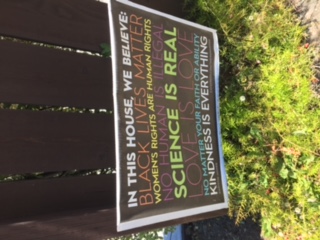
These signs decorate many front lawns in our heavily Socialist Democrat town:

“Virtue” Boasting