Tyranny’s wife 205
The EU is a much prettier version of tyranny than rough Russia.
One might say it is the feminine version. It dresses nicely. It has its hair styled. It paints its nails. It smiles. It thinks it is alluring. It spends more than it has.
It is easy to understand why half the Ukrainians want to live with it. With her. Rather than with unshaven, violent, shabby, ill-mannered Daddy Russia.
Her corruption is prettily packaged. Her despotism has a gentle touch. It really is more pleasant to live with her than with him.
But it would be better for the Ukrainians if they just took off on their own.
Bruce Bawer offers that very advice. He writes at Front Page:
It’s in Europe, and it’s huge – after Russia and the top five EU members, it has Europe’s largest population, and twice as many inhabitants as all the Scandiavian countries put together – but Ukraine isn’t a nation we often think of in the West, except when, as in recent days, it’s in the midst of a crisis. It has spent most of its history being conquered and brutalized by its more powerful neighbors, and in the last century underwent one savage chapter after another: 1.5 million people died in the civil war that ended with its absorption into the USSR; millions more died in Stalin’s deliberately engineered famine in 1932-33; during World War II, Hitler slaughtered an additional three million in what was intended to be the first stage of a program of exterminating two-thirds of the country’s population and enslaving the rest.
And, it should be added, its own historical record of brutal persecution and oppression is fully equal to any of its neighbors’. (See here and here and here.)
Today, unsurprisingly, Ukraine is a basket case of a country, riddled with corruption and living in the shadows of its historic horrors. It’s also a linguistically and philosophically divided land, torn between a western chunk whose people speak Ukrainian and identify with Europe and an eastern chunk whose people speak Russian and still feel an attachment to their massive neighbor to the east.
Viktor Yahukovych, the corrupt, autocratic president who disappeared last weekend in the face of mounting public unrest, is a Russiophile whose fatal error was his decision to strengthen bonds with Moscow (which coveted Ukraine as a key ally in a new Eurasian Union) and to turn down a free-trade agreement with the EU; most of the rioters who sent him packing are Europe-oriented types, the majority of whom are eager to see Ukraine become a Western-style democracy free of Putin’s influence, but some of whom, it should be noted, are neo-Nazis who look westward to Germany for the least attractive of reasons.
Most of the Ukrainians who favor European ties also want to see their country join the EU – which, in their eyes, as one Swedish newspaper put it the other day, is “above all…a symbol of a society free of corruption”. Yulia Tymoshenko, the former prime minister who was sprung from prison on Saturday after Yahukovych took it on the lam – and whose own years in office (ending in 2010) were far from corruption-free – told the Kiev crowds shortly after her release that she’s “sure that Ukraine will be a member of the European Union in the near future and this will change everything”.
Change everything! What is it that makes presumably liberty-loving Eastern European politicians talk about the EU as if it were a magic freedom elixir, a miracle cure for former victims of tyranny?
I suppose part of the explanation is that these politicians travel to the great cities of Western Europe and take in the relative freedom, the relative prosperity, and the relative lack of corruption and thuggery, and assume that all this has something to do with the EU. And part of it, naturally, is the ceaseless stream of pro-EU propaganda poured out by the Western European media and, not least, by the Western European politicians whom the likes of Tymoshenko consort with when they visit the West.
Yet how odd that the superstate’s economic woes haven’t put a dent in the magic for people like Tymoshenko. How odd that even the merest glimpse of the way things work in Brussels – where corruption is, needless to say, very much alive and well, even though it doubtless falls far short of Ukrainian levels – doesn’t give them pause. And how odd that when they witness the arrogance that’s characteristic of virtually all Brussels bigwigs – their habit of responding to any reasonable criticism of the EU not with cogent arguments but with vicious ad hominem attacks – they don’t immediately recognize that they’re observing tyrants in the making, the sort of folks that you’d think they’d had more than enough of over the centuries, thank you very much.
Take European Council president Herman van Rompuy, that colorless, Politburo-style mediocrity, who in a 2011 speech blithely ignored the essentially undemocratic nature of the EU, describing it – outrageously – as “the fatherland, or the motherland of democracy”.
Or take European Commission president José Manuel Durrão Barroso, who started his political career as a Maoist, and who in 2012 argued that the EU’s democracy deficit isn’t a bug but a feature: “Governments are not always right. If governments were always right we would not have the situation that we have today. Decisions taken by the most democratic institutions in the world are very often wrong.”
What he says is not untrue (even democratically-elected governments are almost always wrong), but he is making an argument for despotism.
Or take halfwit EU Foreign Affairs honcho Catherine Ashton, whose 2011 Guardian article lecturing Hosni Mubarak on the need for democracy in Egypt was widely (and rightly) ridiculed as the work of someone who, as Brendan O’Neill neatly put it in the Telegraph,
… has never once bothered the ballot box, never once ventured into the rowdy arena of public opinion to win the masses’ backing, and who was elevated to her current position as the European Union’s high representative for foreign affairs through backroom wheeling and dealing.
Noting Ashton’s enthusiasm, in her Guardian piece, for what she called “deep democracy”, O’Neill explained that “she doesn’t mean deep as in profound – she means bureaucracy, the grey and unaccountable sphere that she haunts, the removed realm of experts and unelected high representatives” – a phenomenon Ashton contrasted (favorably, of course) with mere “surface democracy”, the undesirable, old-fashioned sort of system in which elected officials actually seek (horrors!) to honor their constituents’ wishes.
Even a cursory look at the careers and pronouncements of these unelected demigods, these self-regarding technocratic hacks, is to recognize them as people who itch to rule an empire and who are, quite simply, outraged at anyone who dares to stand in their way for a moment. Given the transparency of their lust for monolithic power – a power, moreover, utterly liberated from any notion whatsoever of responsibility to an electorate – it’s baffling that so many observers can actually take the EU seriously as a formula for European peace rather than for European autocracy.
What Europe has in Barroso, Ashton, & co., after all, is a pack of men and women who have done their level best to impoverish real political debate, to blunt its impact, and to make it seem obsolescent, counterproductive, and in every way undesirable.
Former Czech president and staunch EU critic Václav Klaus asked in his 2011 book Europe: The Shattering of Illusions:
Do we have real politics in Europe today – the political conflict of opinions – or have real politics been in fact eliminated by reducing the weight and importance of the nation states and by the self-confessed apolitical ways of Brussels?
Which is another way of saying that Brussels isn’t a city of politicians who have different political philosophies and who come together to debate ideas and hammer out compromises; it’s a city of technocrats who share an ideology and who work together as a team to translate that ideology into policy – never mind what the rabble think. (Or, as Klaus put it even more bluntly: “the European Union is no longer the symbol of democracy it pretends to be.”)
Klaus has coined the term “Europeism”. It’s a useful word, because it places the unreflecting, reality-defying enthusiasm for Europe in the category it belongs to, along with other, earlier European-isms. Among much else, Europeism views the free market as uncivilized and anarchic, places collective rights above individual rights, and strives, as Klaus excellently puts it, “for a homogenized, ‘decaffeinated’ world (with no flavour, aroma, and smell)”.
Europeists, he writes,
… do not believe in spontaneous, unregulated and uncontrolled human activity. They trust the chosen ones (not the elected ones), they trust themselves or those who are chosen by themselves. They believe in a vertically structured and hierarchized human society … They want to mastermind, plan, regulate, administer the others, because some (they themselves) do know and others do not. They do not want to rely on spontaneity of human behavior and on the outcomes resulting from this spontaneity because they think that rationalistic human design is always better than an unplanned result of interactions between free citizens, constructed and commanded by nobody. Even though we thought that after the collapse of communism all this was a matter of the past, it is not so. It is around us again. Europeism is a new utopism and, I add, it is an extremely naive and romantic utopism.
Above all, writes Klaus, Europeism “is based on the idea that states, more precisely the nation states, represent the Evil – because they were once the cause of wars among other things – while the supranational, continental and global entities represent the Good, because they – according to eurocrats – eliminate all forms of nationalist bickering once and for all”. This understanding of things, he adds, “is obviously childish, yet it is generally accepted in Europe”. Yes, it’s accepted because millions of today’s Europeans have been brainwashed into thinking that national feeling – patriotism – was the root of all of the worst things that happened to the continent in the twentieth century. No, ideology was the root – ideology in the form of Nazism, fascism, and Communism. And Europeism – which, by the way, has multiculturalism and fanatical environmentalism built into it – is the twenty-first-century heir of those wretched systems of thought.
Which brings us back to the latest developments in Ukraine. Tymoshenko’s speech on Saturday night was followed on Sunday by the news that the EU – notwithstanding its own massive financial difficulties – is now ready to hand over bushels of cash to the newly Europe-friendly government in Kiev. …
Note to Ukrainians: accepting the EU’s money is one thing. Go for it. But why this longing, on the part of Tymoshenko or anyone else in your country, to board the Superstate Express? Set aside, if you wish, the economic downside of the whole project, the looming disaster that is the eurozone, and just ask yourselves this: after spending most of your history taking orders from far-off imperial capitals, most of the twentieth century living under the nightmare of Communism, and most of the greater part of the generation that followed under the gravitational pull of post-Soviet Kremlin despotism, why be so desperate to subordinate yourselves to yet another set of haughty, high-handed foreign rulers? Why slip away from being under one thumb only to voluntarily place yourself under another?
Ukraine, here’s one simple piece of unsolicited advice: vote for sovereignty. Vote for freedom. Take the money and run.
Stay out of the EU.
Ending the pax Americana 297
We are in principle against intervention in the internal affairs of other countries. But we are not for isolationism or pacifism – we regard either philosophy as a formula for national suicide. If other countries become belligerent, build up their armed strength, send their warships towards our shores, establish bases in countries on our borders, and declare their aggressive intentions towards us, the politics of those countries become our business. That is happening now. We are under threat – because Obama is deliberately weakening America. And his reaction to the result is to weaken America even more.
The conditions for major war develop much more easily when the U.S. is too weak. They are developing as we speak.
To a meaningful extent, the significant increase we’ve seen in unrest around the globe since 2010 has been made possible, and inevitable, by the retraction of American power. Even where we still have power in place, it has become increasingly obvious that we aren’t going to use it.
We quote from a website interestingly named Liberty Unyielding. The article on the extreme folly of the Obama administration’s moves to weaken America is by Commander Jennifer Dyer, now retired from the US navy. (Her own blog is at Theoptimisticconservative.wordpress.com):
The collapse of order in the Arab nations in 2011 was the first significant stage of the process. The perception that the United States would do nothing about a Hezbollah coup in Lebanon was tested in January of that year. The perception proved to be true, and when protests erupted in Tunisia and Egypt, for causes both natural and manufactured, a set of radical Islamist actors – the “establishment” Muslim Brotherhood, Sunni jihadists, Iran – saw an opportunity. The establishment Muslim Brotherhood has largely won out in Tunisia, but the battle still rages among these radical actors for Egypt, Syria, and now Iraq. Lebanon is being incrementally sucked into the maelstrom as well.
In multiple venues, Russia has watched the U.S. and the West effectively back Islamists in Russia’s “near abroad”: in Turkey (with support for the now struggling Erdogan government); in the Balkans, especially Bosnia and Kosovo; and in Syria. …
There was a time when the implicit determination of the U.S. to enforce the “Pax Americana” order – the post-World War II alignments of the region – held Russia in check. The Russians still derived some security benefit from that order, after all … It appears to me, however, that 2014 will be the year in which it becomes clear that, according to Russians’ perception, they no longer benefit from the old order. If we’re not going to enforce it, Russia will do what she thinks she has to.
In fact, Moscow’s pushback against the plan for Ukraine to affiliate with the EU constitutes just such a blow for perceived Russian interests. It is of supreme importance for Westerners to not misread the recent developments. The EU and the U.S. did back down when Russia pushed hard last fall. The only ones who didn’t back down were the Ukrainian opposition. I predict Vladimir Putin will try to handle the opposition factions cleverly, as much as he can, and avoid a pitched battle with them if possible. He respects what they are willing to do. But he has no reason to respect Brussels or Washington.
And that means he has more latitude, not less, for going after the regional props to the old order, one by one. As always, Russia’s inevitable competition with China is a major driver, along with Russia’s concern about Islamism on her southern border. The whole Great Crossroads – Southwest Asia, Southeast Europe, Northeast Africa, the waterways that snake through the region – is, if not up for grabs, at least in ferment. Look wherever you like: there are almost no nations where there is not a very present menace from radicalism, or where governments and even borders are not gravely imperiled by internal dissent.
Israel is the chief standout for politically sustainable stability and continuity. Romania and Turkey seem likely to at least retain their constitutional order in the foreseeable future, but Turkey’s geopolitical orientation, in particular, is less certain. Greece and Kosovo – even Bosnia – have serious internal problems. Egypt, Sudan, South Sudan, Ethiopia, Eritrea, and Somalia all remain in crisis at various levels. Jordan and Saudi Arabia are relatively stable, and the Arab Persian Gulf states relatively so as well. But their neighborhood is going downhill fast. Iran is riding a wave of radical confidence, and the Taliban are resurgent in Afghanistan.
In this tumultuous region, it’s actually a little funny that Pakistan looks stable and staid compared to Iran, Afghanistan, and neighbors west. We can hope that Islamabad’s perceived need to maintain a symmetrical stance against India will keep Pakistan’s loose federation of intransigents federated, and the nukes under central control. But as we move across South Asia, we near another boiling pot. Thailand – long an American ally and pillar of stability in the region – has been rocked in recent months by national unrest of a kind not seen in Southeast Asia for decades. Islamist radicalism is a growing threat in Indonesia, and an unpacified one in the Philippines, after more than a decade of U.S.-Philippines collaboration in fighting it.
And, of course, China is making real, transformative moves against regional security with her proclamations about air space and maritime rights off her southeast coast.
This disruptive process, like the battles for many of the Arab nations, is already underway. We’re not waiting for something to happen; it’s started.
China assumes, quite correctly, that there will be no effective pushback from the United States. But two other nations with power and means will regard it as intolerable for China to dictate conditions in Southeast Asia: Japan and Russia. The dance of realignment among these nations has implications for everyone in Central Asia and the Far East. The day may be on the horizon sooner than we think when maintaining a divided Korea no longer makes sense to at least one of the major players. The day is already here when Chinese activities in Central Asia are alarming the whole neighborhood, just as Chinese actions are in the South China Sea. …
Russia and Iran are advancing on the US through Central America:
It’s no accident that as radical leftism creeps across Central America (falsely laying claim to a noble “Bolivarian” political mantle), the maritime dispute between Nicaragua and American ally Colombia heats up – and Russia shows up to back Nicaragua and Venezuela – and so does Iran – and unrest turns into shooting and government brutality and violence in Venezuela – and Hezbollah shows up there to openly support the radical, repressive Maduro government.
Now Iran has a naval supply ship headed for Central America, very possibly with a cargo of arms that are not only prohibited by UN sanction, but capable of reaching the United States if launched from a Central American nation or Cuba.
We’re not still waiting for the shocks to start to the old order. They’ve already started. I haven’t surveyed even the half of what there is to talk about …
She looks at the latest defense cuts with dismay and considers what the consequences will be:
This is the world in which the United States plans to reduce our army to its lowest level since before World War II, and eliminate or put in storage much of its capabilities for heavy operations abroad (e.g., getting rid of the A-10 Warthogs, moving Blackhawk helicopters into the National Guard). It’s in this world that DOD proposes to cease operating half of our Navy cruisers, while delaying delivery of the carrier-based F-35 strike-fighter to the Navy and Marine Corps. These cutbacks come on top of cuts already made to training and maintenance expenditures in the Navy, Marine Corps, and Air Force that will affect unit readiness for years to come. …
Then comes what should be a shocking observation:
By cutting back on defense so drastically, America is deciding, in essence, to “fight fair”: to give whatever opponents emerge more of a chance to kill our soldiers, damage our interests, and drag out conflicts. …
That would be hard to believe of any American leadership – until now. It is ludicrous. Worse, it is lunatic. But Obama has never concealed or disguised his wish to weaken America’s military capacity.
The decision “to further limit our capabilities to use power in politically relevant ways” will result in “even more global unrest: more conflict, more shooting, more blood, more extortion and political thuggery menacing civil life in the world’s poorer and more vulnerable nations”, and that cannot be good for America. The point is that –
These unpleasant trends will spill over into civil life in the wealthier nations soon enough …
As it has, she points out, in Ukraine, Thailand, and Venezuela, “whether directly or through second-order consequences”.
Peace and freedom have to be tended constantly; they are not the natural state of geopolitical indiscipline, but its antithesis. …
We’re extraordinarily unprepared for the world that is shaping up around us. …
[And] a world that doesn’t want quiescent trade conditions, tolerance of dissent, the open flow of ideas, and mutual agreements, peacefully arrived at, will not have them.
That’s the world we are sentencing ourselves, for now, to live in. Perhaps we will learn from the consequences how to think again: about what it takes to guard freedom, and indeed, about what freedom actually is.
It is Obama who needs to think again, but there is no reason to hope that he will. It could hardly be more obvious that he does not care for freedom.
Art is dear and life is cheap 74
The State Department has spent millions of taxpayers’ dollars acquiring Art. That is to say, paying for objects that its resident or consultant aesthetes swear are works of Art, worth every penny.
The acquisitions were apparently a priority for Hillary Clinton when she was Secretary of State. If you would see her monument, tour US embassies and look about you.
Fashionable Art doesn’t come cheap. So there was no money left to pay for such a humdrum thing as effective protection of the US diplomatic and CIA missions in Benghazi. Denied the security they needed, four Americans, including the ambassador, were killed there by savage jihadis. Well – Hillary might say – there has to be human sacrifice on the altar of Art, it makes all the difference, and if you don’t understand that, you are a philistine bourgeois.
Look on the bright side. The Art is displayed in many a US embassy. Americans can be proud.
In London, there’s a granite wall built by Sean Scully that cost $1million. We couldn’t find a picture of it, but it’s like this one displayed in an art gallery.

Daniel Greenfield illustrates an article on the subject – which inspired this post – with these pictures of works by Cy Twombly. The top one is at the embassy in Rome.


From his text:
Beijing [embassy] contains $23 million worth of art. Bern has $1.2 million and Luxembourg has $2.2 million.
And here is the grave of Ambassador Stevens, murdered at Benghazi. We don’t know how much it cost, or who paid for it.

*
Post Script: Here is some wall art that really has meaning. The wall is part of the US mission in Benghazi. The paint is blood. A hand put it there the night of the attack. It might have been the hand of Ambassador Stevens himself – or of one of his brutal killers. One does not have to read Arabic to know who signed in for the event on the other wall.
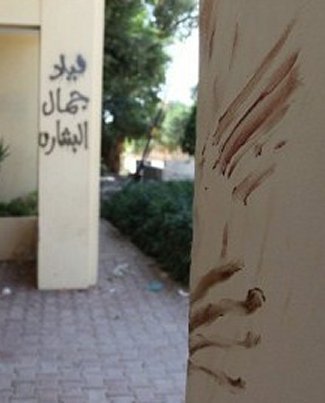
(Hat-tip: our reader and commenter donl)
The lesser evil 86
George Will, at the Washington Post, sees the civil conflict in the Ukraine as the last battle – or “final episode” – of the Cold War.
How pathetic is the plight of the Ukrainians. Their choice is between membership of the corrupt, socialist, failing EU (which is what the people want), or – worse, far worse – domination by Russia (which is what the government wants). Under the Russian boot they would not be much better off than they were when Russia was called the USSR.
So the EU is a haven for them. Rather like sheltering from a volcanic eruption in a cave full of vipers.

The bodies of Ukrainian protestors laid out on the street – sleeping or dead?
Picture from PowerLine, where you can find more.
None so blind 78
What a rotten job the official representatives of Jewish communities in Western countries are doing!
British Jews are still so grateful to Oliver Cromwell for letting them into the country some 350 years ago, that they’d rather put up with anything – slander, humiliation, threats, even physical attack – than complain. Their official representatives play along with the phony “interfaith” racket in the stubborn (but forlorn) hope that it will soften Islamic hatred of them, although that hatred is ineradicably doctrinal as well as political. If it wasn’t for the excellent institution Stand For Peace under the inspired directorship of Sam Westrop exposing the racket for what it is, there would hardly be any resistance at all to the intensifying anti-Semitism and advancing stealth-jihad in the United Kingdom.
And it’s far worse in France and Sweden.
How well are “official Jews” doing to earn their salaries in Canada and the US?
Abraham Foxman recently announced after 27 years steering the Anti-Defamation League (ADL) he will retire next year. How well has he done?
Andrew Bostom, writing at American Thinker, said of Foxman in 2011 that he is –
… the most blindly agenda-driven organizational Jewish “leader.” The Anti-Defamation League (ADL)’s Foxman sprays defamatory charges – rooted in willful ignorance – against all those legitimately concerned with the ceaseless efforts of mainstream institutional American Islam to insinuate Sharia mores and jurisdiction into US society.
Today Mark Steyn says what needs to be said about this self-blinkered Official Jew:
Canada’s “official Jews” [are] among the most useless people on the planet. Under Bernie Farber, for example, the Canadian Jewish Congress was obsessive about the last three neo-Nazi losers living in their mum’s basement and contributing unread blog posts to obscure “white supremacist” websites. But it had nothing to say about the broad-daylight mass Jew-hatred and, indeed, brazen incitement to murder of large groups of people parading through downtown Calgary, Toronto and Montreal. Farber & Co were cardboard warriors, capable only of fighting the battles others had already won long ago.
And so it goes for America’s “official Jews”:
Anti-Defamation League chief Abe Foxman believes that anti-Semitism is at its height since the Holocaust, and threatens the lives of Jews all around the world.
He got that right. He got everything else wrong:
Europe is where the Jewish people have paid the highest price for anti-Semitism, and it’s sort of an old-new phenomenon,” he said, defining it as “nationalists, anti-government people, neo-fascists, neo-Nazis of anti-immigration and anti-government coming together with a glue and cement of anti-Semitism. I think it’s a serious threat to Jewish life.
Is it really possible in 2014 even for the capo di tutti capi of official Jews to be so blind? Foxman is either the most wicked dissembler or, to be more charitable, he reflects merely the blinkered parochialism of America’s liberal Jewish elites. Unlike the head of the ADL, I have no special interest in or responsibility for the welfare of the Jewish people, but I have been to Toulouse, Antwerp, Malmö and the old Jewish East End of London, and I know what I have seen there.
I would like Foxman to go to Toulouse, a city the size of Jacksonville, Florida, where in recent years one synagogue has been firebombed, another set alight when two burning cars were driven into it, a third burgled and “Dirty Jews” scrawled on the ark housing the Torah, where a kosher butcher’s was strafed with gunfire, and a Jewish sports association attacked with Molotov cocktails, and three Jewish children murdered outside their grade school, I would like Foxman to go to Toulouse and tell any Jew he finds there (they are advised by their rabbis not to wear identifying marks of their faith) that it’s all the work of “anti-government people”.
I would like him to go to Malmö – once the first Christian city in Norway and soon to be the first Muslim city in Sweden – and tell such Jews as he can find (they are abandoning the city) that the desecration of Jewish cemeteries and the ugly reinforced steel doors at the Jewish kindergarten and the rocket-proof glass in the windows of the synagogue are all the fault of “neo-Nazis”. Sweden is renowned for its neo-Nazis, isn’t it? Doubtless they were the reason why a year or two back at the Davis Cup the Israeli tennis players had to play their match behind closed doors, in a Baltiska Hallen stadium without a single spectator. For had they opened the doors, the seats would have filled up with Swedish “nationalists” and Swedish “neo-fascists” and all hell would have broken loose.
I would like Abe Foxman to go to Tower Hamlets in London’s East End, where on Holocaust Memorial Day a couple of years ago a visiting New Yorker had to be taken to the Royal London Hospital in Whitechapel after a Jewish tour group was pelted with stones by a group jeering “If you go any further, you’ll die.” I would like Foxman to tell those Jews that their attackers were an “anti-immigration” group.
I would like him to go to Villiers-le-Bel, where a Jewish girl was brutally attacked by a gang shouting “Jews must die!”, or to Odense, where the headmaster says his school can no longer take Jewish pupils for security reasons, and tell them it’s the fault of Danish “nationalists” and French “neo-Nazis”.
But I don’t suppose Abe Foxman will go anywhere outside his bubble, will he? Is it really too much to expect him somewhere in that long laundry list of antiquated irrelevances to utter the “M” word? As Laura Rosen Cohen writes of this contemptible nothing of a man:
Shame on you, Abraham Foxman. Shame on you.
These Jews are a danger to the Jewish people.
Their denial is so thick and so amoral that it is difficult sometimes to find the words to express my utter disgust and contempt.
By fighting the last war against the German Nazis over and over in their heads, they endanger living Jews. But they will never learn.
It’s so cozy to be a professional Jew, fighting the ghosts of WW2 over and over and never facing the real threats to the Jewish people.
Though the Holocaust must never be forgotten, it must not so obsess generation after generation that they fail to see what is happening all about them.
Jewish groups missed the threat 80 years ago, too. But why wouldn’t they? There’d always been anti-Semitism in Europe: You can’t buy property here, you can’t stand for parliament there, and everywhere always a certain sliver of people who just don’t want to be around Jews. But it didn’t turn genocidal until the 1930s, and, after a millennium of low-level Jew hate, you can understand why nobody saw it coming.
But the violent, murderous phase of the new Jew-hatred is already here – in the emergency ward of the Royal London Hospital; in the corpse-strewn schoolyard of Toulouse; in the synagogue in Brussels set alight by Molotov cocktails; in a pleasant Jewish home in Antwerp, where burning rags were pushed through the mail flap; at the RER train station in Auber, where a commuter was savagely assaulted by a mob taunting, “Palestine will kill the Jews”; in the suburban home where a young Frenchman was tortured to death over three weeks while his family listened via phone to his howls of agony as his captors chanted from the Koran; in the stairwell of the apartment house where a Paris disc-jockey had his throat slit, his eyes gouged out, and his face ripped off by a neighbor who crowed, “I have killed my Jew!”
Those “anti-government people” get around, don’t they? The groups who perpetrate this violence come from a minority community – larger than the Jews but not yet larger than everyone else. They are telling you what they will do when they have the numbers to do it. …
Abe Foxman has not had his eyes gouged out, but he is blind, utterly blind.
Green is so yesterday 209
The Europeans made nearly a $100 billion wrong bet on renewable energy, and their economies and citizens have taken a big hit. Now they’ve awakened to their mistakes.
We confess to enjoying more than a little Schadenfreude over this report.
It comes from Investor’s Business Daily:
The media aren’t paying much attention, but in recent weeks Europe has decided to run, not walk, as fast as it can away from the economic menace of green energy.
That’s right, the same Europeans who used to chastise us for not signing the Kyoto climate change treaty, not passing a carbon tax and dooming the planet to catastrophic global warming.
In Brussels last month, European leaders agreed to scrap per-nation caps on carbon emissions. The EU countries — France, Germany, Italy and Spain — had promised a 40% reduction in emissions by 2030 (and 80% by 2050!). Now those caps won’t apply to individual nations.
Brussels calls this new policy “flexibility”. Right. More like “never mind”, and here’s why: The new German economic minister, Sigmar Gabriel, says green energy mandates have become such an albatross around the neck of industry that they could lead to a “deindustrialization” of Germany.
Chancellor Angela Merkel said earlier this year that overreliance on renewable energy could cause “a problem in terms of energy supply” — and she’s always described herself as a green politician and a champion of these programs.
A good example that of how politicians, preoccupied with riding the winds of popularity, fail to think things through.
But green dreams have collided with cold economic reality.
Of course they have. The only question was how long it would take.
Green programs aren’t creating green jobs but green unemployment at intolerable double-digit rates.
The quip in economically exhausted Europe these days is that before we save the planet, we have to save ourselves.
Now European leaders are admitting quietly that they want to get into the game of fracking and other new drilling technologies that have caused an explosion of oil and gas production in the U.S. …
If Europe wants to remain competitive, these nations must tap the fountain of abundant and cheap shale gas and oil. … European leaders now realize a major factor behind the economic woes in euroland is that electric power costs are two to three times more expensive than in the U.S.
Consider the price of natural gas in the U.S. vs. other nations in the chart below. U.S. prices are about three to four times lower.
… Few American politicians get it. President Obama talked in his State of the Union speech about doubling renewable energy output over the coming years. … these are exactly the goals the Europeans are abandoning. Why chase the losers?
Why not try a different approach to energy policy? Get rid of all taxpayer subsidies for energy — oil, gas, wind and solar power, biofuels, electric-battery-operated cars and others — and create a true level playing field where every energy source competes on efficiency and cost rather than political/corporate favoritism?

We guess that will not happen while Obama is president. He remains green in judgment.
The EU criminally subsidizes terrorism 98
The Eurozone is busy lurching from disaster to disaster …
It looks clear that 2014 is going to be an “annus horribilis” for the European Union [EU], with voters going to the polls in May 2014 and the recent opinion polls showing not so much Eurosceptic as simply anti-EU parties in the lead in most major European countries.
We cheer every sign that the undemocratic and deeply corrupt EU is failing. For one thing, it squanders money on paying “salaries” to Palestinian terrorists – consequently supporting and encouraging terrorism.
If the EU bureaucrats expect gratitude, they will be continually disappointed.
We quote from an article by Douglas Murray for the Gatestone Institute:
There are many ways in which the EU displays a casual disregard for its distribution of taxpayers’ money. But one of the most outrageous ways by far – with some very stiff competition – is the way in which the EU wastes taxpayers’ money by giving huge lumps of it in aid to the Palestinian Authority [PA]. The laxity with which this is done and the uses to which much of that money is put highlights a problem which ought to make even the EU blush – and any decent taxpayer rebel.
Ignorance can be no excuse. In recent years a number of organizations and individuals have persistently highlighted the manner in which EU funding has been used to facilitate hate-materials and hate-teaching in Palestinian schools. Foremost among the organizations that have highlighted this has been Palestinian Media Watch [PMW], which has systematically and carefully collected and translated for wider English-speaking consumption the sort of language that is used routinely in the education sectors in Palestinian society. And as in the schools, so in the media. For EU money is also used to fund various Palestinian media outfits. And the diet of hatred they spew out is the stuff of legend. …
But it is not just in schools and the media that EU money has been put to such wildly inappropriate use. As highlighted before, perhaps the most appalling misuse of public funds has been the EU payment of salaries to the families of convicted terrorists. This issue of the EU payments of terrorist’s salaries while the terrorists are in prison has been a not yet hot-enough potato for some time now. After the last round of exposure in 2012, some EU officials criticized the PA for using public monies in this way. But as PMW has just shown again, the response of PA officials to this is not only disrespectful towards the EU. It is openly contemptuous, derogatory, scornful and dismissive of the hand that is presuming to feed them.
As Palestinian Media Watch recently highlighted, in November alone the EU donated approximately 11 million euros to pay the salaries of PA government employees. And yet, in that same month, one PA minister has been shown openly to have mocked the uses to which the PA puts the EU money: in one appearance, the minister said about the EU’s weak recent requests, “The Europeans want their money that comes to us to remain clean – not to go to families of those they claim to be “terrorists” … [but] these [prisoners] are heroes.”
Or, as the head of the Prisoners’ Club showed, the salaries to both government workers and prisoners are paid alongside one another:
“What is disbursed to the prisoners is exactly what is disbursed to me and you [a PA civil servant]. These are salaries. Therefore, when the salaries are paid to those working in [government] ministries and institutions, they will also be paid to the prisoners.” …
Paying people to hate you and your values, and paying people to carry out acts of terrorism against your friends, is a strange use to which any private individual might choose to put his money. But for a government – and a supra-government at that – to use taxpayers’ money in such a way is criminal.
Note that the US is doing it too.
Reality heaps coals of fire on Green heads 92
Obama wants wind, sun, and algae to provide the energy needed by the nation. He hates coal. Coal mines are being closed, or operating under ever more onerous regulations and restrictions.
But – as Steven Hayward of PowerLine reports , quoting various sources –
If you draw back a bit and take a look around the world, what you find is that the fastest growing source of energy continues to be: Coal. …
China approved the construction of more than 100 million tonnes of new coal production capacity in 2013 – six times more than a year earlier and equal to 10 percent of U.S. annual usage – flying in the face of plans to tackle choking air pollution. The scale of the increase, which only includes major mines, reflects Beijing’s aim to put 860 million tonnes of new coal production capacity into operation over the five years to 2015, more than the entire annual output of India.
Germany too is mining more coal. Much more.
Some windless and cloudy days last month rendered Germany almost entirely dependent on old-fashioned fossil fuels and nuclear to provide their electricity …
Germany’s wind and solar power production came to an almost complete standstill in early December. More than 23,000 wind turbines stood still. One million photovoltaic systems stopped work nearly completely. For a whole week coal, nuclear and gas power plants had to generate an estimated 95 percent of Germany’s electricity supply.
But what will happen when Germany shuts down all its nukes because they fear a tsunami from the North Sea? They’re going to build more coal plants:
Germany’s energy transition has also been a transition to coal: Despite multi-billion subsidies for renewable energy sources, power generation from brown coal (lignite) has climbed to its highest level in Germany since 1990. It is especially coal-fired power plants that are replacing the eight nuclear power plants that were shutdown, while less CO2-intensive, but more expensive gas-fired power plants are currently barely competitive. Energy expert Patrick Graichen speaks of Germany’s “energy transition paradox”: the development of solar and wind farms, yet rising carbon dioxide-emissions.
Europe as a whole is turning, or returning, to coal.
Europe’s appetite for cheaper electricity is reviving mines that produce the dirtiest type of coal …
Across the continent’s mining belt, from Germany to Poland and the Czech Republic, utilities … are expanding open-pit mines that produce lignite. The moist, brown form of the fossil fuel packs less energy and more carbon than more frequently burned hard coal.
The projects go against the grain of European Union rules limiting emissions and pushing cleaner energy. Alarmed at power prices [that are] about double U.S. levels, policy makers are allowing the expansion of coal mines that were scaled back in the past two decades …
And in the US, coal – loved or hated – still fuels the nation:
Coal remains the biggest source of fuel for generating electricity in the U.S. and coal exports are growing fast. Demand is being stoked by the rise of power-hungry middle classes in emerging economies, led by China and India. By the end of this decade, coal is expected to surpass oil as the world’s dominant fuel source …
The moral of the story is, as Steven Hayward says: “Reality intrudes on green dreams.”
Or, in the words of another familiar but too often ignored aphorism: “You can’t buck the market.”
Swedish suicide by political correctness 286
The liberal left likes to hold Sweden up as a model socialist state, proving that socialism can work.
They could not be more wrong.
Sweden is a country wrecked by political correctness and Muslim immigration, and made so wretched by its own folly that it’s committing national suicide.
This is from Front Page, by Bruce Bawer:
Sweden is self-destructing, and more and more people are writing about it – but, with very few exceptions, still not in the mainstream Swedish media, where denial continues to reign supreme. Indeed, even as concerned observers abroad (especially in neighboring Denmark and Norway, where the elites still look to their larger neighbor as a multicultural role model while many, if not most, ordinary householders view it as a cautionary example) are sounding the alarm about the fallout of Swedish immigration policies, Sweden’s own mainstream media – and the rest of its cultural establishment – are laboring overtime to silence the truth-tellers and keep the rabble from openly questioning the wisdom of their betters. …
One rare recent exception to the Swedish media’s see-no-evil approach to immigration and its consequences was a fascinating map, published last month in the newspaper Sydsvenskan, showing the relative levels of danger in the various neighborhoods of Malmö, the city that is regarded by many cogent observers as the ninth circle of the Scandinavian inferno.
Meanwhile, as I say, the admonitory essays keep coming. One example: “Sweden’s Race to the Bottom,” a bracingly frank piece that appeared on December 4 on the website of Jyllands-Posten, Denmark’s biggest newspaper. The author, Morten Uhrskov Jensen, didn’t mince words. His opening sentence: “Sweden has chosen to break down.” Jensen went on to outline the steady slide in the quality of education in Swedish primary schools over the last decade or so, as detailed in a recent PISA study, and to link that decline to what Jensen bluntly called the country’s “insane immigration policy.” Sweden, warned Jensen, “will have to pay a very high price for its experiment with permitting excessive immigration from dysfunctional states.” He placed special blame on the media …
Five days later, Jyllands-Posten offered another grim report, this one entitled “A Land of Ghosts and Shadows.” In it, Danish author Mikael Javling recounted the repercussions of a recent advertisement in the newspaper Dagens Nyheter. The ad was for a book – its title might best be translated as The Immigration Cover-Up – that quietly but devastatingly lays bare the suicidal folly of Sweden’s immigration regime. It’s a remarkably comprehensive work, providing an informative overview of such topics as asylum smuggling, immigration and crime, sharia law, the costs of immigration, censorship of Islam critics, the wielding of the word “racism” as a weapon, the treachery of such pro-immigration authors as Stefan Jonsson and Mattias Gardell, and feminist fecklesness in the face of Muslim patriarchy. Privately printed by the authors, Karl-Olav Arnstberg (an ethnologist) and Gunnar Sandelin (a former reporter for Swedish television), after they failed to secure a publisher, the book, Javling wrote, can justifiably be described as a piece of “underground literature” which, like Solzhenitsyn in the USSR, is being read “only behind closed curtains.”
The Dagens Nyheter ad for The Immigration Cover-Up was a rare exception to the Swedish media’s systematic exclusion of alternate views. According to Javling, the newspaper’s editors put Arnstberg and Sandelin through several rewrites, forcing them to tone down their language and make the ad as innocuous as possible, before they finally agreed to print the thing. Nonetheless, anodyne though it was, it thoroughly enraged the crème de la crème of the Swedish left, who gathered in Stockholm to protest what one of them denounced, in a fiery speech, as “racist propaganda” and to demand that the editors of Dagens Nyheter make a public show of contrition. (All this in response to a nearly 400-page scholarly tome that – crammed with statistics and footnotes – is every bit as dry and dispassionate as the left’s reaction was hot-headed and hysterical.) Jalving didn’t hide his disgust: calling the PC profs, pols, and pressmen at the demo “spoiled little children in suits,” he contrasted them with the majority of Swedes, whom he characterized as “seasoned and lucid Vikings” who’ve “had enough of the elites’ lies and careerism.” I hope he’s right, but I wonder how long these Vikings plan to wait before actually doing anything to try to pull their country back from the precipice.
The day after Jalving’s piece appeared, Expressen, the Swedish daily, ran a story announcing that its editors had hooked up with a Swedish research group, imaginatively named Researchgruppen, to perform a serious, in-depth investigation. Of what? Muslim terrorist cells? Of course not. In good Swedish-media fashion, the goal of Expressen‘s probe was to unearth and expose the names of the readers of three alternative online news sources, Avpixlat, Fria Tider, and Exponerat. I call these sites “alternative” because they run the sorts of stories – about things like, oh, Muslim terrorist cells – that mainstream Swedish media won’t touch. But Expressen doesn’t call them “alternative.” It calls them “hate sites.” (I’ve seen hate sites, and though I haven’t done a thorough study of these three sites, the material I’ve read on them from time to time is no more hateful than the typical article at Front Page or PJ Media.) Anyway, Researchgruppen managed to figure out the e-mail addresses of no fewer than 6200 people who had left “hateful comments” at the three “hate sites” – and then managed to figure out whom those addresses belonged to and proceeded to gather “personal data” on them, which, Expressen promised, would be served up in future articles.
Among the individuals exposed by Expressen as a participant in the discussions on these three sites was Anders Dahlberg, a member of both the National Guard and the Sweden Democrat Party. He lives in the southern town of Skåne and is currently running for a local political office. Researchgruppen identified him as the author of a number of anonymous comments at the Avpixlat site. The one Expressen singled out for opprobrium was his suggestion that it might be impossible to end Sweden’s multicultural society without the use of force, and that ethnic Swedes might want to arm themselves in preparation for that eventuality. Members of the Swedish elite rushed to express their revulsion at this contemptible sentiment – none of them, of course, pausing to ask whether Dahlberg’s statement is, in fact, more or less contemptible than the roles they themselves have played in the ongoing erasure of the nation that he’s plainly determined to save.
Then, this past Tuesday evening, somebody threw a bomb into the mail slot of Dahlberg’s home. The explosion caused the front door to fly off its hinges and across the living room. Although Dahlberg, his wife, and their children were all home at the time, nobody was hurt. The news of the attack was followed hard upon by a report that Dahlberg had been stripped of his position in the military. “What he has written is not consistent with the values of the Ministry of Defense,” said an armed forces spokesman.
So it goes. On Thursday evening, in reaction to a clash in Stockholm between neo-Nazis and “anti-racists,” thousands of citizens of Uppsala, Gothenberg, and Malmö took to the streets in yet another iteration of that favorite Scandinavian pastime, the torchlight procession against racism. …
Stockholm anti-racists plan a Sunday demo. Perusing images of the Thursday evening processions, which showed the pious multicultural multitudes flaunting yet again their proud refusal to test their common ideology against reality, I couldn’t help pondering the melancholy question: are they really unaware that they’re marching their country into oblivion, or are they consciously embracing extinction in the belief that even self-slaughter is preferable to being called a racist?
The Muslim menace denounced in Switzerland 95
Except for a quotation from Martin Luther (“Here I stand. I can do no other.”) and another from Leviticus (“Love thy neighbor”), we like this speech by Swiss MP Oskar Freysinger against the encroachment and subversion of Islam in Europe.
A rousing speech. Almost a cry “To arms!”
But not quite. Our guess is that nothing effective will result from it.
We can only be glad that in at least one country in suicidal Europe it is still possible to speak the truth about Islam, and denounce its hideous creed, without the speaker being prosecuted and threatened with fines and imprisonment.
(Video from Tundra Tabloids)